Most families arrive with a word and a recommendation. These pages exist so you can understand the word, weigh the recommendation, and know which questions would test it. They are written the way we explain things in the chair — including the parts where the honest answer is "it depends on the records."
How we use these pages ourselves
When we recommend treatment, we'll point you to the relevant page here and ask you to read it before you decide. If our recommendation doesn't match what the page says a specialist should be able to explain — the dental-versus-skeletal split on an overbite, the space analysis behind an extraction, the cause behind an open bite — hold us to it. That's the point of writing it down.
How to read a diagnosis you've been given
Every orthodontic diagnosis has two parts, and the second is the one that matters: what the pattern is, and whether it's dental (the teeth) or skeletal (the jaws). An overbite from tipped teeth and an overbite from a small lower jaw look similar in a photograph and need different treatment. A crossbite of one tooth and a crossbite from a narrow upper jaw have different urgencies. When we explain a diagnosis, we'll show you on the records which of the two you have — and we'd encourage you to ask any clinic to do the same, because a recommendation that skips that distinction has skipped the diagnosis.
Why timing appears on almost every page
Because for the skeletal patterns, age is the treatment. A narrow upper jaw can be widened easily at nine and only surgically at nineteen. A lower jaw sitting back can be guided forward during growth and only repositioned surgically after it. An underbite is a manageable pattern at seven and a surgical conversation at twenty. This is the clinical basis for our practice's conviction about growth modification, and it's why several condition pages send parents back to the age-seven check.
The second-opinion triggers, collected
Across these pages the same moments recur: when extractions are proposed, when surgery is mentioned, when a first phase is recommended for a young child, when a quote is far outside market range, and when something about the visit felt rushed. In each, a free second consultation is an hour well spent — and we say so knowing it applies to our own recommendations as much as anyone's.
Questions families ask about orthodontic diagnoses
What's the difference between a dental and a skeletal problem?
Dental problems are about where the teeth sit within the jaws; skeletal problems are about the jaws themselves — their size, width and relationship. Dental problems can be corrected at any age by moving teeth. Skeletal problems can be guided during growth, camouflaged after it, or corrected surgically. The distinction decides both the treatment and the timing, and it's the first thing we establish on the records.
Can a child grow out of a bite problem?
Some dental issues improve as the jaws grow and baby teeth exchange — mild crowding, small gaps, a slight deep bite. Skeletal patterns don't grow out; they grow in. A crossbite with a jaw shift, an underbite and a narrow palate typically get more entrenched with age, which is why we assess at seven.
My dentist mentioned an overbite. Is that serious?
Usually not, and often it's mild. What matters is whether it's the teeth or the jaw, and how much. The overbite page explains how we sort that out.
How do I know if I need a second opinion?
When extractions are proposed, when surgery is mentioned, when a first phase is recommended for a young child, when a quote is far outside market range, or when the visit felt rushed. Consultations are free, so the cost of checking is an hour.
How the conditions relate to each other
They rarely arrive alone. A narrow upper jaw produces crowding, a crossbite and sometimes a breathing pattern all at once. A lower jaw sitting back produces an overjet, a deep bite and a retruded profile together. A thumb habit produces an open bite and a narrow arch. When we diagnose, we look for the pattern underneath the list of symptoms, because treating the pattern — usually by guiding growth in a child or by choosing the right appliance in an adult — resolves several symptoms at once. A plan that treats each symptom separately is longer, more expensive and less stable.
Conditions we treat, and conditions we refer
Everything on this page is orthodontic and we manage it. Some things that arrive looking orthodontic aren't: enlarged adenoids behind a child's mouth breathing belong to an ENT; joint disc problems behind jaw pain belong to a physiotherapist or physician; active gum disease in an adult belongs to a periodontist before any tooth moves. Part of a specialist's job is knowing what isn't theirs, and we'll tell you when a finding belongs elsewhere.
A closer look: what "the records" actually show
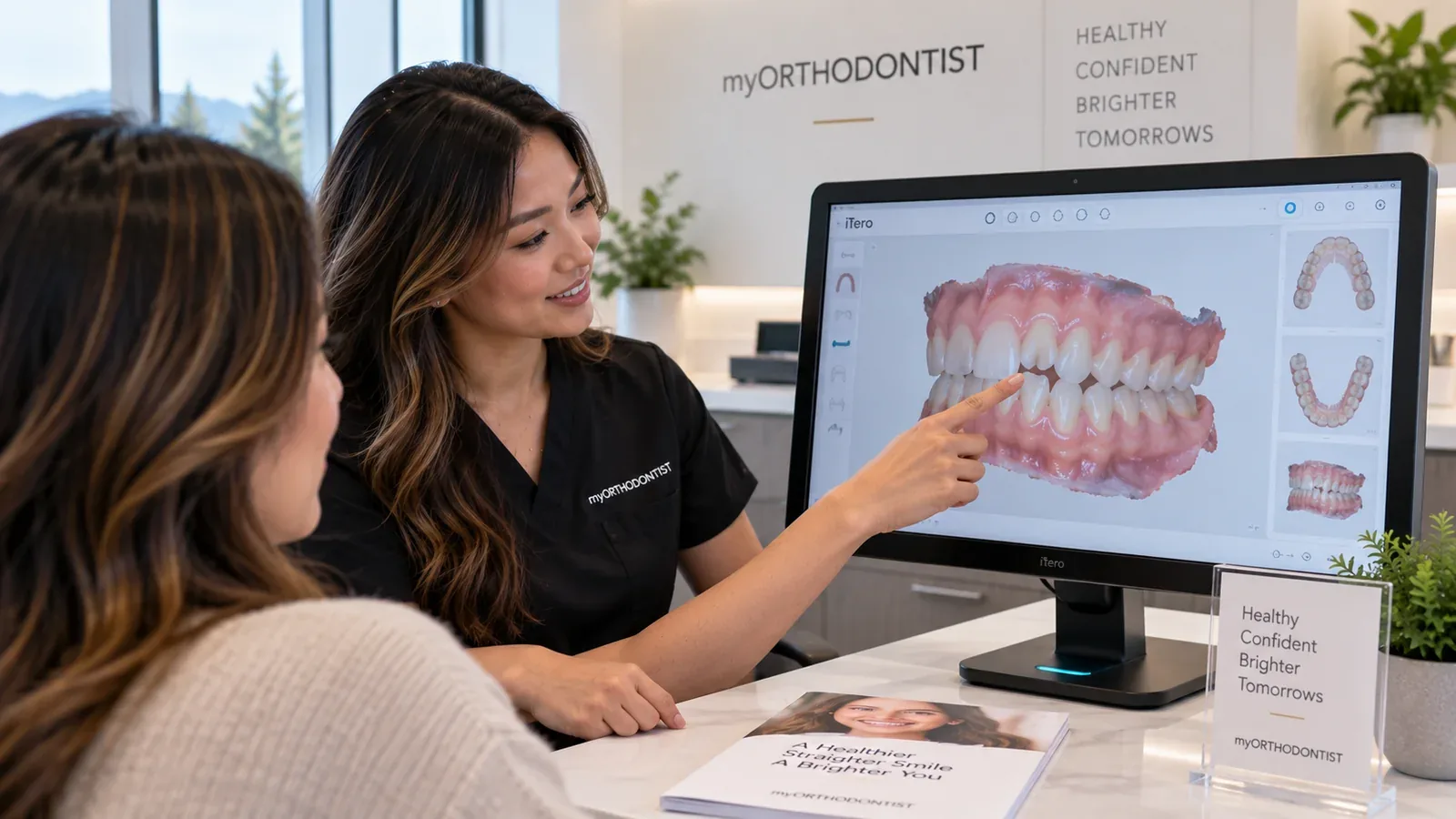
A panoramic X-ray shows every tooth, erupted and not — the only way to see a drifting canine, a missing adult tooth, or the eruption sequence in a seven-year-old. A profile (cephalometric) X-ray shows the jaws in relation to each other and to the skull: it's where "the lower jaw sits back" or "the upper jaw is narrow" becomes a measurement rather than an impression. A 3D scan measures the arches and models the bite. Photographs document the face and smile. Together, these turn a list of symptoms — crowding, an overjet, a crossbite — into a pattern with a cause, and the cause is what we treat. A consultation without them is a consultation without a diagnosis, whatever else it offers.
How a diagnosis becomes a plan
Once the pattern is clear, the plan tends to write itself. Skeletal in a growing child: guide growth now, align later. Skeletal in an adult: camouflage if moderate, surgical if severe, and an honest conversation either way. Dental at any age: the appliance that best makes the required movements, priced beside its alternative. Habit or posture-driven: address the cause alongside the mechanics or it returns. At each step there's a judgement call, and at each step we'll tell you what the call was and why — because a plan you understand is one you'll finish.
Before you go
Find your diagnosis above and read its page; then read the twelve questions with your specific condition in mind. If your child is under eleven and the pattern is skeletal, read growth modification before any consultation — it will change the questions you ask.
Misconceptions we correct most often
“My child will grow out of it.”
Dental quirks sometimes; skeletal patterns grow in, not out.
“An overbite means the top teeth overlap the bottom.”
They're supposed to, slightly. The problem is how much, and whether it's the teeth or the jaw.
“If it doesn't hurt, it doesn't need treating.”
Most orthodontic problems are painless for decades, then expensive.
What Coquitlam families search for, answered
“What is a malocclusion?”
Literally a bad bite — the umbrella term for any misalignment of teeth or jaws. Class I is a normal jaw relationship with dental problems; Class II is the lower jaw or teeth behind the uppers; Class III is ahead. The class tells us the pattern; the records tell us the cause.
“Can crooked teeth cause health problems?”
Crowded teeth trap plaque and are harder to keep healthy; deep bites wear teeth; crossbites load joints unevenly; some patterns relate to breathing. None is an emergency; all are easier addressed early.
“Will my child need braces?”
Perhaps not — and a free assessment at seven tells you either way, with evidence. Most children need a recall date; a minority benefit from guiding growth while it's possible.