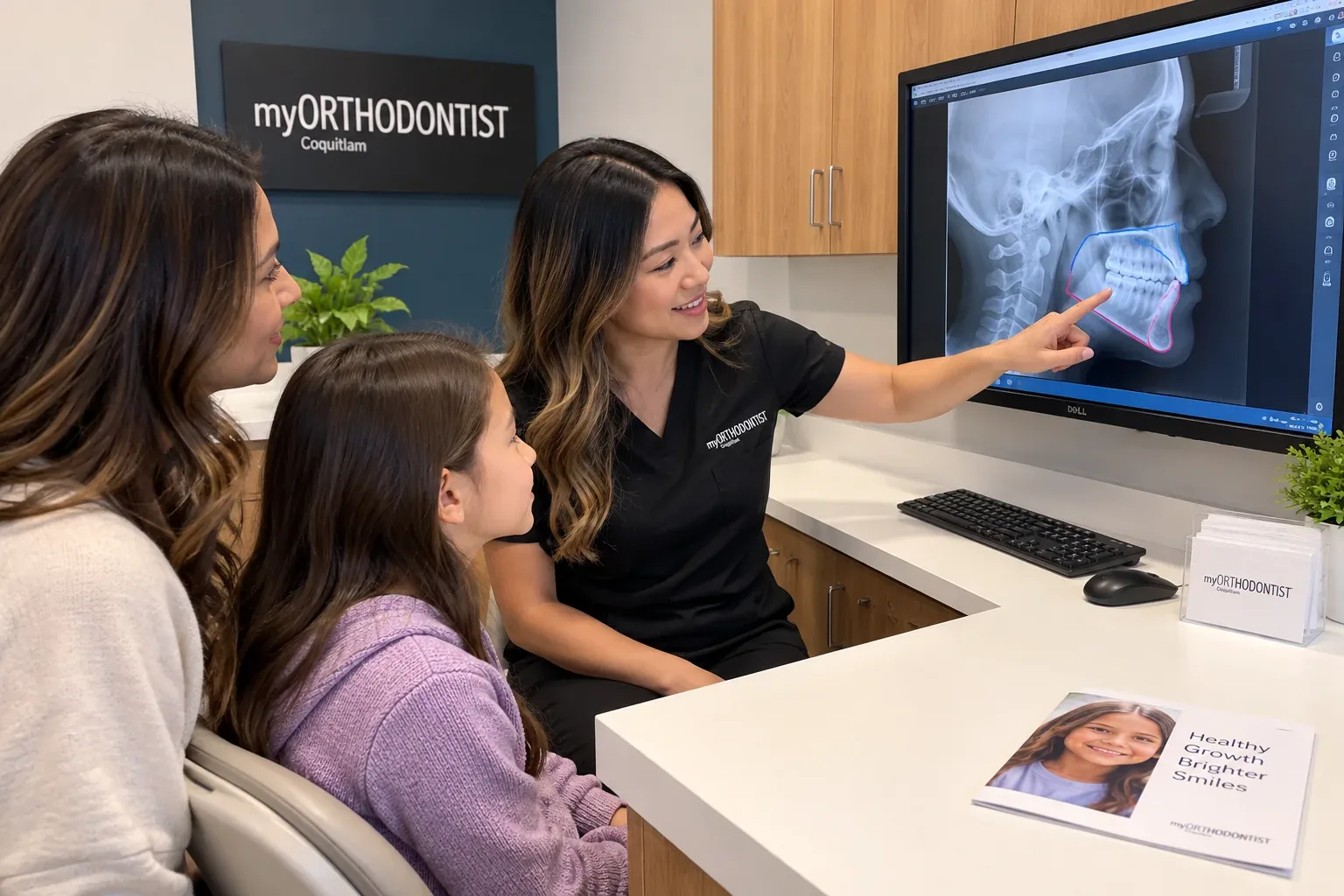
An underbite — lower teeth biting in front of the uppers — is usually a jaw-relationship pattern with a strong genetic component, not just a tooth-position quirk. That’s why it tops the list of reasons to take the age-7 assessment seriously.
Why the calendar is the treatment
- Childhood (roughly 6–10): the upper jaw’s growth sutures are open, so guidance appliances (expanders, facemask protraction) can genuinely influence jaw position. This window does not reopen.
- Teens: camouflage treatment — braces or aligners positioning teeth to compensate for the jaw pattern — handles mild-to-moderate cases well once growth is nearly done.
- Adults: mild underbites camouflage successfully; severe skeletal cases involve an honest conversation about surgical orthodontics, which a good specialist names upfront rather than mid-treatment.
The decision a parent actually faces
If your child’s lower teeth sit in front, book the assessment now rather than “waiting until the adult teeth are in” — the whole point is to evaluate before growth closes options. The most common outcome is still monitoring, but for the minority who benefit from early guidance, the window is the treatment. This is also a case where a second opinion earns its hour if surgery is ever mentioned.
How we handle an underbite at each age
At six to nine, if the pattern is mild and the child's upper jaw is simply a little behind, a reverse-pull facemask worn at night for six to nine months can bring the upper jaw forward while the growth seam is open — a treatment that becomes impossible by the mid-teens. If a narrow upper arch is part of the picture, we combine it with expansion. In the early teens, once growth guidance is no longer available, we assess whether the discrepancy is small enough to camouflage with braces and elastics; many are. For the adults whose lower jaw is genuinely long, we have the honest conversation about a surgical-orthodontic plan, with MSP coverage for the surgery itself when medically required.
Why we're firm about the early look
Because an underbite is the pattern where our growth-modification philosophy has the most at stake. A child seen at seven has options a child seen at fourteen doesn't, and the difference can be the difference between an appliance and an operation. We won't treat every underbite early — some are dental, some are mild, some will be watched — but we want to be the ones deciding that on the records, not the calendar.
Underbite questions we're asked
Can an underbite be corrected without surgery?
Often, if treated during growth — a facemask or expansion in a young child can bring the upper jaw forward. In teens and adults, mild-to-moderate underbites can be camouflaged with braces; severe skeletal ones usually need a surgical-orthodontic plan.
At what age should an underbite be treated?
Assessed by seven; treated early — six to nine — when the pattern is skeletal and growth guidance is still possible. It's the most time-sensitive bite pattern.
Do underbites run in families?
Strongly. If a parent has one, we'd want to see the child at seven rather than later.
Will my child's underbite get worse?
The lower jaw keeps growing into the late teens, so a skeletal underbite usually becomes more pronounced with age, not less.
Related reading
- Growth modification — why we treat skeletal patterns while growth is possible
- Jaw surgery — the honest answer for severe adult cases
- MSP and jaw surgery — what's covered in BC
The bottom line
An underbite is the pattern where age is most of the treatment. Seen at seven, growth guidance may correct it. Seen at fourteen, camouflage may manage it. Seen at twenty-five and severe, surgery is the honest answer, with MSP covering the surgical part when it qualifies. If it runs in your family, have the child seen early — the assessment is free.
Underbite: what to establish at the consultation
- Skeletal (jaw) or dental (teeth) — on the profile X-ray
- Age and remaining growth — is guidance still possible?
- Family history — underbites run in families and keep growing
- If waiting: what exactly are we watching for, and until when?
- If surgery is ever mentioned: a second opinion, offered by us