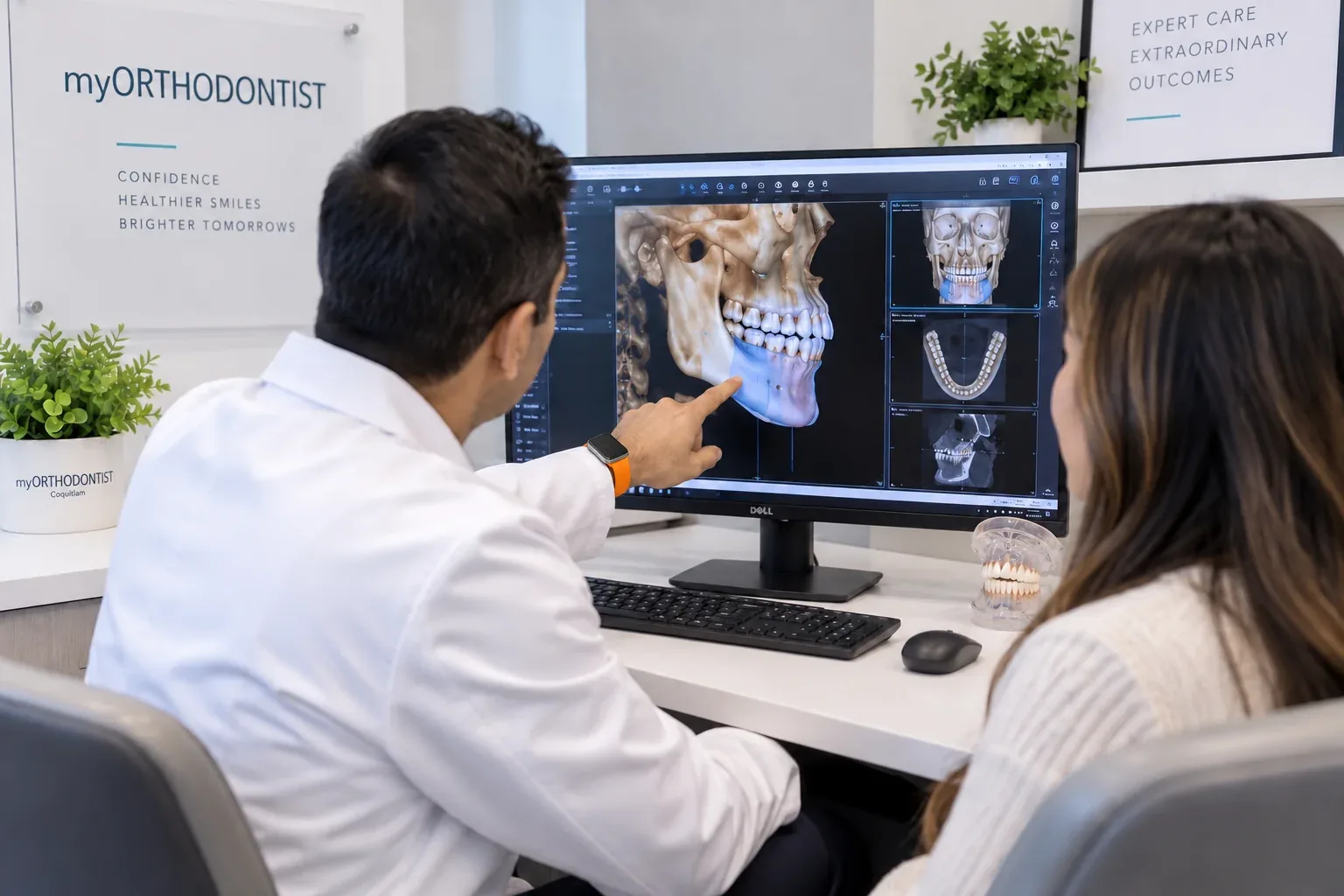
Upper canines travel farther than any other tooth to reach their place, which is why they’re the ones that most often get stuck in the bone — “impacted.” Caught early, impaction is often preventable with simple moves; caught late, it becomes a longer project.
Caught early (roughly ages 8–11)
A panoramic X-ray shows a canine drifting off-path years before anything looks wrong in the mirror. Timely extraction of the stubborn baby canine — sometimes with a little space creation — redirects the adult tooth’s eruption in a large share of cases. Minimal intervention, major save. This single scenario justifies the age-7 assessment on its own.
Caught late
An impacted canine in a teen or adult is still very treatable: an oral surgeon exposes the tooth, a small attachment and chain are bonded, and braces apply gentle traction to guide it into place over months. It works reliably; it simply costs more time than prevention would have. Leaving an impacted canine untreated isn’t neutral either — it can resorb the roots of neighbouring teeth, which is why “just leave it” deserves scrutiny and imaging.
What we look for at seven, eight and nine
On a panoramic X-ray the upper canines should be sitting high in the bone, angled gently toward their places. When one is angled across the roots of the front teeth, or sitting further toward the middle than its partner, it's drifting — and it will not correct itself. At that stage the intervention is often modest: remove the baby canine early so the adult tooth has a clear path, sometimes create a little room. We've watched canines that looked destined for impaction turn and erupt normally after that small move. It's one of the best-value interventions in children's orthodontics, and it's invisible without the X-ray.
What we tell adults with an impacted canine
That it's very treatable, that it adds time — usually six to twelve months of traction on top of the comprehensive plan — and that leaving it is not a neutral choice, because an impacted canine can quietly resorb the roots of the teeth beside it. The process is well established: an oral surgeon exposes the tooth in a short procedure, we bond a small attachment and chain, and braces guide it into place over months. Aligners can occasionally finish such a case but rarely start one; this is braces territory, and we'll say so.
The rare alternative
Occasionally a canine is so badly positioned, or the patient so far along, that extracting it and closing the space (or placing an implant later) is the more sensible path. That's a genuine judgement call and a textbook moment for a second opinion — which we'll suggest ourselves if we're the ones recommending it.
Impacted canine questions we're asked
How do I know if my child's canine is impacted?
You usually can't from the outside. A panoramic X-ray around age eight or nine shows whether the canine is tracking toward its place or drifting.
Can an impacted canine be left alone?
Not safely. It can resorb the roots of neighbouring teeth over time, and it leaves the baby canine or a gap in its place.
How long does bringing a canine down take?
Six to twelve months of gentle traction added to the comprehensive plan, after a short surgical exposure.
Is the exposure surgery painful?
It's a minor procedure under local anaesthetic with a few days of tenderness; most patients describe it as easier than expected.
Related reading
- Why age seven — the X-ray that catches drifting canines early
- Braces — the appliance that guides a canine into place
- Second opinions — if extraction of the canine is proposed
The bottom line
One panoramic X-ray at eight or nine catches a drifting canine while a small early move can still redirect it. Caught late, it's a well-established but longer correction with a surgical exposure. Left alone, it can damage neighbouring roots. This single scenario justifies the age-seven visit on its own, and it's why we take that X-ray.
If an impacted canine is diagnosed, ask
- Can eruption still be redirected without surgery?
- If exposure: who does the surgery, and the sequence?
- What's the traction timeline added to treatment?
- Any root resorption risk to neighbours on the scan?
- Full cost including the surgical component?