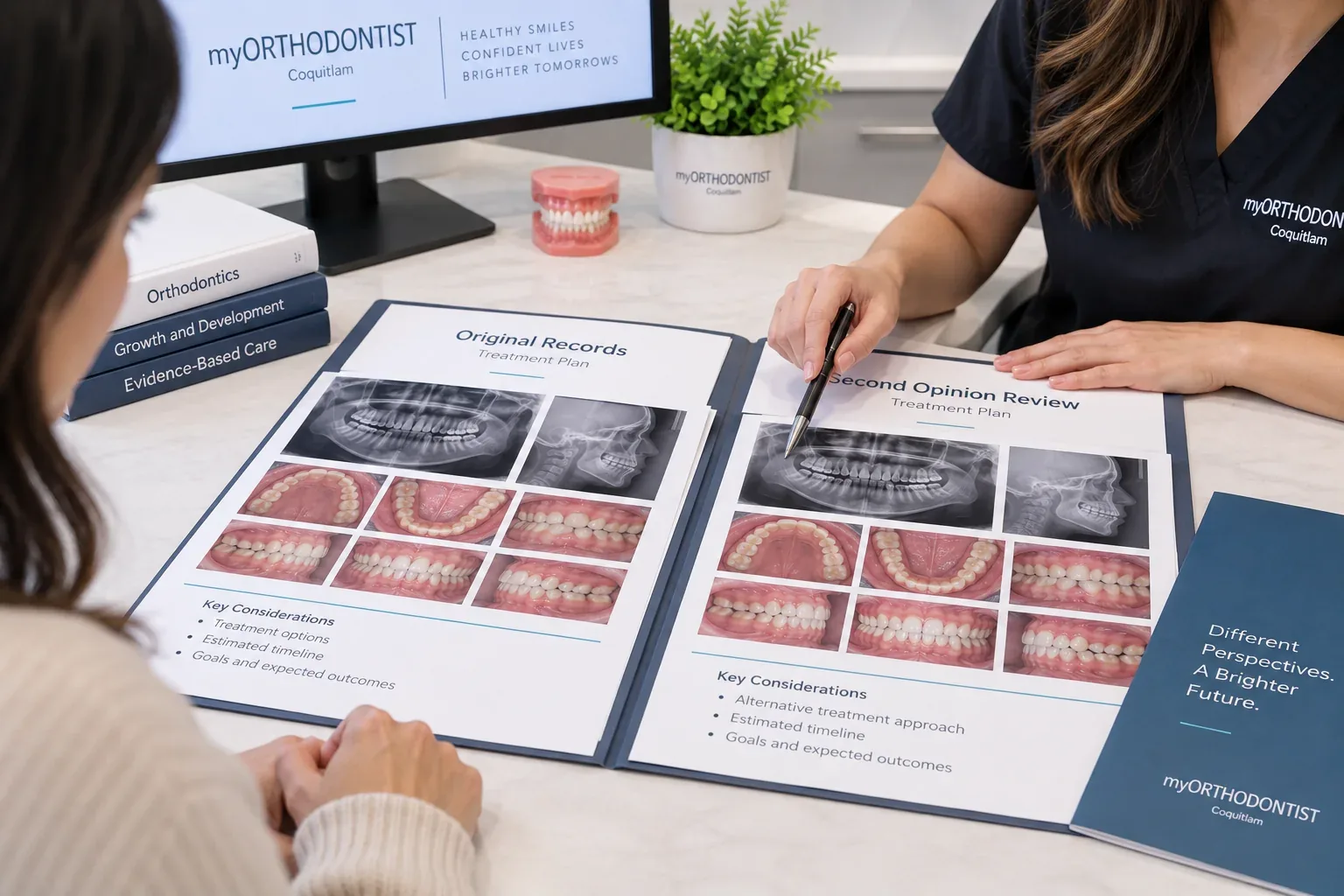
Specialists give second opinions constantly, welcome patients seeking them, and provide them without drama. Since consultations in this market are free, the only cost of a second opinion is an hour of your time — trivially worth it for a five-figure, two-year decision.
When a second opinion is clearly warranted
- Extractions are recommended — often correct, but a judgement call worth confirming since it’s irreversible.
- Phase 1 treatment is proposed for a young child — verify it meets a genuine early-treatment indication and that the clinic can name what it prevents.
- Surgery is mentioned — surgical orthodontics is sometimes the honest answer; you want two specialists agreeing before that road.
- The quote is far outside market range — in either direction.
- You’d simply like a specialist’s read — if your dentist has proposed treatment, a free specialist consult adds a second data point; good dentists welcome it, and complex findings flow back to them anyway.
- Something felt off — rushed exam, deflected questions, signing pressure. Instinct counts.
How to do it well
Book a standard consultation and say plainly that you’re seeking a second opinion — clinics prefer knowing. Bring the first clinic’s findings if you have them, but let the second clinic take its own records and reach its own conclusion before you share the first plan; independent agreement is the whole value. Then compare the reasoning, not just the recommendations: when two specialists differ, the one who explains the trade-offs more clearly is usually the one who’ll manage your treatment more thoughtfully.
If the opinions agree
You’ve confirmed the plan and can choose between clinics on everything else that matters — experience, quote contents, logistics — with real confidence. That’s exactly what the free-consultation system is for.
What a second opinion is not
It isn't an accusation, and it isn't shopping for the answer you wanted. It's the ordinary due diligence anyone applies to an irreversible decision. We give second opinions every week, we receive them — patients we've quoted go elsewhere to check, and sometimes come back, sometimes don't — and we'd think less of a colleague who resented it than of a patient who sought it.
How we conduct one
We take our own records rather than working from the other clinic's, because independent agreement is the whole value. We'll ask what was recommended only after we've formed a view. Then we tell you plainly where we agree, where we differ, and why — including, quite often, "this is a reasonable plan and I'd be comfortable with you proceeding there." When we differ, we try to explain the trade-off rather than just the conclusion, because a difference between two specialists usually reflects a genuine judgement call, not an error.
The cases where we most often differ from what a family arrived with
Extractions proposed where expansion during growth could create the room. Phase 1 proposed for a child with mild crowding and a normal jaw relationship. Aligners proposed for a bite correction that would be faster and more predictable in braces. Surgery mentioned to an adult with a moderate discrepancy that camouflage could handle. And the reverse of all of these too — families told to wait when a crossbite was steering a growing jaw. None of those are indictments of anyone; they are exactly the calls that benefit from two sets of eyes.
Second-opinion questions
Will the second orthodontist just agree with the first?
Often, and that's valuable — independent agreement is reassurance you can act on. When they differ, you learn the trade-off.
Do I have to tell the first clinic?
No, and there's no need to. Most clinics expect comparison.
Is a second opinion free?
Consultations in the Tri-Cities generally are, ours included.
What if the opinions disagree?
Compare the reasoning, not just the recommendations. A third consult is worth the hour if the difference is extractions, surgery or Phase 1.
Related reading
- How to choose — the five-step framework
- Crowding — where the extraction question lives
- Phase 1 indications — what a first phase should be able to name
The bottom line
Free, routine, and welcome. Get one when extractions, surgery, a first phase, or an unusual quote is on the table — or when the visit felt wrong. We give them every week, we receive them, and we'll suggest one ourselves for the recommendations that deserve two sets of eyes.
Bring to a second-opinion visit
- The first clinic's written quote (share it after the exam)
- Any X-rays already taken — we may not need to repeat them
- Your specific worry: extractions? timing? surgery? cost?
- The questions you didn't get to ask the first time
- An open mind — agreement is a good outcome