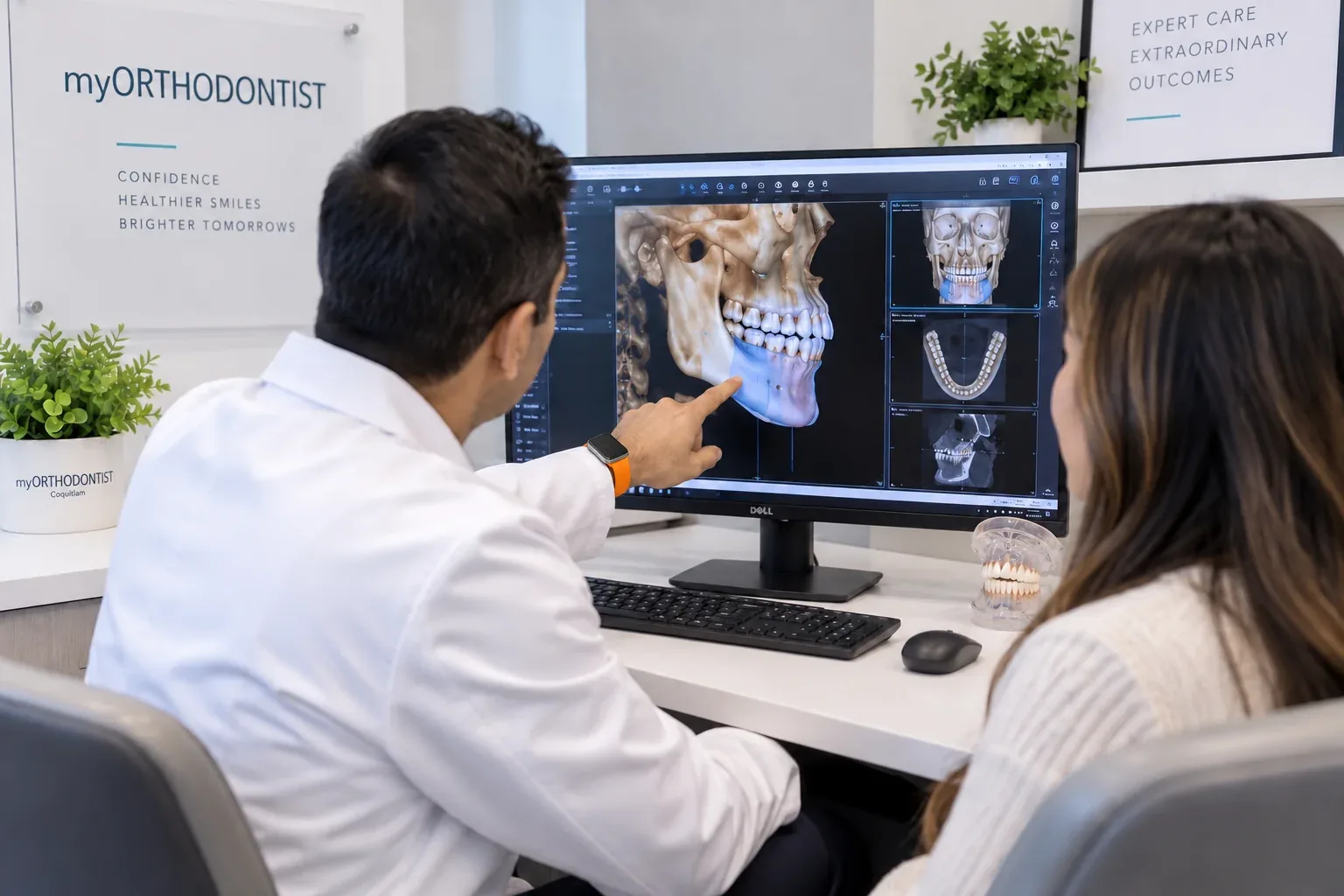
Orthognathic surgery repositions one or both jaws when the mismatch between them is too large for tooth movement alone to correct — an underbite where the lower jaw is genuinely long, an open bite from a vertical growth pattern, a severe overjet with a small lower jaw, or an asymmetry. It is combined with orthodontics before and after, and performed by an oral and maxillofacial surgeon in hospital.
Who it's for
Adults, mostly, whose jaw growth is complete and whose skeletal discrepancy causes real problems — a bite that doesn't function, facial imbalance they find distressing, speech or chewing difficulty, or in some cases a compromised airway. Camouflage orthodontics (moving teeth to disguise the mismatch) is often possible for mild-to-moderate cases; surgery is for the cases where camouflage would compromise the teeth or the face.
Why we talk about children on this page
Because many of these patterns were visible at nine. A lower jaw sitting back, a narrow upper jaw, an emerging underbite — during growth, these can be guided. After growth, they can only be moved surgically. It is the single strongest argument we know for the early assessment, and it is why our practice leans toward growth modification when it's indicated.
The process, honestly
- Joint assessment by orthodontist and surgeon — records, 3D imaging, a plan you can see simulated.
- Pre-surgical orthodontics, typically 12–18 months, aligning the teeth within each jaw so they'll fit when the jaws are repositioned. The bite often looks worse during this phase — that's expected.
- Surgery — in hospital, under general anaesthetic, usually one to two nights' stay, with a recovery of several weeks to soft food and normal activity.
- Post-surgical orthodontics — a few months of finishing, then retention.
The question everyone asks next is cost. In BC it has a specific answer, on the next page.
How we work with the surgeon
Surgical cases are planned jointly from the beginning. We take the orthodontic records; the oral and maxillofacial surgeon takes the 3D imaging and assesses MSP eligibility; together we produce a plan you can see simulated before you decide. Pre-surgical orthodontics — typically twelve to eighteen months in braces — is done at our clinic; surgery in hospital under the surgeon's care; post-surgical finishing back with us. You'll have two teams, but one plan and one sequence, and we'll tell you at the outset what each part costs and who covers what.
What we say to families of growing children
That many surgical cases we see in adults were visible, and often guidable, at nine. A lower jaw sitting back, a narrow upper jaw, an emerging underbite — these are the patterns that growth modification exists for. We can't promise that early treatment avoids surgery; growth has a mind of its own. But it changes the odds, and it's the reason we'd rather see a child at seven than an adult at twenty-seven.
Jaw surgery questions we're asked
How do I know if I need jaw surgery or just braces?
Records. A profile X-ray and a clinical exam show how large the jaw mismatch is; mild-to-moderate cases camouflage with orthodontics, severe ones don't. We'll show you where yours sits.
What's the recovery like?
One to two nights in hospital, two weeks of soft food and rest, several weeks before full activity; the swelling resolves over a month or two.
Will it change my appearance?
Yes — that's often part of the point. The simulation shows you the expected change before you decide.
Could early treatment have avoided this?
For many adult surgical cases, the pattern was guidable at nine. That's why we assess children early and lean toward growth modification.
Related reading
- MSP coverage — what BC pays for and what it doesn't
- Growth modification — how children can avoid this page
- Adult expansion — the width-only surgical option
The bottom line
Jaw surgery is the honest answer for some adults with a skeletal mismatch too large to camouflage — planned jointly with a surgeon, simulated before you decide, with MSP generally covering the surgery when it qualifies and the orthodontics a private fee. For many children, the same pattern is guidable at nine. That's why we look early, and it's why this page begins with growth.
Surgical case: questions for both teams
- Could camouflage orthodontics achieve an acceptable result instead?
- What specifically will the surgery correct — shown on the simulation
- Pre- and post-surgical orthodontic fee, in writing
- MSP eligibility confirmed by the surgeon's office
- Recovery time and time off work or school, honestly