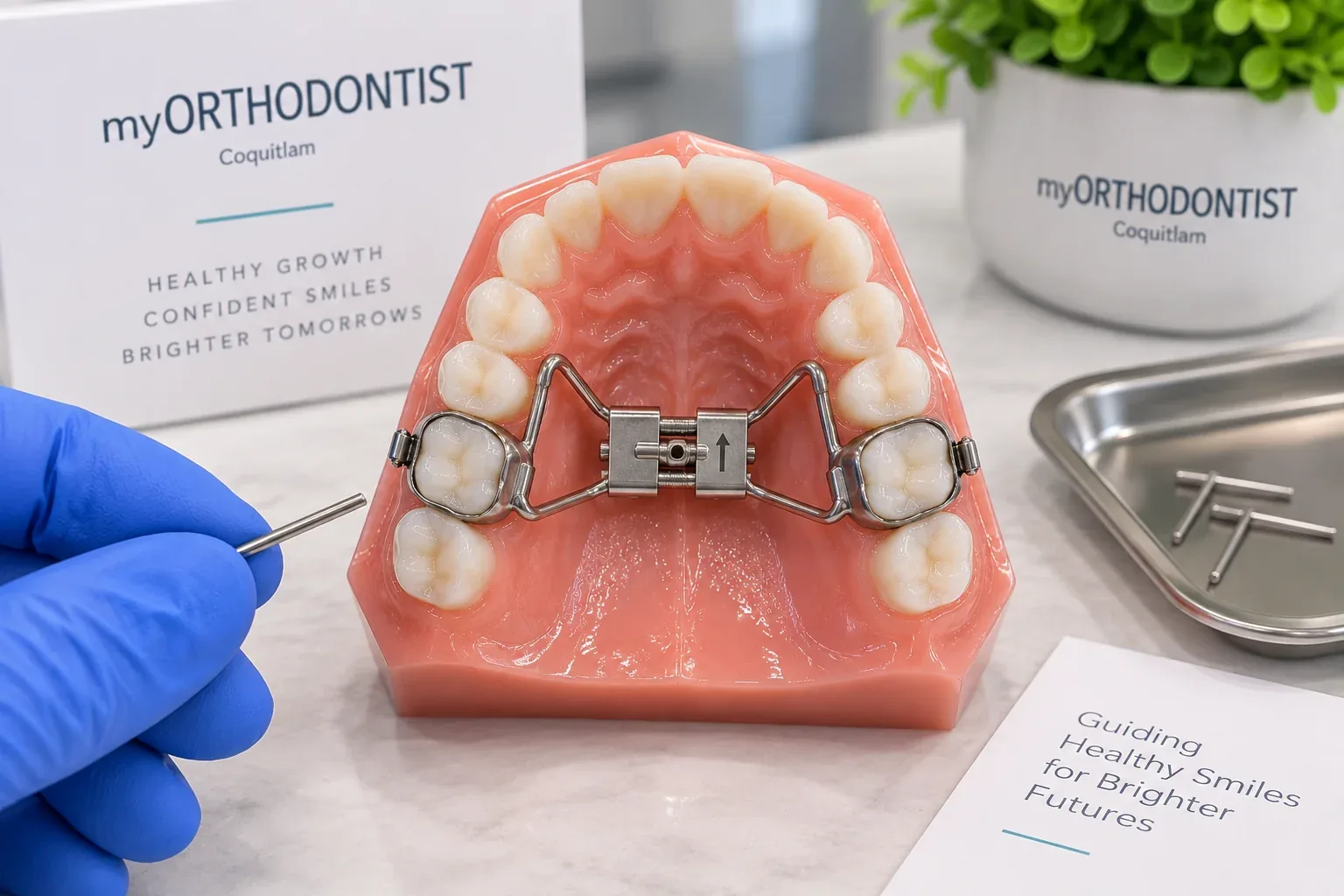
A crossbite means upper teeth biting inside the lowers — in front (anterior) or on the sides (posterior). The one-sided posterior crossbite is the pattern specialists genuinely don’t like to watch and wait on: every bite can force the growing lower jaw to shift sideways, and a functional shift practiced for years can become a permanent asymmetry.
Options by situation
- Palatal expansion (childhood) — a narrow upper jaw widened while growth sutures are open; comfortable, quick, and definitive for the right case. The gold-standard reason Phase 1 treatment exists.
- Invisalign First — handles some mild expansion and dental crossbites in kids for suitable cases.
- Braces or aligners (teens/adults) — dental crossbites of individual teeth correct well at any age; skeletal width in adults is a harder conversation, occasionally involving surgically assisted expansion.
What to verify at a consultation
Crossbite consult checklist
- Is it dental, skeletal, or a functional shift?
- One-sided: is the jaw deviating on closure?
- If expansion: why now, and what appliance?
- If waiting: what exactly are we watching for?
- What does Phase 2 still cost afterward?
A specialist who shows you the shift in the mirror and on your child’s records — rather than just prescribing — is demonstrating exactly the consultation standard this site exists to teach.
How we treat a crossbite at each age
In a child with a narrow upper jaw and a shifting bite, we treat early and we don't apologise for it: expansion while the growth seam is open, often built into a twin block if the lower jaw also needs guidance, or a simple expander or removable plate when it doesn't. Six to nine months, comfortable, and the shift disappears with the crossbite. A single tooth in crossbite — one incisor caught behind the lowers — is a smaller job at any age, sometimes partial braces for a few months. In adults with a skeletal crossbite, dental expansion can help mild cases; genuine width needs a different conversation.
What happens if a shifting crossbite is left
The jaw grows into the shifted position. The face becomes subtly asymmetric, the joints load unevenly, and what was a six-month appliance at eight becomes a complex correction at eighteen — occasionally a surgical one. This is the pattern we most want to see early, and the one we'd ask your dentist to send our way without waiting for the full set of adult teeth. Palatal expansion explains the appliance; the age-seven page explains the timing.
For adults with a crossbite
A single-tooth crossbite corrects readily at any age. A skeletal crossbite — a genuinely narrow upper jaw — is the harder adult conversation, because the growth seam is closed; dental expansion helps mild cases, and real width needs assisted expansion. Either way, an untreated crossbite wears the involved teeth unevenly and loads the jaw joints, so it's worth assessing even when it's never bothered you.
Crossbite questions we're asked
Is a crossbite an emergency?
Not an emergency, but not something to wait years on either. A crossbite that shifts the jaw is best treated while the child is growing, because the asymmetry it produces becomes permanent.
Can a crossbite fix itself?
A single-tooth crossbite occasionally does as baby teeth exchange. A skeletal crossbite from a narrow palate doesn't.
How is a crossbite treated in an adult?
A single tooth: braces or aligners, readily. A narrow upper jaw: dental expansion for mild cases, surgically assisted or bone-anchored expansion for real width.
How long does expansion take?
Active expansion a few weeks; holding it several months while the seam consolidates; the whole first phase typically six to nine months.
Related reading
- Palatal expansion — the appliance and the age window
- The twin block — expansion built into jaw guidance
- Adult expansion — the options once growth is done
The bottom line
A crossbite that shifts a growing jaw is the clearest reason for early treatment we know: six to nine months of expansion at eight prevents an asymmetry that's permanent by eighteen. A single-tooth crossbite is simpler at any age. An adult skeletal crossbite is a different conversation. If you've seen the shift in your child's mirror, book the free assessment now rather than at the next checkup.