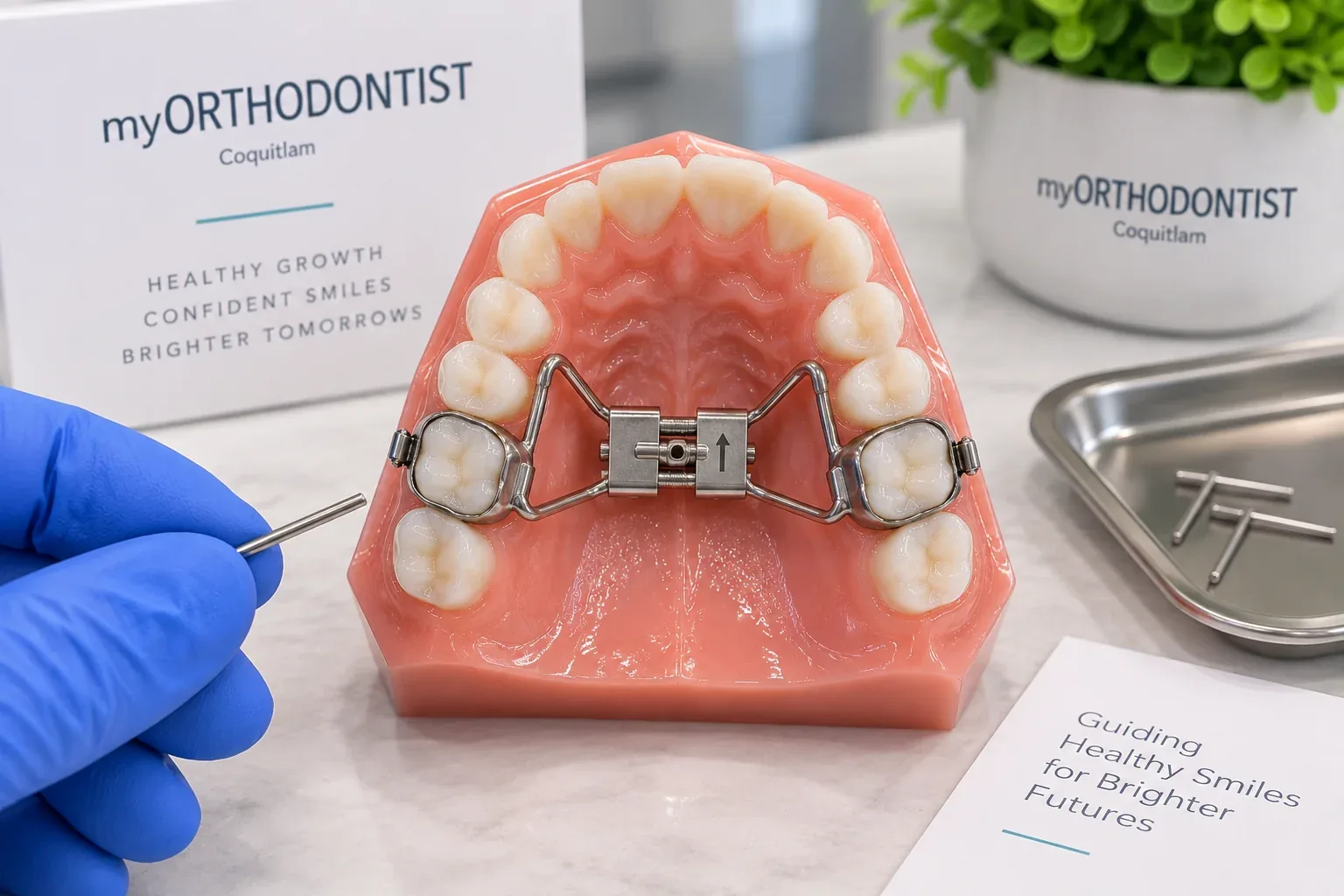
Once the midline seam of the upper jaw has fused — typically by the mid-teens — conventional expanders mostly tip the teeth outward rather than widening the jaw. For an adult with a genuinely narrow upper arch, real skeletal expansion means either a surgically assisted procedure or, in selected cases, a bone-anchored expander that can sometimes achieve it without open surgery.
Why an adult might need it
A crossbite across the back teeth, significant crowding that would otherwise mean extractions, a narrow nasal floor contributing to breathing concerns, or as part of a broader surgical-orthodontic plan. Many adults with mild narrowness need none of this — dental expansion and alignment within the existing jaw is enough — so the first step is measuring how much is skeletal.
The two routes
- Surgically assisted expansion — an oral surgeon releases the seam in a short procedure, then a conventional expander widens the jaw over weeks. Predictable; involves a surgical episode and recovery.
- Bone-anchored (mini-implant) expansion — an expander anchored to the palate with small temporary implants, which in suitable adults can separate the seam without surgery. Case selection is everything: age, seam maturity on 3D imaging, and the amount of widening needed all decide whether it's realistic.
What we'd tell you
Which route your imaging supports, what each involves, and — candidly — whether you need skeletal expansion at all. This is also the moment we'd mention, gently, that the same width problem is a routine six-month appliance in a nine-year-old, which is why we assess children early and why expansion during growth sits at the centre of our philosophy.
How we decide which route
A 3D scan of the upper jaw shows how mature the midline seam is, which is the whole question. In younger adults the seam can be immature enough that a bone-anchored expander separates it without surgery; in older adults it usually isn't, and a surgically assisted expansion is the reliable path. We also measure how much width is actually needed — a few millimetres can often be achieved dentally, tipping teeth outward within the existing jaw, without either. We'll show you the scan and the numbers and tell you which of the three fits.
What each involves, honestly
- Dental expansion — braces or aligners, no procedure; for mild narrowness only, and with limits on stability.
- Bone-anchored expansion — four small temporary implants in the palate under local anaesthetic, an expander attached, daily turns over weeks; some discomfort, no hospital. Not every adult is a candidate.
- Surgically assisted expansion — a short day-surgery procedure to release the seam, then a conventional expander; a week or two of recovery. Predictable, and sometimes the only honest option.
Adult expansion questions
Can an adult's palate be expanded without surgery?
Sometimes — bone-anchored expanders separate an immature seam in some younger adults. A 3D scan tells us whether yours is a candidate.
Is surgically assisted expansion major surgery?
It's a short day procedure with a week or two of recovery — far less than full jaw surgery.
How long does adult expansion take?
Active expansion a few weeks; consolidation several months; then the comprehensive phase.
Is it worth it?
For a genuine skeletal crossbite or a breathing-related narrow palate, often yes. For mild narrowness, dental expansion usually suffices and we'll say so.
Related reading
- Palatal expansion in children — the routine version, during growth
- Crossbite — why width matters
- Airway — when expansion is about breathing
The bottom line
An adult upper jaw can be widened — surgically assisted, or in some younger adults with a bone-anchored expander — when a genuine skeletal crossbite or a breathing-related narrow palate calls for it. Mild narrowness usually doesn't need either. The 3D scan decides, and we'll show you. And if you have a nine-year-old, this is why we look at palates early.
If it were our own palate
We'd ask for the 3D scan and the millimetre figure before hearing about procedures. If dental expansion could do it, we'd take that. If not, we'd rather know the surgical picture honestly than start a plan that couldn't deliver the width.
Adult expansion: confirm before deciding
- Seam maturity assessed on a 3D scan
- Millimetres of width actually needed
- Whether dental expansion alone would suffice
- Which procedure, by whom, and its recovery
- Retention plan — expansion in adults needs it