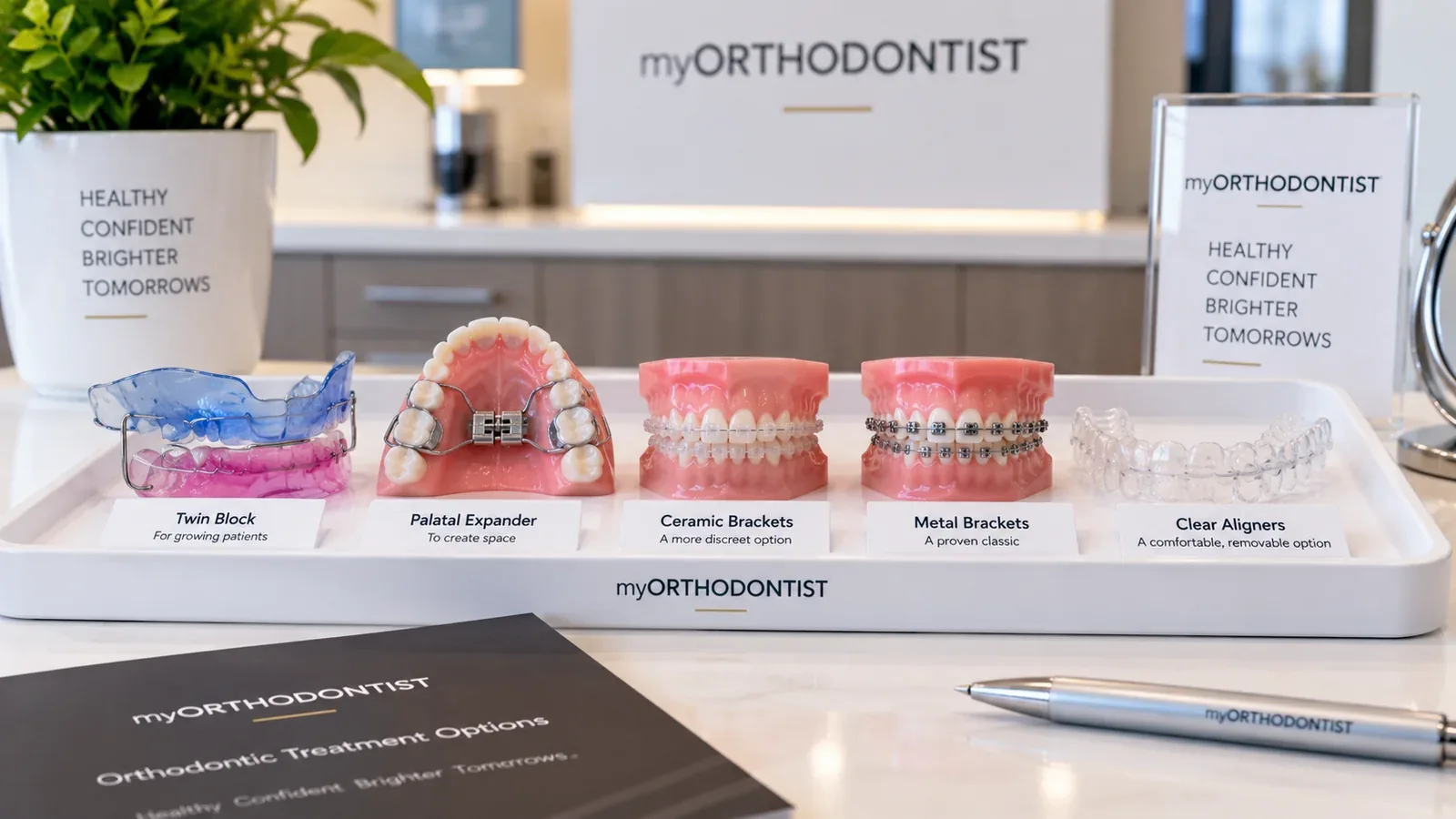
There is no universally “best” treatment — only the best match between a case, a lifestyle and a budget. These guides explain each option the way a specialist would in an unhurried consultation.
Fixed appliances
Braces
Metal, ceramic and self-ligating systems: how they work, timelines, and when they beat aligners.
Clear aligners
Invisalign
How aligner treatment works, compliance realities, and why provider experience matters more than the product.
Ages 5–11
Early orthodontics
Interceptive treatment, palatal expansion and the age-7 assessment — what’s necessary vs. optional.
Adults
Adult orthodontics
Treatment at 30, 50 or 70: discreet options, retreatment after relapse, and pre-restorative alignment.
After treatment
Retainers & retention
Why retention is lifelong, retainer types compared, and what replacement should cost.
Diagnosis
Common problems
Crowding, overbite, underbite, crossbite and more — what each looks like and how it’s treated.
How treatment decisions actually get made
A thorough consultation weighs four factors: the malocclusion itself (some bites need the control of fixed braces; many suit aligners), age and growth stage, compliance (aligners only work worn 20–22 hours a day), and budget. A specialist should walk you through all four and show you the trade-offs — if a consultation skips straight to a single recommendation, read our 12 questions guide before signing anything.
How we choose between them
We start with the records, not the catalogue. The bite and the growth stage narrow the options first: a skeletal problem in a growing child points to guiding growth before anything else; a bite correction in a teenager points to the control of fixed braces; mild crowding in a compliant adult points to aligners. Only then do preferences enter — appearance, food freedom, budget — and we price the viable options side by side so the family, not the inventory, decides. Because we fit every one of these appliances, we have no reason to steer you toward one.
What every treatment has in common
A free first visit with a certified specialist. Records before any recommendation. A written fee that includes your retainers. Adjustments or checks every six to ten weeks. A retention phase afterward that, honestly, never quite ends. And a partnership with your family dentist throughout — cleanings and checkups continue during orthodontic treatment, and we coordinate at the start, during and at the finish.
Where to start reading
Parents of young children: early orthodontics, then the signs that warrant Phase 1. Parents of teens: teen orthodontics and the braces-or-aligners decision. Adults: adult orthodontics, and if your teenage retainer stopped years ago, relapse and retreatment. Everyone, eventually: retainers.
Frequently asked questions about orthodontic treatment
How long does orthodontic treatment take?
Most comprehensive cases run 12–30 months; limited adult cases 6–12; a first phase for a child 9–15. We quote a range after records and a firm estimate once the plan is designed.
Does treatment hurt?
Bonding and fitting don't. A few pressure-sore days follow, and after some adjustments. Nothing that soft food and ordinary pain relief don't cover.
Can I switch from aligners to braces mid-treatment, or the reverse?
Yes, and we sometimes plan it — a short braces phase then aligners to finish. If aligner wear isn't working for a teenager, switching early is far better than a stalled case.
What happens if I move away during treatment?
We transfer records to an orthodontist near your new home and adjust the fee for the completed portion. It's routine.
Do you treat adults over 60?
Yes. Healthy teeth move at any age; gum health is the prerequisite, not birth year.
How we sequence treatment for a family
Many Coquitlam families have two or three children moving through the assessment window in turn, and we plan for the household rather than the patient. A seven-year-old's assessment, a ten-year-old's twin block and a thirteen-year-old's braces can be timed so visits overlap, insurance maximums are mapped across siblings, and the family isn't in the clinic every week for a decade. Ask us to sketch the whole family's likely timeline at the first visit — it's a ten-minute conversation that saves years of scheduling.
What happens between visits
Most of treatment happens at home: wearing the appliance, keeping the teeth clean, eating sensibly, calling when something breaks. We spend the last part of every bonding or fitting appointment on exactly that, and we'd rather you called with a small question than waited with a broken bracket. Your dentist continues cleanings and checkups throughout — orthodontic treatment runs alongside dental care, never instead of it.
A closer look: how a plan gets designed
After the consultation, the specialist sits with the records — the scan, both X-rays, the photographs — and works through a sequence: what's the pattern, what are the goals, what movements achieve them, which appliance makes those movements most predictably, in what order, over what time, with what retention. For aligner cases that becomes a digital simulation, refined tooth by tooth; for braces, a bracket prescription and a wire sequence; for a child, an appliance choice and a growth timeline. The plan is presented back to you with the reasoning, priced beside its alternative. Families sometimes assume the appliance is chosen first and the plan fitted around it; at a specialist practice it's the other way round.
Where treatments overlap
Many cases use more than one: a twin block then braces; braces then aligners; expansion then partial braces; aligners with a short elastic phase. Combining appliances isn't a sign the first one failed — it's usually the plan from the start, using each tool for the movements it does best. When we recommend a sequence, we'll explain what each stage does and what the whole is expected to cost, so a second appliance is never a surprise.
Before you go
Read the page for your age group, then the condition you've been told you have. If cost is the question, the cost hub; if choosing a clinic is, the choosing guides. And if you'd like a specialist's read on all of it, the consultation is free.
Misconceptions we correct most often
“Invisalign is the modern treatment and braces are old.”
Both are current. Each fits different movements; we fit both.
“Phase 1 means two rounds of braces.”
Phase 1 is usually an appliance, not braces, and it aims to make the later braces phase shorter.
“Retainers are optional after a few years.”
Teeth drift for life. Retainers are how the result doesn't.
What Coquitlam families search for, answered
“What are the different types of orthodontic treatment?”
Growth-modification appliances for children (twin blocks, expanders), fixed braces (metal, ceramic, self-ligating), clear aligners (Invisalign and its child and teen versions), limited treatments for adults, surgical-orthodontic plans for severe skeletal cases, and retention after everything. Each has its page here.
“What is the newest orthodontic treatment?”
Aligner planning has advanced most in the last decade; bone-anchored expansion for adults is the other notable change. Neither replaces diagnosis, which hasn't changed at all.
“Which orthodontic treatment is fastest?”
For mild alignment, aligners; for bite correction, braces; for skeletal patterns in children, whichever is done during growth rather than after it.