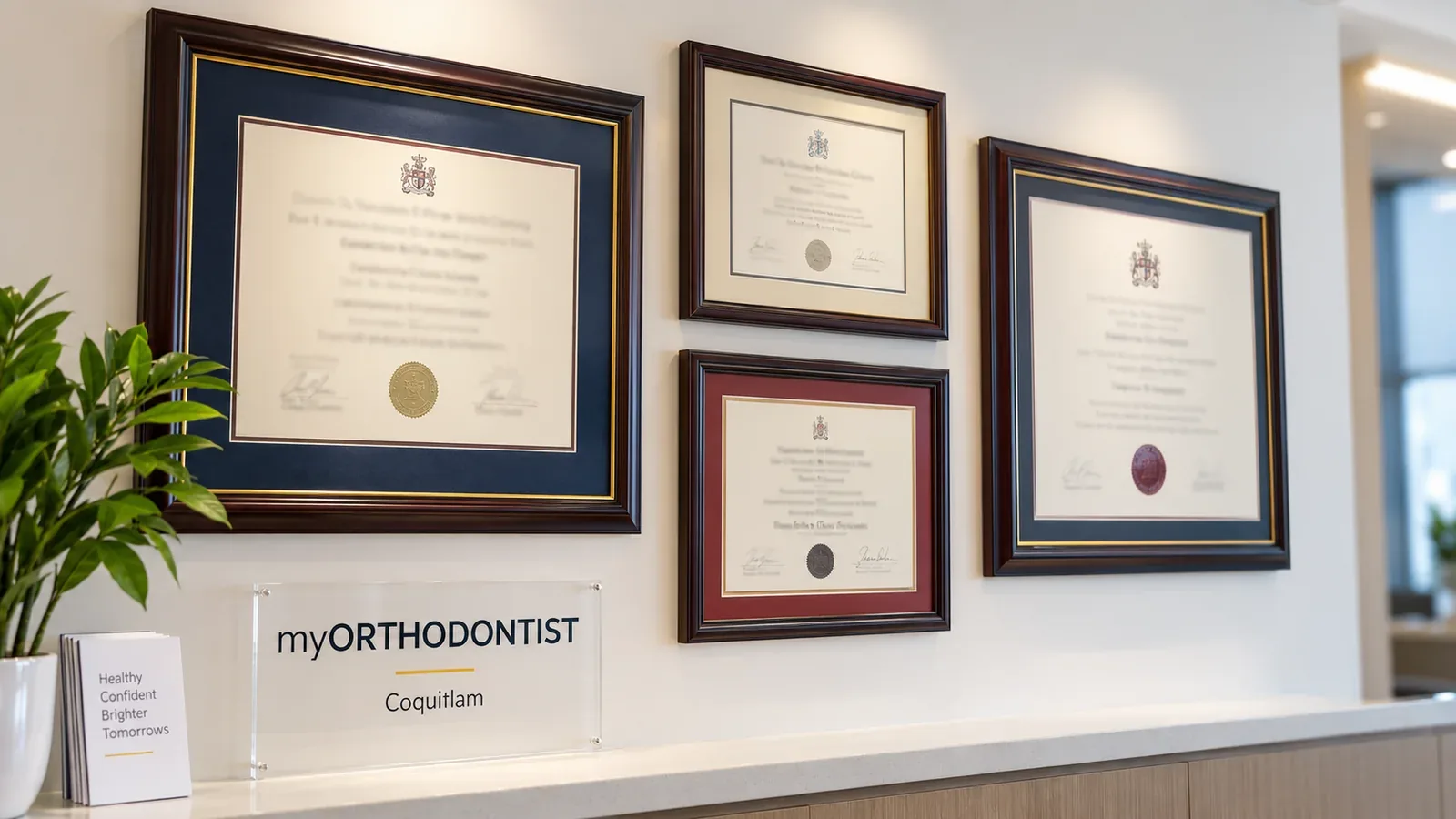
“Orthodontist” is a protected title in British Columbia. To use it, a dentist must hold specialty registration in orthodontics with the BC College of Oral Health Professionals (BCCOHP) — the provincial regulator for all oral health providers.
What it takes to earn
- A dental degree (DMD/DDS) — four years.
- An accredited full-time orthodontic residency — two to three further years of graduate training exclusively in orthodontics: diagnosis, craniofacial growth, biomechanics, and supervised treatment of hundreds of cases, usually with a Master’s degree.
- Specialty examination and registration with BCCOHP as a Certified Specialist in Orthodontics.
How to verify any provider — two minutes
- Go to the BCCOHP public online registry (search “BCCOHP registrant lookup”).
- Search the provider’s name.
- Check the registration class: it should state specialty registration in orthodontics — not general dentistry alone.
Every legitimate specialist expects patients to do this and will gladly give you their registered name. Our clinic lists its specialists — Dr. Alireza Haerian Ardekani and Dr. Aly Kanani — by name on the team page precisely so you can.
Titles that are not this credential
- “Provider tiers” (Gold, Platinum, Diamond) — manufacturer volume awards, open to general dentists.
- “Orthodontics offered” — a service listing, not a specialty.
- Course certificates — weekend or short-course training in aligners is not a residency.
None of these are disqualifying — many excellent general dentists provide aligner care for suitable cases — but none of them mean “orthodontist.” The register simply tells you which kind of training stands behind the title, so you can match the provider to the complexity of your case.
Why the credential exists at all
Orthodontics looks simple from the outside — brackets, wires, straight teeth — which is exactly why the specialty exists. The hard part isn't moving a tooth; it's deciding which teeth to move, where, in which order, at what age, with what effect on the jaw joints, the airway, the face and the long-term stability of the result. Residency training is two to three years of nothing but those decisions, under supervision, across hundreds of cases. General dentistry has to cover everything; the specialty exists to go deep on this one thing.
What "registered" actually protects you from
Registration means the College has verified the training, sets the standards of practice, requires continuing education, and provides a complaints process with real authority. It doesn't guarantee a good orthodontist — nothing does — but it removes the worst uncertainty: whether the person planning your treatment was ever formally trained to plan it. Our own registrations are public. Both of our doctors are listed as Certified Specialists in Orthodontics, and we'd encourage you to look before you book.
The team question, one more time
None of this is an argument against your dentist. General dentists are the quarterbacks of oral health; many provide orthodontic care and some do it very well, especially for mild adult cases. The register simply tells you which kind of training stands behind a title so you can match the provider to the complexity of your case — and the best outcomes we see usually start with a dentist who knew when to refer. How the team works is the fuller picture.
Credential questions we're asked
Is 'orthodontist' a protected title in BC?
Yes. Only dentists with specialty registration in orthodontics with BCCOHP may use it.
What's the difference between a specialist and a dentist who does braces?
Two to three years of accredited residency devoted entirely to orthodontics, and usually a practice limited to it. Both are licensed; only one trained specifically for this.
Are Invisalign 'Diamond' or 'Platinum' providers specialists?
Not necessarily — tiers measure aligner volume and are open to general dentists. Check the register separately.
How do I look up an orthodontist's registration?
Search the BCCOHP public register by name and confirm the orthodontics specialty class. Two minutes.
Related reading
- Dentists and orthodontists — how the professions work together
- Provider tiers — what the badges mean
- Our orthodontists — two registrations you can check
The bottom line
"Orthodontist" is a protected title in BC that requires two to three years of accredited residency and specialty registration with BCCOHP. Check the register — two minutes — for anyone who'll plan your treatment. It doesn't replace judging the consultation, and it says nothing against your dentist; it simply tells you which training stands behind the title.
Two-minute credential check
- Search the provider's name on the BCCOHP public register
- Confirm the registration class says orthodontics specialty
- Note how long they've held it (experience matters too)
- Check both doctors if a practice has two
- If in doubt, ask the clinic for the registered name — a specialist answers instantly