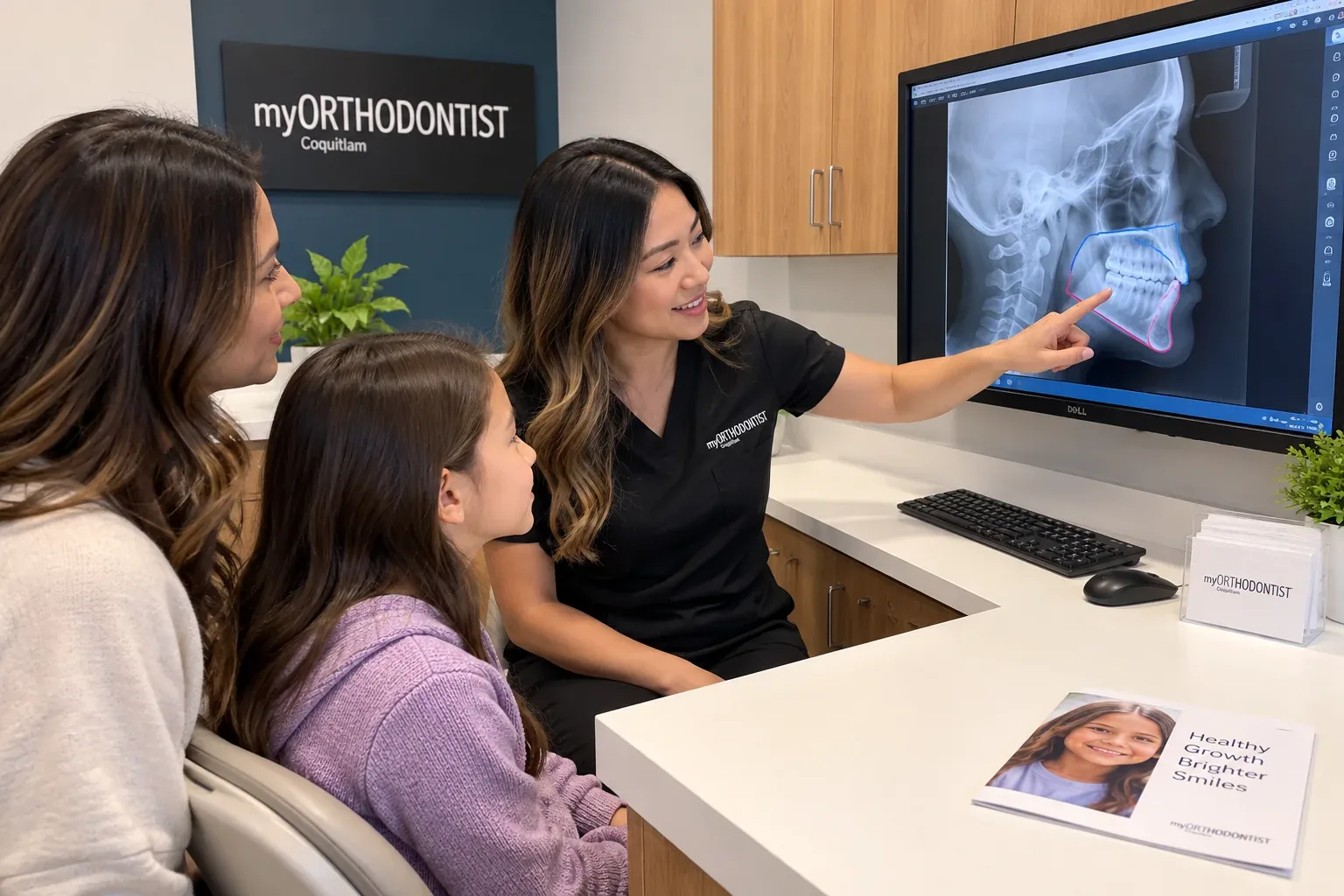
We believe the most valuable orthodontics often happens before a single adult tooth is straightened: guiding the growth of the jaws themselves, while a child is still growing, so that the teeth have room to arrive and the bite has a foundation to settle into. Done at the right time, it can mean fewer extractions, less complex treatment in the teens, and — for some children — no conversation about jaw surgery later.
What "growth modification" actually means
A child's upper jaw has a growth seam down its midline that stays open until roughly the early teens, and the lower jaw is still lengthening well into adolescence. Appliances placed during that window can influence how those jaws develop: widening a narrow upper arch, encouraging a retruded lower jaw forward, or holding growth in check where it's excessive. None of that is possible once growth has finished. At that point orthodontics can only move teeth within the jaws we're given — which is why an adult with a significant skeletal discrepancy sometimes hears the word "surgery."
Why we lean toward it
In our experience, a jaw foundation set correctly at nine saves a great deal at fourteen: the adult teeth erupt into adequate space, the bite relationship is already close, and the comprehensive phase is shorter and gentler. It is also the strategy most likely to keep a child's permanent teeth — crowding that would once have been solved with extractions is often solved instead with room. Our preferred tools are functional appliances such as the twin block, expansion, Invisalign First for suitable younger children, and Invisalign with mandibular advancement for growing teenagers, chosen case by case.
The honesty that has to come with it
Not every seven-year-old needs Phase 1, and a practice that puts every child in an appliance is not practising growth modification — it's practising revenue. The indications are specific, and when a child doesn't meet them the right plan is free monitoring until the timing is right. We'll show you on your child's records which pattern we see, and if we recommend a first phase we'll tell you exactly what it's meant to prevent.
A day in the life of a growth-modification patient
A ten-year-old wearing a twin block puts it in after breakfast, wears it to school, takes it out to eat lunch and play soccer, and wears it through the evening and overnight. Speech is normal after the first fortnight. Every six to eight weeks the family comes in, we check the bite, advance the position if the growth has caught up, and turn the expansion screw. At nine to twelve months the profile has visibly changed, the front teeth are no longer prominent, and the appliance comes out for a rest phase with a retainer. The child then has three or four years of normal life — monitored free — before a comprehensive phase that is, in our experience, shorter and simpler for the work already done.
The evidence question, honestly
Whether early growth modification changes final outcomes has been debated in the orthodontic literature for decades, and honest clinicians disagree. Our position is a clinical one, formed over thousands of cases: for the skeletal patterns we've named, treating during growth produces results — fewer extractions, less complex second phases, fewer surgical conversations — that we don't see when the same children are treated late. We state it as our position, we apply it selectively, and we're glad to discuss the literature with any parent who'd like to.
Growth modification questions
At what age does growth modification stop working?
Upper-jaw expansion becomes difficult after the early teens; lower-jaw guidance is most effective before the growth spurt, roughly eleven to thirteen. After that, orthodontics moves teeth, not jaws.
Is it painful?
Pressure for a few days after each adjustment; children adapt quickly.
Does every child with an overbite need it?
No — only the skeletal pattern where the lower jaw sits back. Dental overjets are treated later, with braces or aligners.
Is the evidence settled?
No. Honest specialists disagree. Ours is a clinical position formed over thousands of cases, applied selectively, and we're glad to discuss the literature.
Related reading
- The twin block — our workhorse appliance
- Phase 1 indications — who this is for
- Jaw surgery — what early guidance can sometimes avoid
Growth-modification questions worth asking anywhere
- Which growth pattern are you seeing on the records?
- What specifically does Phase 1 prevent or make easier later?
- What happens if we wait — and what closes?
- What will Phase 2 still involve, and cost?
- Would you monitor instead, and what are we watching for?