By seven the first adult molars and incisors have arrived, and with those landmarks a specialist can read how the jaws are developing and where the bite is heading — years before it's obvious in the mirror. Most children assessed at seven need nothing yet. A meaningful minority benefit from something only possible while they're growing.
What we can see at seven
Arch width and whether the palate is narrow. Whether the lower jaw is sitting back or forward. Whether a crossbite is steering the jaw. Whether the canines are tracking toward their places or drifting toward impaction. Whether a habit or breathing pattern is shaping growth. All of these have windows, and several of those windows are closing by eleven.
What the visit is
Thirty to forty-five minutes, free. A look, a panoramic X-ray, an airway-aware screen of breathing and sleep, and a plain-language verdict. The most common outcome by far is "developing well — see you in a year," and monitoring visits at our practice cost nothing until the timing is right for anything. The less common outcome is a specific indication for early treatment, explained on the records, with what it prevents and what Phase 2 will still involve.
Should you wait for your dentist to refer?
You don't need a referral in BC, though your dentist is often the first to notice and remains part of the team throughout. If your child is seven and no one has looked at the bite specifically, the visit is worth booking — the cost of being early is an hour; the cost of being late can be an appliance that no longer works.
What a seven-year-old's visit feels like
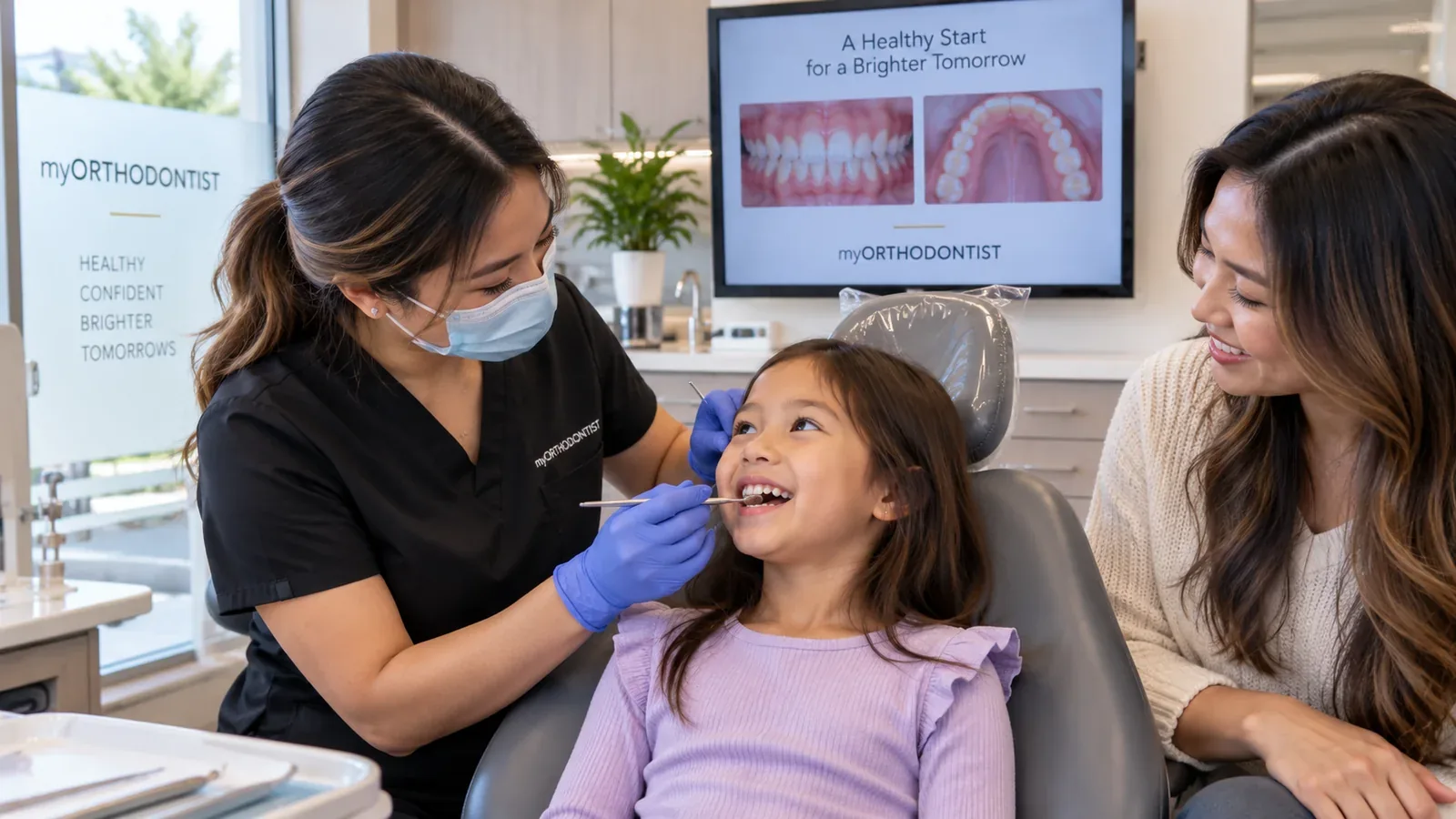
Short, and friendly. We count teeth, look at the bite from the front and the side, watch the child close and open, ask about thumbs and soothers and sleep, and take a panoramic X-ray — which most children find interesting rather than frightening. Then we talk to the parent with the pictures on the screen. There's no impression material, nothing to bite into, and the child usually leaves with a sticker and the impression that the orthodontist's office is a fine place. That matters: a child who starts treatment at ten having already visited twice is a child who isn't scared.
What we might say, and what we won't
"Developing well, see you next year" — most often. "There's a crossbite steering the jaw and I'd like to fix that this year" — sometimes, with the reason shown. "Let's watch this canine on the X-ray and take a small step if it hasn't turned by next year" — sometimes. What we won't say is "everything's fine" without having looked at the jaws, or "start now" without naming what starting now prevents. The indications are the checklist we work from.
First-visit questions
Is seven too early?
No — it's when the growth story becomes readable and several windows are still open. It's rarely too early; it's sometimes too late.
What if my child is nine or ten and hasn't been seen?
Book now. Most windows are still open at ten; fewer at twelve.
Will there be X-rays?
Usually a panoramic X-ray — a quick, low-dose image that shows every tooth including unerupted ones.
Does the visit cost anything?
No. Nor do the monitoring visits that usually follow.
Related reading
- Phase 1 indications — what we're looking for
- Early orthodontics — the hub
- Book a consultation — how to arrange it
The bottom line
Seven is the age at which a specialist can read where a child's bite is heading and still do something about it. The visit is free, short, and usually reassuring. For the minority with a skeletal pattern, it opens a window that closes by twelve. If your child is seven or older and no one has looked specifically at the jaws, book it.
If it were our own seven-year-old
We'd book the look, expect a recall date, and be quietly relieved by it — while knowing that the one time in five it's something else, we'd have caught it years before it was hard.