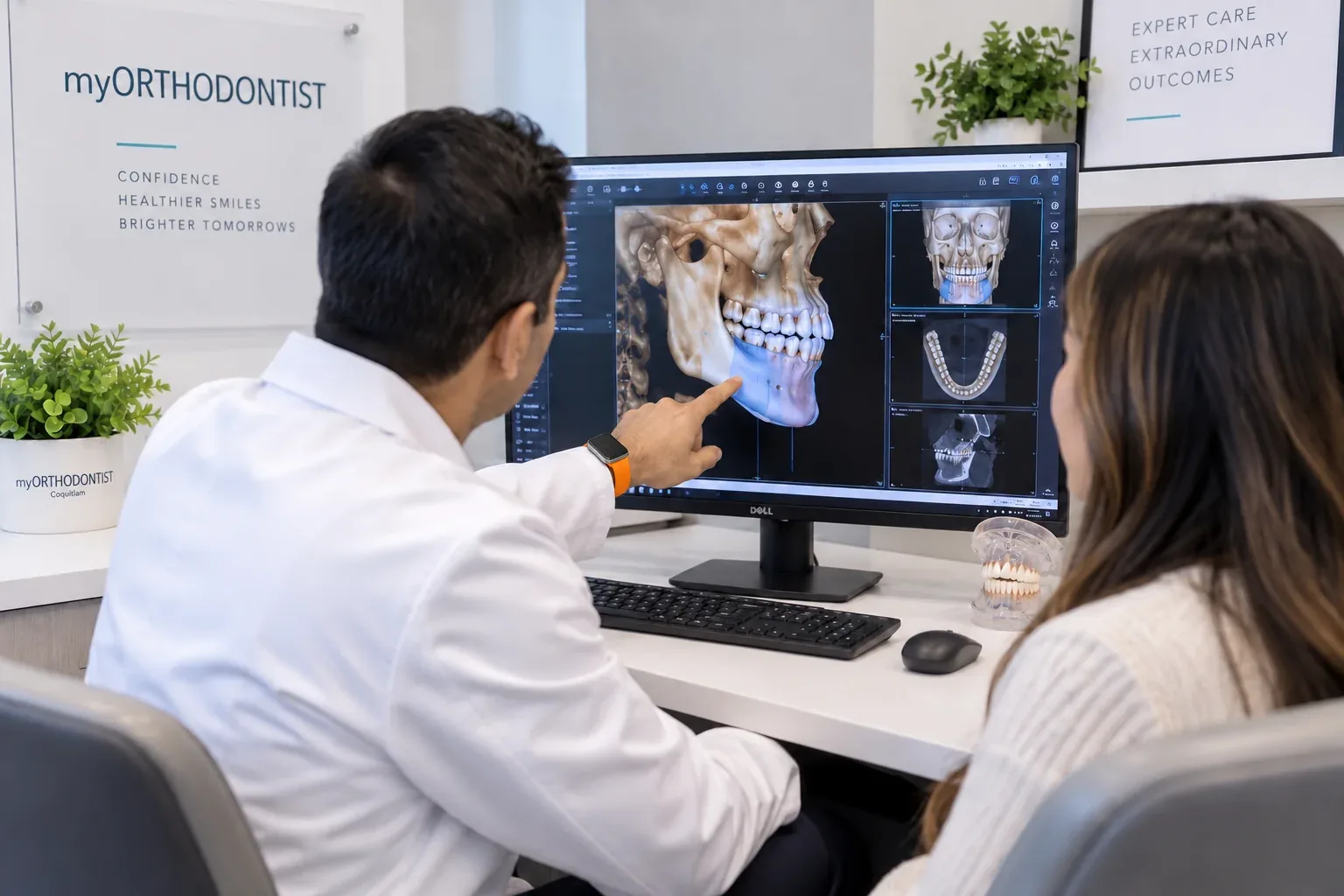
Airway-aware orthodontics starts from a simple observation: jaw size and position shape the space the tongue and airway occupy, and habits like chronic mouth breathing shape jaw growth right back. Screening the two together — rather than treating tooth position in isolation — is the philosophy the myORTHODONTIST network practises and has published on extensively.
What airway-aware screening looks for
- In children: habitual mouth breathing, snoring, restless sleep, dark under-eye circles, narrow high palates, low forward tongue posture, and open-bite patterns — signals that jaw development and breathing may be interacting.
- In adults: narrow arches, tongue scalloping, grinding and disturbed sleep worth flagging — with referral to physicians or sleep specialists when appropriate, since orthodontists screen and coordinate; they don’t diagnose sleep disorders.
How it changes treatment decisions
Sometimes materially: a narrow-palate child with airway flags strengthens the case for expansion during growth; a tongue-posture-driven open bite gets habit and myofunctional support alongside mechanics, or it relapses. Sometimes the answer is that the airway is fine and treatment proceeds conventionally — the lens is diagnostic, not a product upsell.
Keeping the claim honest
“Airway” has become marketing language in some corners of dentistry, so apply this site’s usual standard: ask any provider what specifically they screen, what they found in your case, and what they’d refer out. Concrete answers distinguish a philosophy from a slogan. Our clinic’s specialists screen every consultation this way — and the assessment, as always, is free.
How the screen actually works at our practice
It's a set of questions and a set of observations, not a gadget. We ask about snoring, mouth breathing, restless sleep, morning tiredness, bed-wetting past the usual age, and daytime attention. We look at how the lips rest, how the tongue sits, the width and height of the palate, the position of the lower jaw, and signs of grinding. In children the pattern is often visible in the face itself. When several of those line up, we say so — and we say what we think the orthodontic contribution could be, and what belongs with a physician or ENT instead.
Where orthodontics genuinely helps
A narrow upper jaw widened during growth also widens the floor of the nose and gives the tongue somewhere to rest. A lower jaw sitting back, guided forward during growth, brings the tongue base with it. In the right child, those are meaningful changes to the space air moves through — and they're only available while the child is growing. In adults, the same anatomy is a different conversation, and sleep apnea proper is a medical diagnosis managed by physicians, with orthodontics occasionally part of a surgical plan.
Where it doesn't
Enlarged adenoids and tonsils, allergic congestion, and many causes of snoring are not orthodontic problems, and an appliance won't fix them. We'd rather send a child to an ENT than sell a parent an expander for the wrong reason. The airway relationship is real and it is patient-specific; the honest position is to screen everyone, treat the structural part where it's indicated, and coordinate the rest. Mouth breathing and snoring in kids go deeper.
Airway questions we're asked
Can orthodontics cure sleep apnea?
No. Sleep apnea is a medical diagnosis managed by physicians. Orthodontics can change jaw structure during growth in ways that support breathing, and can be part of a surgical plan in adults — as a contributor, not a cure.
Does expansion help a child breathe?
In a child with a narrow palate, widening it also widens the nasal floor and gives the tongue room; in the right child that's meaningful. In a child whose nose is blocked by adenoids, it isn't the answer.
Should I see a doctor or an orthodontist first?
Your doctor, for snoring and sleep concerns. Then us, for the structural part. We'll coordinate.
Is 'airway orthodontics' a marketing term?
It can be. The test is whether the clinic can tell you specifically what they screened, what they found, and what belongs elsewhere.
Related reading
- Mouth breathing in children — what we screen for
- Snoring in kids — when it isn't normal
- Palatal expansion — the structural piece
The bottom line
Breathing and jaw growth shape each other; we screen every patient; we treat the structural part where it's indicated and refer the rest. Orthodontics is a contributor to airway health in the right child, not a cure for sleep disorders. Ask any clinic what specifically they screened and found — the answer separates a philosophy from a slogan.
Airway questions for any clinic
- What specifically do you screen for, and what did you find in my child?
- Which findings are orthodontic, and which need a physician?
- What would the appliance change about breathing — concretely?
- Who else should be involved, and will you coordinate?
- Would you treat this if breathing weren't a factor?