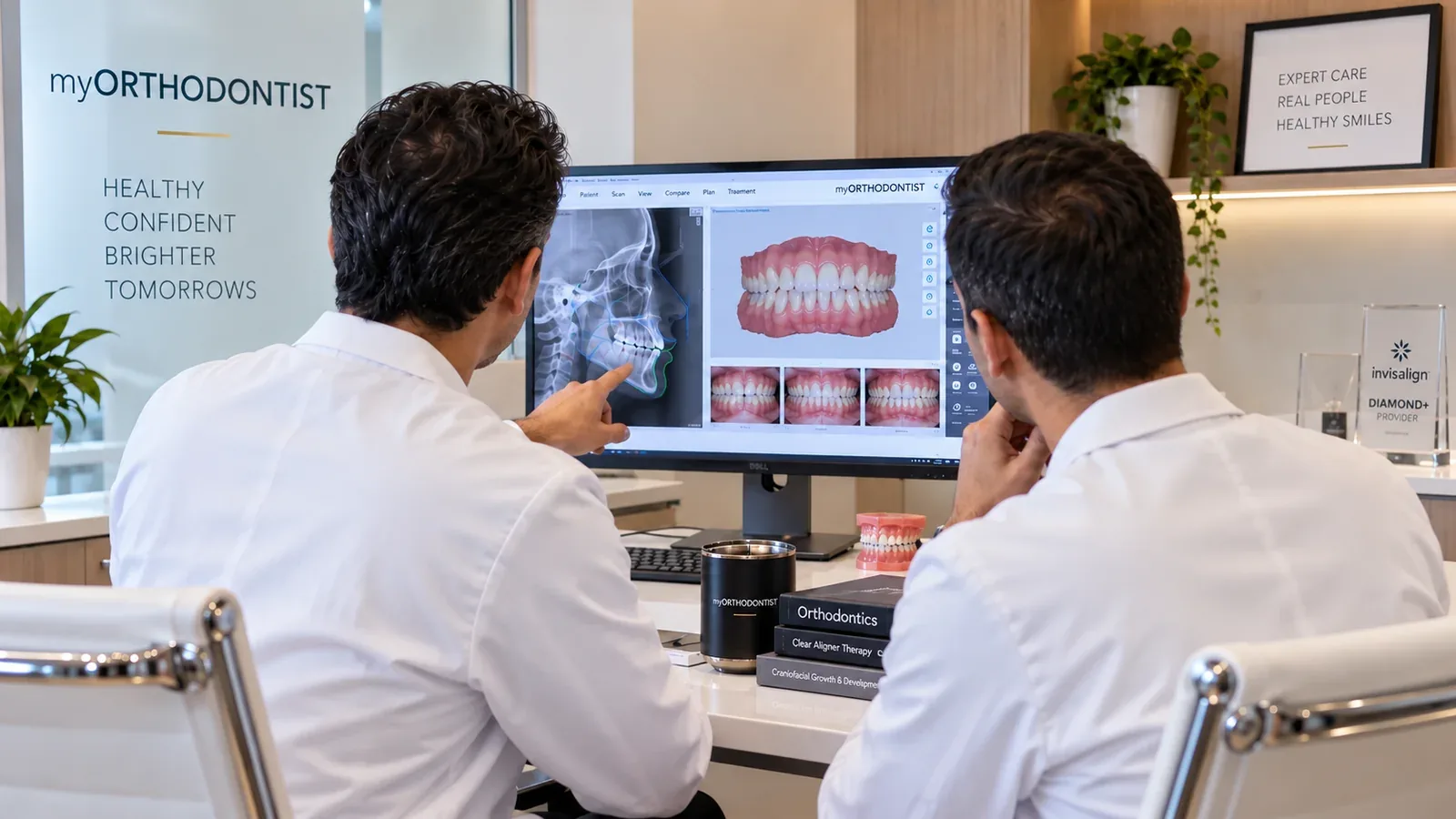
Your general dentist is the quarterback of your oral health — the expert you see for cleanings, fillings, crowns, root canals and extractions, and the person who knows your mouth's history better than anyone. When orthodontic treatment enters the picture, dentists and orthodontists work as a team: your dentist keeps your teeth and gums healthy through treatment, and often spots the orthodontic need in the first place. Many of the best treatment outcomes start with the words "your dentist referred you."
Two kinds of expertise, both essential
A general dentist's training is broad by design — mastery across restorative work, gum health, oral surgery basics and prevention. An orthodontist is a dentist who then chose to narrow: an additional two to three years of accredited full-time residency devoted entirely to diagnosis, facial growth and tooth movement, followed by specialty registration with BCCOHP, and usually a practice limited to orthodontics — which means thousands of cases of accumulated pattern recognition in this one discipline.
Neither path is "better." They're different jobs. You wouldn't ask an orthodontist to do your root canal; the specialist model exists so each professional can go deep on their piece of your care.
Can general dentists provide braces or Invisalign?
Yes — and some do it very well, particularly dentists who've invested seriously in orthodontic training and keep a steady aligner caseload. For genuinely mild adult cases — a little relapse, minor crowding, a healthy bite — treatment with a dentist you already know and trust can be a reasonable, convenient choice.
The honest difference is volume and focus. Most general dentists treat a handful of orthodontic cases a year alongside everything else they do; an orthodontist treats them all day, every day. That depth matters most for children and teens (where growth prediction and timing decisions are the heart of specialty training), for bite corrections that involve jaws rather than just teeth, for borderline calls like extractions and impacted canines, and for the moments when a case goes off-script mid-treatment.
A fair way to decide
- Ask your dentist first. A good GP will tell you honestly whether your case sits within their comfort zone or belongs with a specialist — most refer readily, because the relationship works both ways.
- For kids, teens and bite work, see a specialist. This is what the residency exists for, and your dentist stays fully involved throughout.
- When in doubt, use the free consultation. A specialist assessment costs nothing, takes an hour, and gives both you and your dentist a clear picture. Sometimes the answer is "your dentist can absolutely handle this" — a good specialist says so.
What doesn't change either way
You keep your dentist. Orthodontic treatment runs alongside your regular dental care, never instead of it — cleanings and checkups continue throughout, and your orthodontist and dentist coordinate at the start, during treatment, and at the finish. Our clinic works with referring dentists across the Tri-Cities every day, and treats that partnership as the foundation of good care.
How the partnership works in practice at our clinic
A referral arrives with a note — "crossbite, seven, please assess" — and we book the family directly. After the visit we write back with findings and a plan or a recall date. Through treatment, cleanings and checkups continue at the dentist as normal, and if a cavity or a gum issue turns up we talk to each other about sequencing. At debond we send the retention plan so the dentist can watch the bonded wire at every cleaning. It's unglamorous, and it's the reason the outcomes are good: two professionals who each know what the other is doing.
Frequently asked questions
Can my dentist do Invisalign?
Legally, yes, and many do. For mild adult cases with an experienced dentist, that can be a reasonable choice. For children, bite corrections and complex cases, specialty training matters more.
Will I offend my dentist by seeing an orthodontist?
No. Referral is how the professions are designed to work, and most dentists refer routinely. If yours provides orthodontics, a specialist consult is a second data point — good dentists welcome it.
Do I keep my dentist during braces?
Always. Cleanings continue, and matter more with brackets. We coordinate throughout.
Who do I call if something breaks?
Us, for the orthodontic hardware. Your dentist, for a toothache or a lost filling. We'll sort out anything in between together.
What we owe referring dentists, and what we ask
We owe prompt findings, honest plans, and returned patients — a referral is a trust, not a transfer. We send a note after every referred consultation, at milestones, and at debond with the retention plan. We ask, in return, for the X-rays they've already taken so we don't repeat them, for a heads-up when dental work is planned during treatment, and for a look at the bonded retainer at cleanings for years afterward. It's an unglamorous partnership and it's the reason the outcomes are good.
A closer look: a case that went well because of the partnership
A general dentist in Port Moody noticed a nine-year-old's upper canines weren't where they should be on a routine X-ray and sent the family to us. We confirmed both canines drifting toward impaction, removed the baby canines early, and created a little room. Eighteen months later both adult canines had turned and erupted normally — no surgical exposure, no traction, no year added to the eventual braces. The dentist's routine X-ray, the referral, and the small early intervention did what a complex late correction would otherwise have done. Neither profession could have managed it alone, and neither needed to.
How to have the conversation with your dentist
Ask directly: "Would you refer this, or would you treat it yourself?" A good dentist answers honestly and often volunteers a specialist's name. If your dentist provides orthodontics and recommends treatment, ask whether they'd mind you getting a specialist's read — they won't, and if the case is mild we'll say so and send it back. What you shouldn't feel is caught between two professionals; the system is designed for both to be involved, and it works best when they are.
Before you go
If you don't have a family dentist, find one first — treatment goes better with cleanings alongside. If you do, mention them when you book and we'll coordinate from the first visit. And read what the credential means, which is the fuller answer to who trained for what.
Misconceptions we correct most often
“Orthodontists compete with dentists.”
We depend on them. Referral is how the professions are designed to work.
“My dentist doing Invisalign means they're an orthodontist.”
It means they're a dentist offering aligners — sometimes very well, for suitable cases.
“Seeing a specialist means leaving my dentist.”
Never. Cleanings continue and matter more.
What Coquitlam families search for, answered
“Can a general dentist do braces?”
Legally yes, and some do well, particularly mild adult cases. The specialty residency is what trains the complex ones.
“Do I need a referral from my dentist for an orthodontist in BC?”
No, though your dentist's involvement helps and we coordinate from the first visit.
“Is an orthodontist a doctor?”
An orthodontist is a dentist with two to three further years of accredited specialty training, registered as a specialist. In BC the title is protected.
Deciding who should manage your case
- Ask your dentist first — most refer readily
- Children, teens and bite work: see a specialist
- Mild adult alignment: a dentist you trust can be reasonable
- When in doubt: the specialist consult is free
- Whoever treats, you keep your dentist