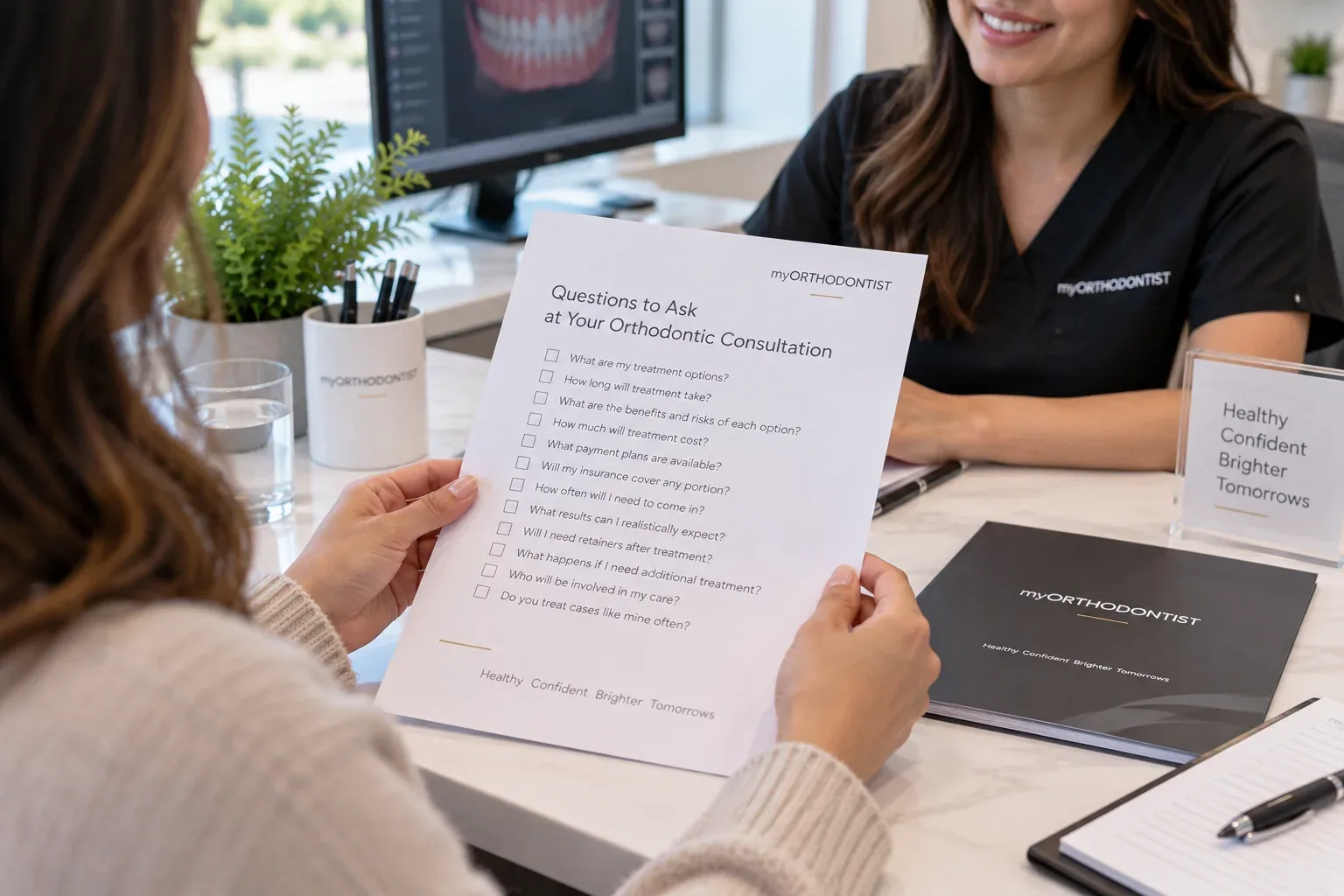
There are eight or more credible orthodontic options within a short drive of Coquitlam Centre, and their websites are hard to tell apart. The differences that matter are not on the surface: who trained for how long, who examines you personally, what the quote leaves out, and whether "not yet" is an answer a clinic is willing to give.
The framework in one paragraph
Confirm the credential. Weigh real experience. Audit the consultation itself — records before opinions, the specialist in the room, every option with its downsides, no signing pressure. Compare quotes on what they contain, never on the headline number. Then weigh logistics honestly, because you'll make this trip fifteen times. Each step has its own guide below, and the twelve questions make the whole audit portable.
A word about your dentist
Your general dentist is the quarterback of your oral health and, very often, the person who first notices an orthodontic need. Many dentists provide orthodontic care themselves and some do it very well; orthodontists bring two to three extra years of specialty residency and full-time focus. How the team works explains when that depth matters most — and why the best outcomes usually start with a dentist's referral.
What the comparison usually comes down to
After hundreds of these conversations, we can tell you where most families actually land. They visit two clinics, sometimes three. The clinics look similar on paper — both certified specialists, both offering braces and aligners, prices within a few hundred dollars. The decision then turns on three things the website never showed them: how thoroughly the first visit examined the child rather than sold to the parent; whether the quote was complete or had gaps; and whether the clinic gave a straight answer when the honest one was inconvenient — "not yet," "braces would be faster," "this is mild, your dentist could do it." We'd rather you weigh us on exactly those three things.
How to use two free consultations well
Book both before attending either, so neither clinic is a foregone conclusion. Bring the same list of questions to each. Ask for the written quote to take home rather than discussing it in the room. Note who examined the patient — the specialist personally, or a coordinator with the specialist appearing for a minute. Then compare the two visits side by side that evening, while both are fresh. The red-flags page gives you the vocabulary for what you noticed; the cost guides let you check what each quote left out.
What we promise on our side of the table
Records before any opinion. The orthodontist — not a coordinator — examines you and explains the findings. Every viable option priced side by side, including the cheaper one, and including "wait." Retainers inside the fee, in writing. No same-day discount, no limited-spots language, no follow-up pressure. If you leave and choose another clinic, we'd like you to leave having learned something useful about your own case — that's the point of publishing all of this.
What "a good orthodontist in Coquitlam" actually means
People search that phrase thousands of times a year, and no search engine can answer it, because "good" depends on whose child, which bite, and what the family values. What can be defined is the floor: a certified specialist, a diagnostic consultation, a complete quote, an honest answer when the honest answer costs the clinic a case. Above that floor, clinics differ in philosophy — how they think about early treatment, how readily they reach for aligners, how they handle borderline extraction cases — and those differences are legitimate. Our aim on this site is to make the floor checkable and the philosophies visible, so the comparison is between real things rather than adjectives.
Frequently asked questions about choosing an orthodontist
How many orthodontists should I consult before deciding?
Two is usually enough if they broadly agree on diagnosis and range. Three if they disagree on something fundamental — extractions, surgery, Phase 1. More than that tends to add anxiety rather than information.
Is a bigger or newer clinic better?
Neither reliably. What matters is who plans your treatment and how long they've been doing it. Ask directly: how long has the person designing my plan been practising, and how many cases like mine?
Should I choose the clinic my dentist recommends?
It's a strong signal — dentists see outcomes from every clinic in the area — but it's still worth a second free consultation. Good dentists expect you to compare.
Does it matter if the orthodontist is a specialist?
For children, teens, bite corrections and borderline cases, we think it matters a great deal: that's what the residency trains. For mild adult alignment, an experienced general dentist can be a reasonable choice. How the team works.
What if two clinics quote very different prices?
Compare contents before concluding anything. A lower fee that excludes retainers, refinements and emergency visits is often the higher fee. What a complete quote includes.
The three philosophies you'll encounter
Most Tri-Cities orthodontic practices fall somewhere along three spectrums, and knowing them helps you read a consultation. Early versus late: some clinics treat almost every child with a first phase; some wait for the full adult dentition regardless; we sit deliberately in between — firmly pro-growth-modification where the pattern is skeletal, firmly against appliances where it isn't. Aligner-forward versus braces-forward: some practices reach for aligners first and braces reluctantly, or the reverse; we carry both and let the movements decide. Extraction-tolerant versus extraction-averse: honest specialists disagree about borderline crowding; our bias is toward creating room during growth so the question arises less often in the teens. None of these positions is wrong. What's wrong is a clinic that can't tell you where it stands.
A note on marketing you'll see
"Top-rated." "Award-winning." "Diamond provider." "Advanced technology." Some of it is true and none of it is a credential. Provider tiers measure aligner volume; awards are often paid listings; every clinic has a scanner. The two things worth verifying are the specialty registration and the consultation itself — and both are free to check. Reading reviews and provider tiers decode the rest.
A closer look: the consultation as a diagnostic instrument
The first hour reveals more than most families realise, if you know what to watch. Does the clinic take records before anyone offers a view, or does a recommendation arrive from a glance in the mirror? Does the orthodontist examine you personally, or appear briefly after a coordinator has done the talking? When you ask about the alternative — braces at an aligner clinic, waiting at a Phase 1 clinic — is it discussed on its merits or dismissed? Is the written quote handed over with an invitation to take it home, or explained verbally with a form to sign? None of these are trick questions; they're simply how a clinic practises, shown to you for free. We'd suggest treating the consultation as the interview it is — for both parties.
Why we think a published standard helps everyone
Referring dentists tell us the hardest part of their job is answering "which orthodontist?" without sounding like a salesperson for a colleague. Parents tell us the hardest part is knowing what a good answer would even sound like. A published set of criteria helps both: the dentist can say "ask these questions," and the parent can recognise the answers. It also disciplines us. Every claim on this site is one a patient could carry into our consultation and check, and knowing that shapes how we practise. We think that's healthy, and we'd be glad if other clinics published their standards too — the families of the Tri-Cities would be better served for it.
Before you go
If you read nothing else in this section, read the twelve questions and the red flags, and take both to two free consultations. Verify the credential on the register. Compare the quotes on contents. Then choose the clinic whose reasoning you could explain to a friend — and if that's not us, we've still done our job.
Misconceptions we correct most often
“The most expensive clinic is the best.”
Price tracks inclusions and overhead, not skill. A complete mid-market quote beats an incomplete premium one.
“A specialist is always better than my dentist.”
For children, bites and complex cases, we think so. For mild adult alignment with an experienced dentist, not necessarily — and we'll say so.
“I should choose the clinic with the newest technology.”
Every credible clinic has the scanner. Choose the diagnosis, not the equipment.
What Coquitlam families search for, answered
“How do I know if an orthodontist is good?”
Verify the registration; ask how long they've practised and how many cases like yours; watch whether the consultation begins with records; read the quote for inclusions; note whether they ever say “not yet.” Five checks, all free.
“Should I go to an orthodontist or my dentist for braces?”
For children, teens, bite corrections and complex cases, a specialist; for mild adult alignment, an experienced dentist can be reasonable. Your dentist will usually tell you honestly which yours is.
“Orthodontist consultation — what to ask?”
Twelve questions, published on this site with our own answers. The one that matters most: what exactly does the fee include?
The five-step shortlist test
- BCCOHP specialist registration confirmed
- Experience and case volume asked about directly
- Consultation was diagnostic, not a sales pitch
- Quotes compared on contents, not price
- Logistics work for 18–24 months of visits