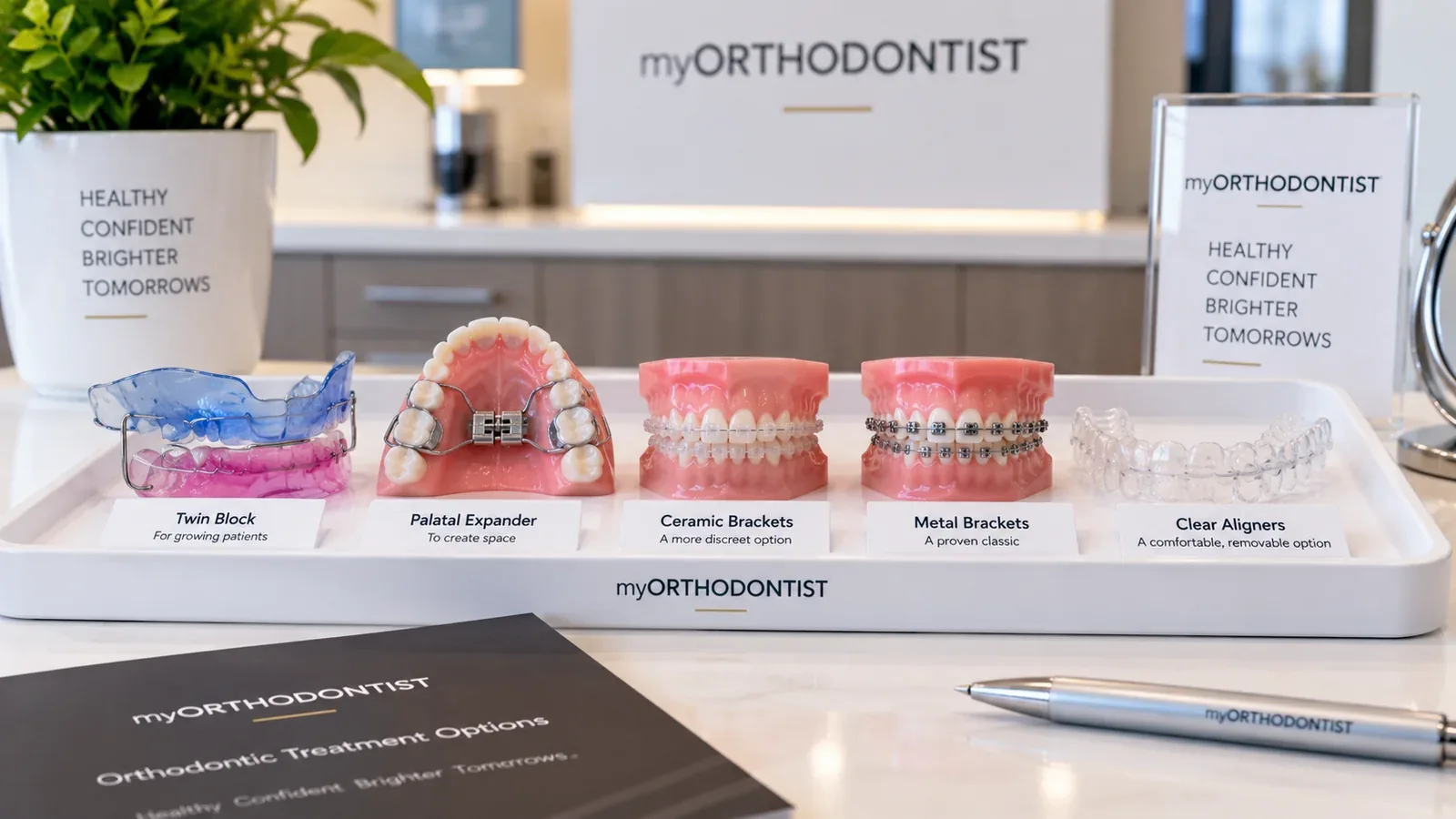
Orthodontics carries a vocabulary that clinics use fluently and patients rarely hear twice. Here are the terms most likely to appear in your consultation or written plan.
Appliances & hardware
- Bracket — the small attachment bonded to each tooth that holds the wire.
- Archwire — the wire connecting brackets; it supplies the force that moves teeth.
- Ligature / colour tie — the tiny elastic ring holding the wire into a bracket (the colours kids choose).
- Self-ligating bracket — a bracket with a built-in clip instead of an elastic tie.
- Attachment — a small tooth-coloured bump bonded to a tooth so clear aligners can grip it.
- Elastics — rubber bands worn between arches to correct bite relationships.
- Palatal expander — an appliance that widens a narrow upper jaw during growth.
- Retainer — the removable or bonded appliance that holds teeth after treatment.
Diagnosis terms
- Malocclusion — literally "bad bite"; the umbrella term for any misalignment.
- Overbite — how far upper front teeth vertically overlap the lower ones.
- Overjet — how far upper front teeth sit forward horizontally.
- Crossbite — upper teeth biting inside the lowers (why timing matters).
- Open bite — front teeth that don't meet when the back teeth close.
- Crowding / spacing — too little or too much room in the arch.
- Impaction — a tooth stuck in the bone, classically the upper canine.
- Midline — the centreline between the front teeth; specialists check upper against lower.
Treatment & process
- Records — the photos, X-rays and scans that a real diagnosis requires.
- Panoramic X-ray (OPG) — the single wide image showing all teeth, roots and jaws.
- Cephalometric X-ray — the side-profile X-ray used to measure jaw relationships.
- Bonding / debonding — putting braces on, and taking them off.
- IPR (interproximal reduction) — polishing fractions of a millimetre between teeth to create space.
- Refinement — an additional series of aligners to finish a case precisely.
- Phase 1 / Phase 2 — early childhood treatment, then comprehensive treatment in the teens.
- Relapse — teeth drifting back after treatment; what retention prevents.
Credentials
- Certified Specialist in Orthodontics — a dentist with 2–3 further years of accredited residency, registered as a specialist with BCCOHP (how to verify).
- Provider tier — a manufacturer's case-volume ranking (Bronze to Diamond, plus Sapphire); not a training credential.
Hearing a term that isn't here? Ask the clinic to define it on the spot — a specialist who can't explain their own vocabulary in plain English is telling you something useful.
Terms we use at our practice that you may hear elsewhere too
- Twin block — a two-piece removable appliance that guides a growing lower jaw forward; our workhorse for the retruded-jaw pattern (explained).
- Invisalign First — the aligner system for mixed dentition, used for early treatment in six-to-ten-year-olds (explained).
- Mandibular advancement — Invisalign aligners with precision wings that guide a growing lower jaw forward while aligning teeth (explained).
- Growth modification — treatment during growth that changes how the jaws develop, as distinct from moving teeth within finished jaws.
- Camouflage — moving teeth to disguise a jaw mismatch rather than correcting the jaws.
- Orthognathic surgery — surgical repositioning of the jaws, combined with orthodontics (explained).
- Functional appliance — any appliance that uses the child's own muscles and growth to reposition the jaws.
- Anchorage — what a tooth movement pushes against; sometimes temporary mini-implants provide it.
- Direct billing — the clinic claims from your insurer so you pay only your share.
- Lifetime maximum — the total an insurer will ever pay toward one person's orthodontics; it never resets.
Why we defined them
Because a treatment plan you can't read is a treatment plan you can't evaluate, and we'd rather you evaluated it. If a term in your written plan — from us or anyone — isn't here or isn't clear, ask for it in plain English. We'll add it to this page.
Glossary questions
What does 'Class II' or 'Class III' mean?
Class II: the lower jaw or teeth sit behind the uppers (overjet pattern). Class III: they sit ahead (underbite pattern). Class I is a normal relationship.
What is 'interproximal reduction'?
Polishing a fraction of a millimetre from between teeth to create space — routine and conservative when used judiciously.
What does 'anchorage' mean in my plan?
What the tooth movement pushes against; sometimes small temporary implants provide it.
What is a 'refinement'?
An additional aligner series to finish a case precisely. Most cases need one; ours are included.
Related reading
- Conditions — the patterns these terms describe
- Your first visit — where you'll hear them
- FAQs — more plain-language answers
The bottom line
If you can read your treatment plan, you can evaluate it — and evaluate ours. Every term on this page appears somewhere on this site with its full explanation; every term that isn't here yet will be, once a patient asks. Ask.