“Overbite” covers two related patterns: a deep bite (upper front teeth overlapping the lowers too far vertically) and overjet (upper teeth angled forward horizontally). Both wear teeth unevenly, can strain the jaw, and in children carry real trauma risk to prominent front teeth.
The options, honestly compared
- Braces — the benchmark for significant vertical correction; bite-opening mechanics are fixed appliances’ home turf.
- Invisalign — handles mild-to-moderate deep bites well with precision bite ramps; severe vertical cases remain harder for plastic.
- Growth-guidance appliances — for children and young teens with large overjets, functional appliances harness growth to bring the bite together, often before or alongside braces.
- Timing itself — in growing kids, treating a prominent overjet earlier can cut trauma risk; in adults, correction is mechanical rather than growth-assisted but works at any age.
How a specialist decides
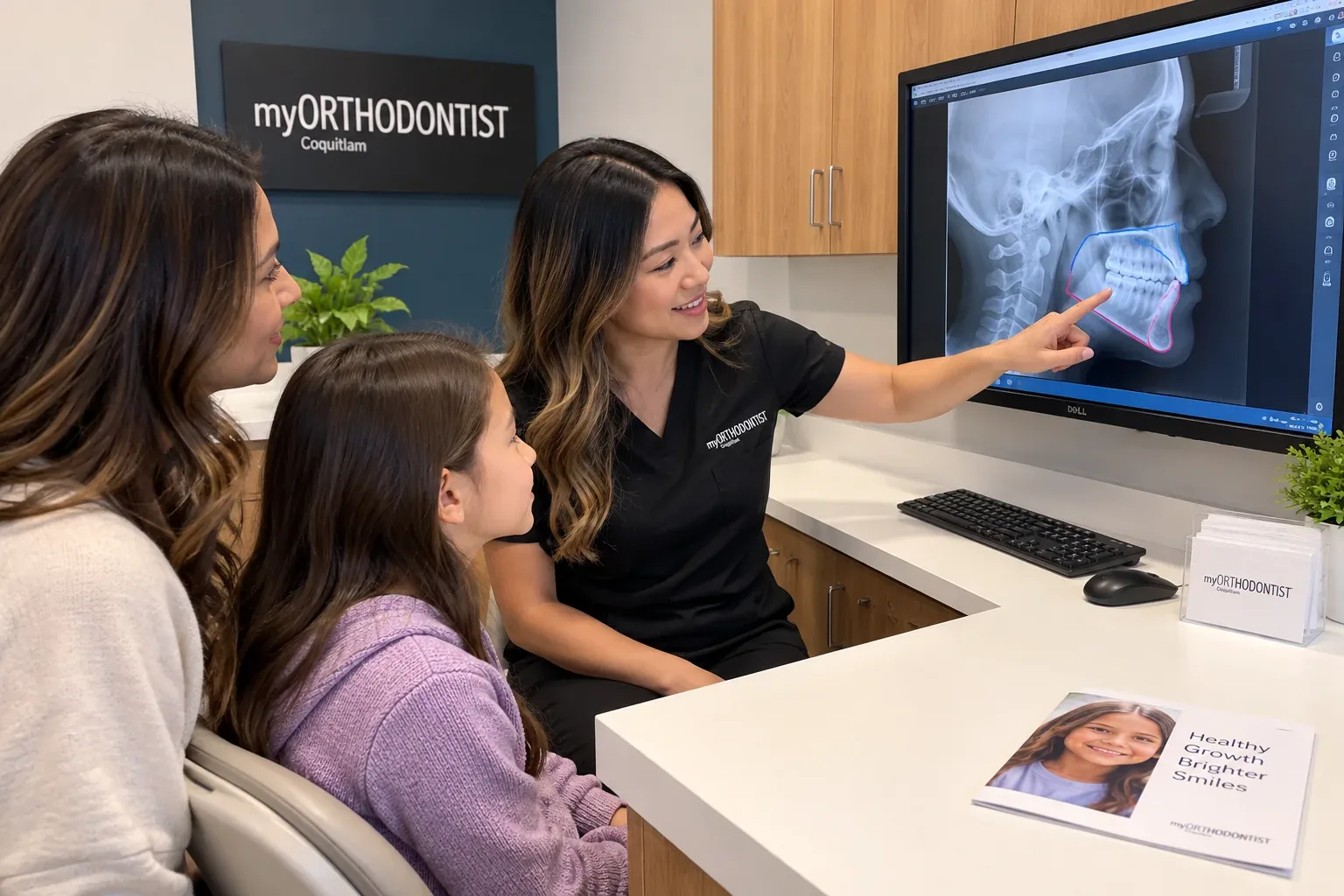
The call rests on how much of the overbite is dental (tooth angulation) versus skeletal (jaw relationship), how much growth remains, and the vertical pattern of the face — exactly what consultation records reveal. Ask any provider to show you the measurement on your own X-ray and explain which category you fall into; the quality of that explanation is itself a provider signal (see the 12 questions).
Costs sit inside the standard comprehensive ranges in the cost guide. A free specialist consultation puts a written number and option comparison on your specific case.
How we sort out which kind you have
A profile X-ray tells us most of it: whether the lower jaw sits back, whether the upper teeth are flared forward, how the vertical proportions of the face are built. Then a clinical look at where the lower lip sits, whether the front teeth touch the palate, and how the back teeth meet. A deep bite with a well-positioned lower jaw is largely a tooth problem — braces or aligners with bite-opening mechanics. A large overjet with a retruded lower jaw is a jaw problem, and in a growing child that's a twin block conversation before it's a braces conversation.
The aligner route for growing teens
For an eleven-to-fourteen-year-old with a mild-to-moderate skeletal overjet, Invisalign with mandibular advancement guides the lower jaw forward and aligns the teeth in one continuous treatment. We recommend it for suitable cases; for younger children and larger corrections, the twin block remains our first tool.
Why we treat the jaw version early
Because it's the clearest example of what growth modification can do. A ten-year-old with a small lower jaw and prominent upper teeth can have that jaw guided forward during growth, closing the overjet and — not incidentally — bringing the tongue base forward and reducing the trauma risk to teeth that stick out. The same child at twenty has the same jaw and only two options: camouflage the discrepancy by tipping teeth, or reposition the jaw surgically. We'd rather have the growth conversation at nine.
What to expect from treatment
Deep bites open steadily over the first year of treatment and are among the more satisfying corrections to watch; overjets close as the bite relationship changes, often with elastics in the later months. Retention for both is the usual nightly routine, and deep bites in particular like to creep back if it's skipped. Costs sit in the standard comprehensive ranges; a Phase 1 twin block, where indicated, has its own fee and rationale.
Overbite questions we're asked
Can an overbite be fixed without braces?
Mild dental deep bites can be treated with aligners using bite ramps. Skeletal overjets in growing children are treated with a twin block before braces; in adults, without braces, the options are camouflage or surgery — so 'without braces' usually means 'with aligners' for mild cases only.
Does an overbite get worse with age?
A deep bite can deepen as teeth wear and drift; an overjet from a small lower jaw stays roughly fixed after growth. Neither self-corrects.
Is an overbite dangerous?
Rarely, but a deep bite can wear the lower incisors and irritate the palate, and a large overjet in a child roughly doubles the risk of fracturing a front tooth in a fall.
How long does overbite correction take?
Twelve to twenty months in braces or aligners for dental cases; a nine-to-twelve-month twin block phase plus a later comprehensive phase for skeletal cases in children.
Related reading
- The twin block — how we guide a retruded lower jaw during growth
- Invisalign for overbite — what aligners can and can't do for a deep bite
- Braces cost — what overbite correction costs, with retainers included
The bottom line
Decide first whether it's the teeth or the jaw — the profile X-ray tells. A dental deep bite corrects with braces or aligners at any age. A skeletal overjet in a growing child is a twin block conversation, and one of the best uses of early treatment we know. In an adult, camouflage or surgery, honestly weighed. Retention matters because deep bites creep back.
Overbite consultation checklist
- Deep bite or overjet — which, and how much (mm)?
- Dental or skeletal — shown on the profile X-ray
- For a child: is growth guidance indicated now?
- For an adult: camouflage or surgical — and why
- Retention plan, since deep bites relapse