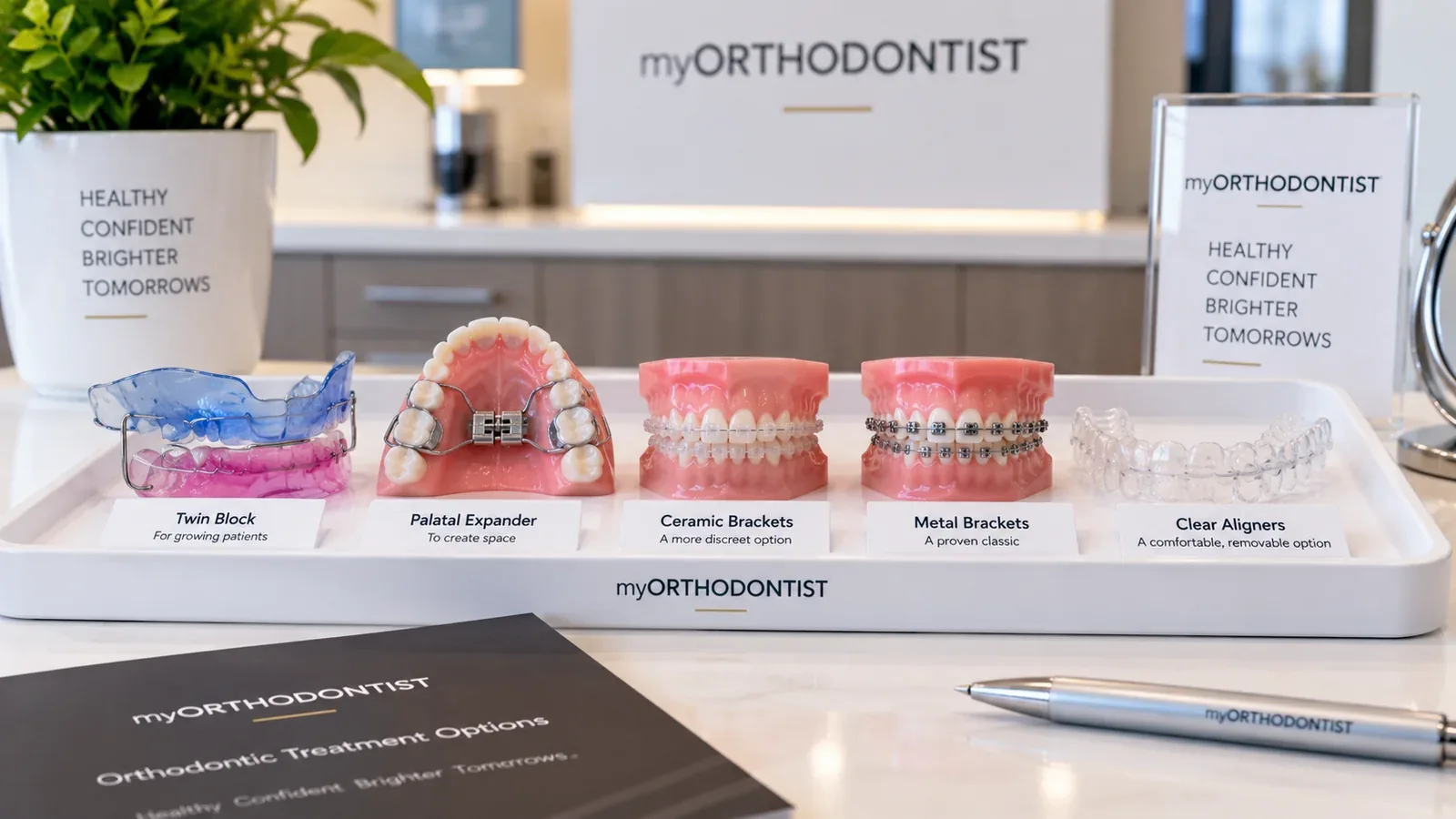
Braces apply light, continuous force through brackets and archwires to move teeth and guide bites into alignment. Modern systems are smaller, more comfortable and more efficient than what today’s parents wore — and for complex bite correction, they remain the gold standard against which aligners are measured.
Types available in Coquitlam
- Metal braces — the workhorse: strongest, most precise, lowest cost, and the usual choice for children and complex cases.
- Ceramic (clear) braces — tooth-coloured brackets with the same mechanics; discreet for teens and adults, slightly more fragile.
- Self-ligating systems — clip-based brackets that can reduce friction and adjustment frequency in some cases.
What braces do better than aligners
Significant bite correction, rotating rounded teeth, closing extraction spaces, and vertical movements are generally more predictable with fixed appliances. They also remove the compliance variable entirely — braces work 24 hours a day whether or not a teenager remembers them. The honest comparison for your specific case is exactly what a specialist consultation is for.
Timeline and what to expect
Most comprehensive cases run 12–30 months: bonding day (about 90 minutes, painless), an adjustment cycle every 6–8 weeks, a few days of pressure-soreness after each visit, and a retention phase after removal. Our patient resources cover eating, cleaning and handling loose brackets.
Before choosing a braces provider, verify
- Specialist designs and supervises the plan
- Quote includes ALL adjustments and retainers
- Emergency visits (poking wires) included
- Both metal and ceramic offered with honest pricing
- Estimated timeline given in writing
Cost in Coquitlam typically falls between $6,000 and $9,000 for comprehensive treatment — our braces cost guide breaks down what drives the range and what should be included.
How we fit braces at our practice
Bonding takes about ninety minutes and doesn't hurt. We place each bracket by hand at a position the plan specifies — the precision here is most of the treatment — tie in a light first wire, and spend the last twenty minutes on the things that make the next two years easier: how to brush around the hardware, where the wax goes, what to eat this week, and how to reach us if something pokes. Adjustments follow every six to eight weeks. Somewhere around month four, other people notice. Somewhere around month eighteen or twenty, we start talking about retainers.
Metal, ceramic, or a mix
Metal brackets are the value choice and the strongest; children love the colour ties. Ceramic brackets are tooth-coloured and nearly invisible at conversation distance, with a modest premium and one care note — the elastic ties can stain with coffee and curry, though they're replaced at every visit. Many of our teen and adult patients run ceramic on the upper front teeth and metal on the rest, which captures most of the discretion for a fraction of the cost. We'll offer the mix rather than assume.
What braces do that aligners don't
They work regardless of willpower — bonded on, twenty-four hours a day — which for many teenagers is the more respectful design. They handle the movements plastic struggles with: large bite corrections, rotations of round teeth, closing extraction spaces, guiding an impacted canine into place. And they are, more often than aligner marketing suggests, the faster route for a complex case. The honest comparison for your case is on Invisalign or braces; the honest fee is on braces cost.
Frequently asked questions about braces in Coquitlam
How much do braces cost in Coquitlam?
At our practice, typically $6,000–$8,500 for comprehensive treatment, in writing, with retainers and all visits included. The full breakdown.
How long do braces take?
Twelve to thirty months depending on the case; a range at the consultation, a firm estimate once the plan is designed.
Can adults get braces?
Yes, and many do — often ceramic on the upper front teeth with metal elsewhere. Adult orthodontics.
What can't you eat with braces?
Hard, sticky and chewy foods — popcorn, hard candy, caramel, ice. Everything else, cut rather than bitten. We'll give you the list at bonding.
Do you offer clear braces?
Yes — ceramic brackets, usually on the upper front teeth where they matter most. Ceramic braces.
Are braces or Invisalign better for teenagers?
It depends on the case and, honestly, on the teenager. Braces work regardless of willpower; aligners need 22 hours a day. How we decide with families.
What the appointments are like
Bonding: about ninety minutes, reclined, painless, with a lot of explaining at the end. Adjustments: fifteen to twenty-five minutes every six to eight weeks — a wire change, sometimes a new elastic pattern, colours if you want them. Emergency visits: ten minutes to clip a wire or re-bond a bracket, usually same or next day. Debond: an hour of satisfying scraping and polishing, then the mirror. Retention checks: quick, through the first year, included. We hold after-school and Saturday slots for adjustments because that's when school-age patients need them.
Braces and your dentist
Cleanings continue every six months through treatment — more important, not less, with brackets to clean around. We'll send your dentist the plan at the start and the retention plan at the end, and if a cavity turns up mid-treatment we'll coordinate the sequence with them directly. Your dentist quarterbacks your oral health; we handle the tooth movement.
A closer look: what the wire is doing
The first wires are thin, flexible nickel-titanium alloys that exert a light, continuous force as they straighten out of the crooked path the brackets impose on them — this is the alignment phase, when crowding unravels and other people start to notice. Later wires are stiffer stainless steel, holding the aligned teeth as a unit while elastics, hooks and bends correct the bite. The final wires carry small detailing bends, fractions of a millimetre, that settle each tooth into its finished position. The sequence is planned at the start and adjusted as the teeth respond; the six-to-eight-week interval is the rhythm at which bone remodels enough to take the next step.
Why we still lean on braces for teenagers
Not out of habit. Because a fixed appliance is the only orthodontic tool that works while a fourteen-year-old is asleep, at practice, at a sleepover and mid-exam without anyone remembering it — and because the movements teenage bites most often need are the ones braces make best. We fit aligners for teenagers who'll wear them and we're honest about which teenagers those are. For the rest, braces are the kinder design, and colours at every visit make them a smaller imposition than parents remember from their own childhood.
Before you go
Read Invisalign or braces to see how we'd decide for your case, then braces cost for the fee and everything inside it. Then book the free consultation and see the plan on your own records.
Misconceptions we correct most often
“Braces hurt for months.”
A sore week at the start and a tender few days after adjustments. The rest is background.
“Metal braces are bigger and uglier than they used to be.”
They're a fraction of the size, and the colours are the fun part for children.
“You can't play sports or instruments with braces.”
Both continue — a guard for contact sports, a fortnight's adaptation for brass.
What Coquitlam families search for, answered
“Do braces hurt to get put on?”
No. The bonding is painless; the soreness comes six to twelve hours later and lasts two to four days.
“Can you get braces on the top teeth only?”
Sometimes, for limited cases — a crossbite of one tooth, protruding incisors in a child. Comprehensive cases treat both arches because the bite has to meet.
“How long do braces take for adults vs teens?”
About the same for the same problem — twelve to twenty-four months comprehensive, six to twelve limited. Adults comply better; teenagers have growth to help with bites.