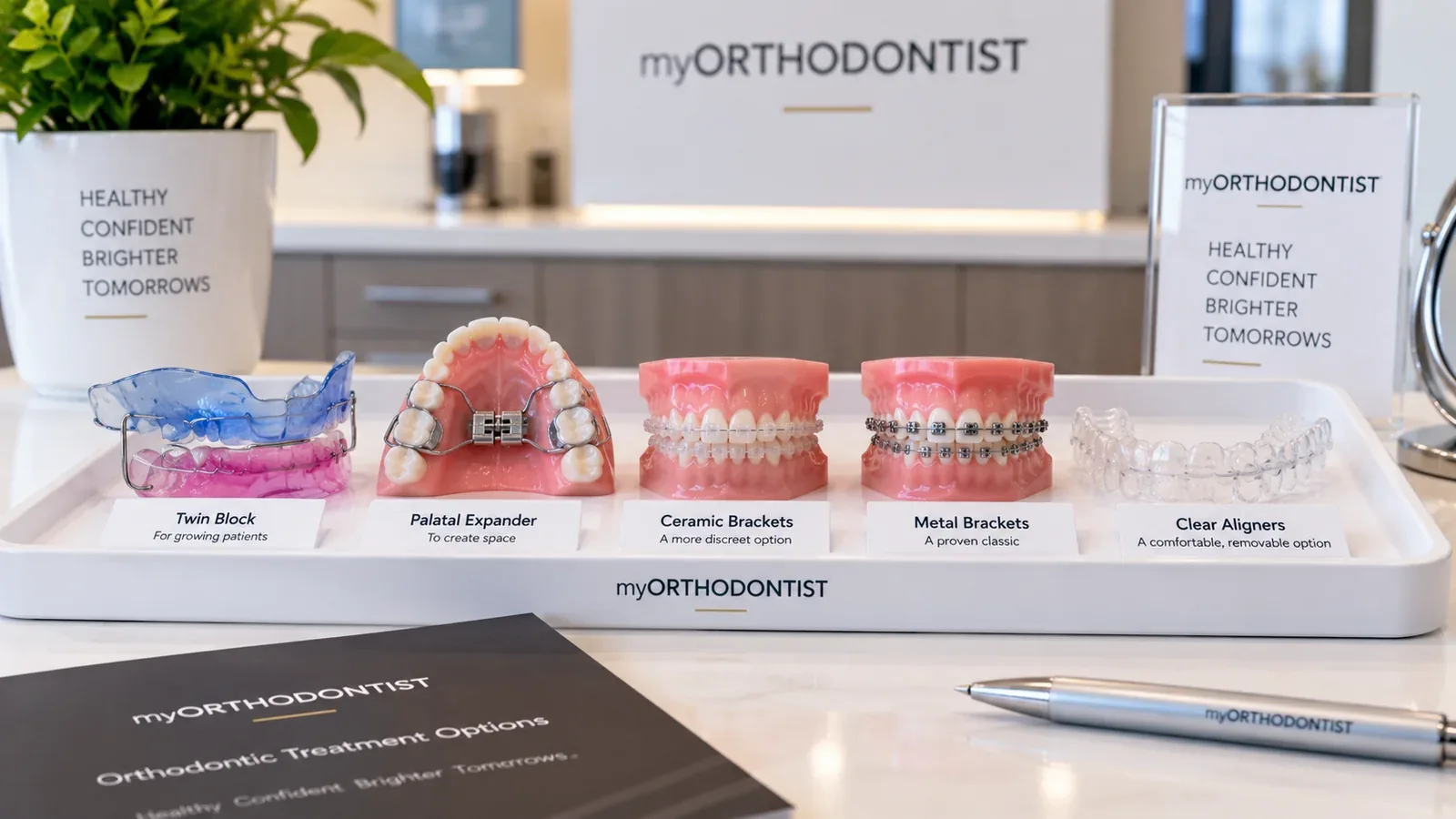
The choice isn't about which appliance is better; it's about which one fits the movements your case needs and the way you actually live. Four questions decide almost every case.
1. What has to move, and how?
Crowding, spacing and mild-to-moderate bite issues: either works, and aligners often win on comfort. Large bite corrections, severe rotations, vertical movements, extraction-space closure: braces are more predictable, and a hybrid (a short braces phase, then trays) is a common honest answer. Read the condition pages for your diagnosis.
2. Will the trays be worn?
Twenty to twenty-two hours a day, every day. Adults usually manage. Teenagers vary, and a stalled aligner case is worse than braces would have been. This is a frank family conversation, and we'll have it with you.
3. What does appearance cost you?
If invisibility genuinely matters — work, grad photos, confidence — aligners or ceramic braces earn their premium. If it doesn't, metal braces are the value choice and nothing to apologise for.
4. Time and money
For your case specifically, which is faster, and what does each cost with retainers and refinements included? We'll give both numbers in writing at the consultation, not one number and a nudge.
Quick self-test
- Complex bite or rotations → braces or hybrid
- Honest doubt about 22-hour wear → braces
- Invisibility is the top priority, case suits → aligners
- Value is the top priority → metal braces
- Not sure → free consultation, records, both quotes
Whatever the answer, insist on seeing both options priced side by side. A clinic that offers only one will recommend that one; it's not dishonesty, just inventory. We carry both so the case can decide.
Cases where we'd steer you, and why
A fourteen-year-old with a large overjet and elastics ahead: braces, because compliance-proof bite correction beats elastics-plus-trays in most teenage mouths. A forty-year-old professional with lower crowding and a healthy bite: aligners, because the case suits plastic and the invisibility is worth it to them. A twelve-year-old with rotated premolars: braces, because round teeth resist trays. A thirty-year-old with a small midline gap: a limited aligner case, priced as one. A teenager whose parent visibly doubts the twenty-two hours: braces, kindly. These aren't rules; they're the patterns behind most of our recommendations.
Two aligner options people don't know exist
Invisalign First brings early treatment into aligners for six-to-ten-year-olds, and Invisalign with mandibular advancement guides a growing teen's lower jaw forward while aligning the teeth. Both change the braces-or-aligners calculation for growing patients, and we recommend both where the records support them.
The hybrid option people don't know to ask about
Some cases are best done in two appliances: a few months of braces to make the movements plastic struggles with, then aligners to finish. It costs a little more in appliances and saves a great deal in refinements, and for an image-conscious patient with a complex case it's often the honest best answer. We'll raise it when it fits. Whatever we recommend, you'll see both options priced side by side — the whole point of carrying both.
Decision questions
Which is better for a teenager?
Whichever they'll actually use. Braces work regardless; aligners need 22 hours. We ask the teen directly.
Which is cheaper?
Overlapping ranges. Limited aligner cases can be cheaper; complex aligner cases can cost more. We price both.
Can I start with aligners and switch?
Yes, and we plan hybrids deliberately for some cases.
Which is more comfortable?
Aligners, generally — no wires. Braces have a sore week and occasional poking; aligners have pressure days.
Related reading
- Braces — what they do best
- Invisalign — what aligners do best
- Invisalign for teens — the compliance conversation
The bottom line
Let the movements and the wear-time decide, not the marketing. Complex bites and rotations lean braces; mild-to-moderate cases in compliant patients lean aligners; a doubtful teenager leans braces, kindly; and some cases are best done in both. At a practice that fits both, you'll see the two options priced side by side and the reasoning for the recommendation. That's what to ask for anywhere.
If it were our own case
We'd ask to see both options priced side by side and the movements explained, and we'd take the recommendation from the clinic that fits both — because a clinic that only fits one has already decided.