Phase 1 exists to change something that will be harder or impossible to change later. That's the test for every sign below: does treating it now prevent a worse problem, or does it just start the clock early?
Signs that usually warrant early treatment
- A crossbite with a jaw shift — upper teeth biting inside the lowers and the jaw sliding to one side on closure. Left alone, the asymmetry can become permanent.
- A narrow upper jaw — especially with crowding or breathing concerns; expansion is time-limited.
- Lower jaw sitting well back — prominent upper front teeth, weak chin, lips that don't meet easily. The twin block window is during growth.
- An underbite — lower teeth ahead of the uppers; the most time-sensitive pattern of all.
- Severe crowding — where creating room now changes the odds of extractions later.
- A canine drifting off course on the X-ray — a small move now can prevent impaction.
- Protruding front teeth at trauma risk — a fall at nine can cost a front tooth.
- Persistent habits — thumb or soother past five or six, reshaping the bite (more here).
- Airway red flags — chronic mouth breathing, snoring, restless sleep.
What early treatment looks like today
For many of these indications the appliance is now clear plastic: Invisalign First handles arch development, dental crossbites and habit-related changes in children who'll wear the trays, and we recommend it for those cases. Larger skeletal corrections still call for a twin block or an expander.
Signs that usually just need watching
Mild crowding of the lower front teeth, small gaps, baby teeth that look crooked, a slightly deep bite with a normal jaw relationship. These are common, they often improve as the jaws grow, and treating them at eight rarely changes the outcome at thirteen. Free monitoring visits are the right plan.
How we decide
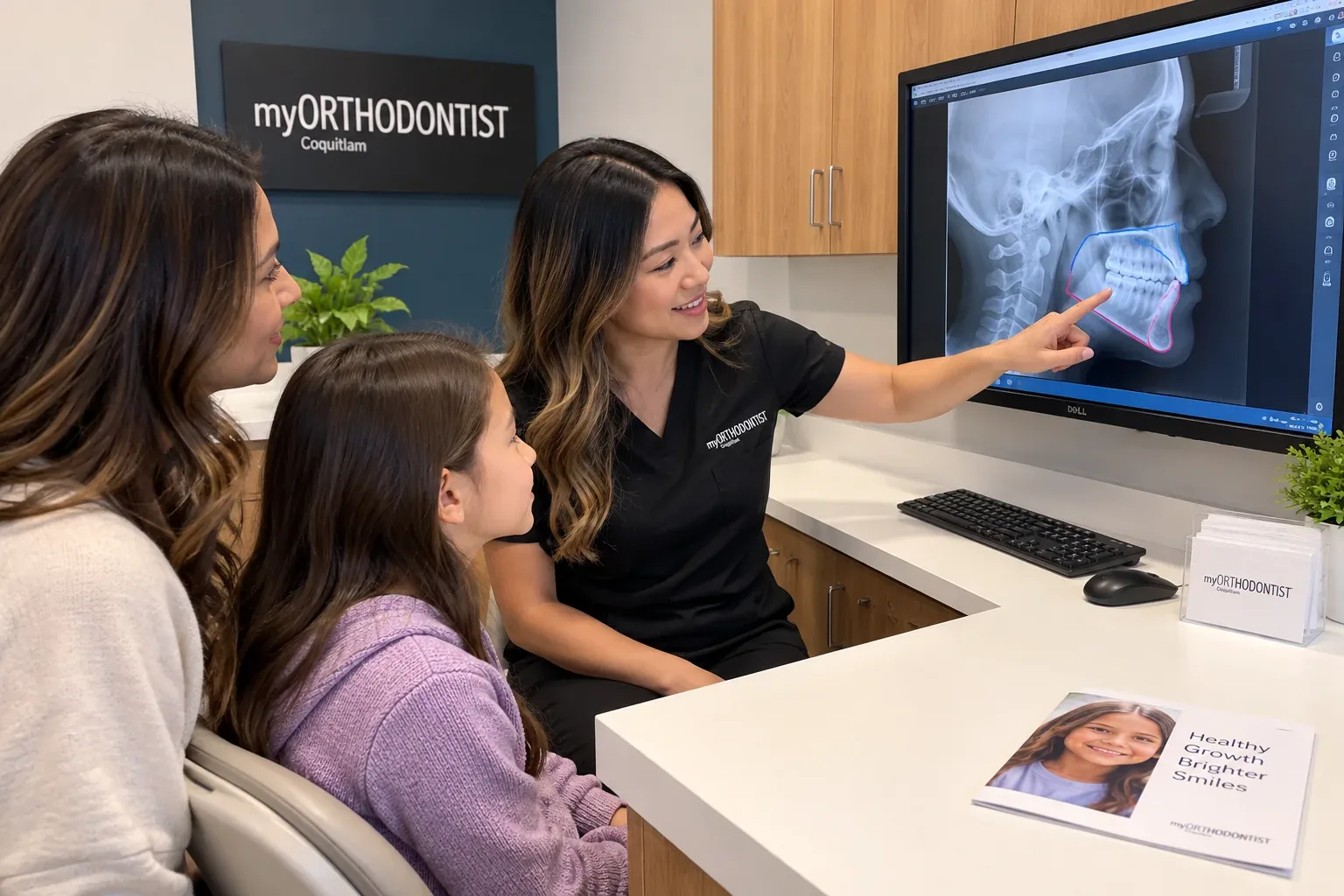
Records — a look, a panoramic X-ray, usually a profile X-ray. We'll show you which pattern we see and name what Phase 1 would prevent. If we can't name it, we shouldn't be recommending it. The growth-modification philosophy behind this is worth reading first.
How we show you the sign, not just name it
A crossbite shift is visible in the mirror when the child closes: we'll point it out. A narrow arch is a measurement on the scan: we'll show you the number. A lower jaw sitting back is a relationship on the profile X-ray: we'll trace it. A drifting canine is a shape on the panoramic film: we'll circle it. The test of any Phase 1 recommendation, ours included, is whether the clinician can put a finger on the record and say "this — and here's what it becomes if we wait."
If your child has none of these
Then the visit was still worth it: you know, on evidence, that the jaws are developing well, and you have a baseline and a recall date. We'll see your child again in a year at no charge, and again the year after, and the comprehensive conversation happens when the adult teeth are in. Most of the children we assess at seven are in this group, and we're glad to say so. What the visit involves; what Phase 1 costs when it is indicated.
Phase 1 questions
My dentist said to wait until all the adult teeth are in. Is that wrong?
For many children it's fine. For the skeletal patterns listed above, it can mean missing a window. If you recognise one, a free specialist look settles it — and we'll send findings to your dentist.
How long does Phase 1 take?
Nine to fifteen months of active treatment, then a rest phase with a retainer.
Will my child need braces later anyway?
Usually a second phase, yes — typically shorter and simpler for the work done early.
What if we do nothing?
For mild patterns, nothing much. For skeletal ones, the pattern grows in and the later fix is longer, more complex, or surgical.
Related reading
- Why age seven — what the first visit involves
- Growth modification — what Phase 1 is for
- Phase 1 costs — the money side
The bottom line
Early treatment is powerful for the specific patterns above and unnecessary for most children. The test of any Phase 1 recommendation — ours included — is whether the clinician can point to the record and name what treating now prevents. If they can, it's worth it. If they can't, it's a second invoice. The free assessment sorts your child into one group or the other on evidence.