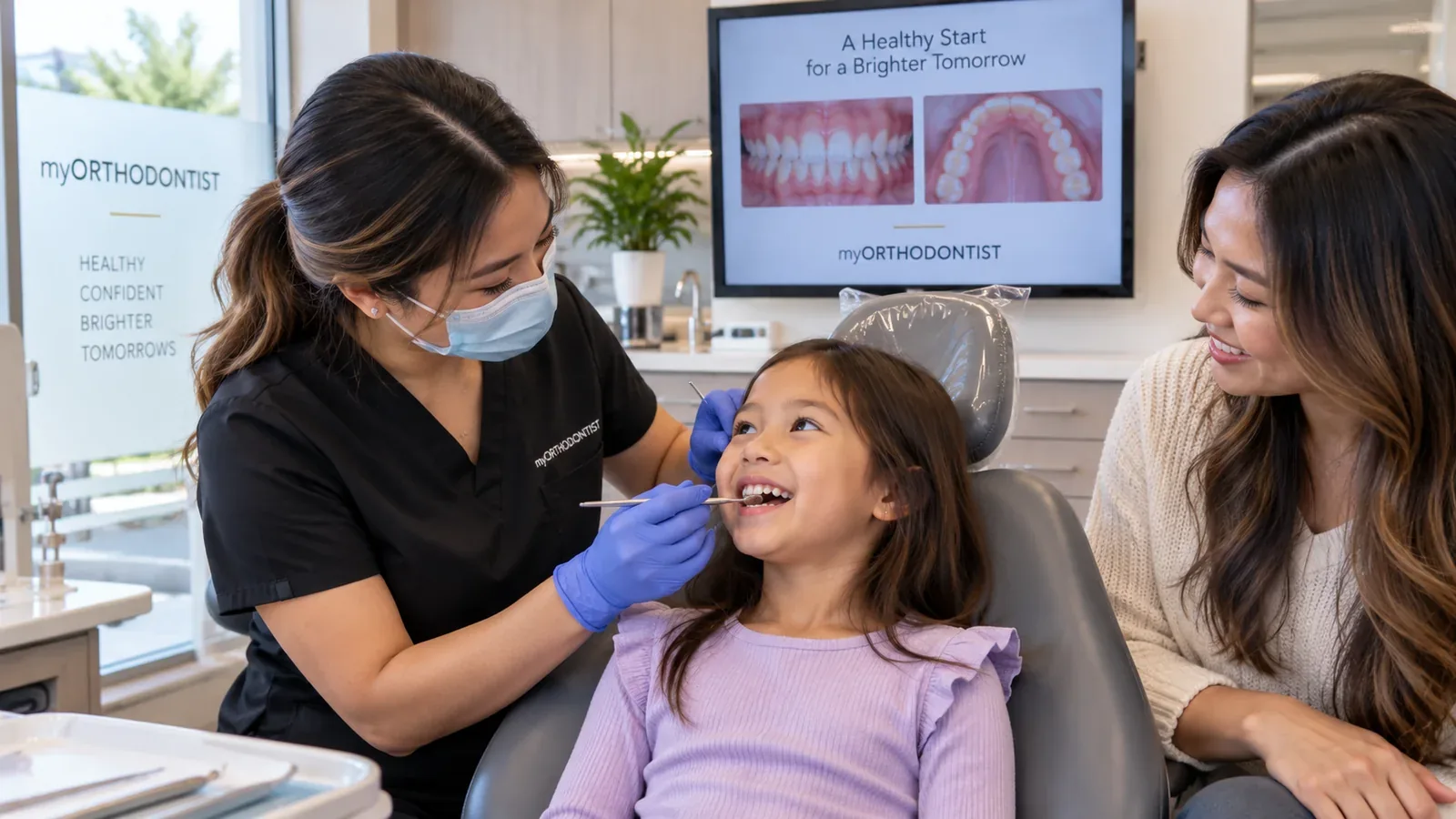
Orthodontic associations recommend a first assessment around age 7, when the first adult molars and incisors have arrived and jaw growth can be evaluated. The purpose is surveillance, not sales: most children assessed at 7 need no treatment yet — they get a growth-monitoring recall and treatment begins, if ever, in the early teens.
When early (Phase 1) treatment genuinely helps
- Crossbites that shift the jaw sideways as it grows
- Severe crowding where guided expansion creates room and may avoid extractions later
- Palatal expansion for narrow upper jaws — most effective while growth sutures are open
- Harmful habits (prolonged thumb-sucking, tongue posture) reshaping the bite
- Airway red flags — mouth breathing, snoring and disturbed sleep can relate to jaw development and deserve airway-aware screening
- Protruding front teeth at high risk of playground trauma
When monitoring is the right plan
Mild crowding, small gaps and a slightly deep bite with a normal jaw relationship are common at seven and often improve as the jaws grow; treating them early rarely changes the result at thirteen, so we monitor them, free, until the timing is right. But where the pattern is skeletal — a narrow arch, a lower jaw sitting back, a crossbite steering the jaw, an emerging underbite — we lean firmly toward guiding growth while it's possible. Those are the children for whom a well-timed first phase means fewer extractions, a simpler second phase, and sometimes no surgical conversation later. The skill is telling the two groups apart on the records, and naming what Phase 1 would prevent before recommending it.
What a first phase actually looks like
If we recommend one, the plan is specific: usually a single appliance — a twin block with expansion built in, an expander, partial braces on the front teeth, or a habit appliance — worn for nine to fifteen months, with visits every six to eight weeks. Children adapt faster than parents expect. Then a rest period with a retainer while the remaining baby teeth exchange, and free monitoring until the teens, when a second phase — usually shorter and simpler than it would otherwise have been — completes the bite. We'll tell you the expected shape and cost of both phases at the first visit.
What we believe, and what we don't
We believe firmly that guiding jaw growth while it's possible is the most valuable orthodontics many children will ever receive — that a narrow arch widened at nine, or a small lower jaw guided forward at ten, means fewer extractions, a simpler teenage phase and no surgical conversation at twenty. We don't believe every seven-year-old needs an appliance, and we won't put one in a child whose jaws are developing well; those children get a recall date and a free visit next year. The skill is in telling the two apart, and the indications page shows you how we do it.
For parents who've been told to wait
Often that's right. Occasionally it isn't — a crossbite steering a jaw, an underbite emerging, a canine drifting on the X-ray, chronic mouth breathing — and the cost of waiting is a window that closes. If your child is seven or older and no one has looked specifically at the bite and the jaws, the free assessment settles it either way. Your dentist remains part of the team throughout, and we'll share what we find.
Frequently asked questions about early orthodontics
Is early orthodontic treatment necessary?
For some children, genuinely — a crossbite steering the jaw, a narrow palate, a lower jaw sitting back, an emerging underbite. For most, no; they need a free recall date. The assessment tells which.
What's the difference between Phase 1 and Phase 2?
Phase 1 changes how the jaws grow, during growth, with appliances like a twin block or an expander. Phase 2 aligns the teeth within the jaws, usually in the teens, with braces or aligners. Phase 1 can make Phase 2 shorter, simpler and non-extraction.
Does Phase 1 mean my child avoids braces later?
Usually not — a second phase typically follows. What it can mean is a shorter second phase, kept permanent teeth, and no surgical conversation later. We'll set that expectation honestly.
How much does early treatment cost?
At our practice, $2,000–$4,500 depending on the appliance, with retention included, and the second phase's likely cost discussed at the same time. Details.
Will my seven-year-old cooperate?
Almost always. Children adapt to appliances faster than parents expect, and involving them in the plan — showing them the mirror progress — is most of the work.
Why we hold this position when some orthodontists don't
The orthodontic literature has debated early treatment for decades, and honest specialists land in different places. Some argue a single comprehensive phase in the teens reaches the same result for most children at lower cost. We've practised long enough, across enough cases, to hold a different view for the skeletal patterns: that the children whose jaws we guided at nine reach thirteen with adequate arches, reasonable bite relationships and their premolars, and that the children we first met at fourteen with the same starting pattern too often arrive with extraction and surgery on the table. We apply the view selectively — it's a philosophy about skeletal patterns, not about seven-year-olds in general — and we're glad to discuss the evidence with any parent who'd like to.
What a Phase 1 year costs a family in time
An assessment. A records visit. A fitting. Six to eight adjustment visits of fifteen minutes each, after school or on a Saturday. Then a rest phase with a retainer and a free check once a year. Most of the work happens at home: wearing the appliance, turning a screw, brushing around it. Families tell us the first two weeks are the adjustment and the rest is routine. Compared with the twenty-plus visits of a comprehensive teenage phase, it's a modest investment of time — and, for the right child, it changes what that later phase involves.
A closer look: the appliances, and why we choose each
The twin block for a lower jaw sitting back — our workhorse, with expansion built in when the arch is narrow. A fixed or removable expander for a narrow arch on its own. A facemask for a young child with an emerging underbite. Partial braces on the front teeth for a crossbite of a single tooth, or to protect protruding incisors. Invisalign First for arch development and dental corrections in a child who'll wear the trays — increasingly our recommendation for those cases. A habit appliance for a thumb that won't stop. A space maintainer when a baby tooth is lost early. Each does one job, during a window, and none is an appliance we'd place without naming the job. When a child needs none of them, they need a recall date and a sticker.
A note for parents told "just wait"
That advice is often right and occasionally costly. The patterns worth not waiting on are specific and visible at seven: a crossbite that shifts the jaw, a narrow palate, a lower jaw sitting back, an emerging underbite, a canine drifting on the X-ray, a breathing pattern shaping the face. If you recognise one, a free specialist look settles it, and we'll send our findings to your dentist either way. If you don't, waiting is probably fine — and a free assessment confirms that too.
Before you go
Read the signs, then the philosophy, then the money. Then book the free assessment — the most common outcome is reassurance, and it's still worth an hour.
Misconceptions we correct most often
“Every seven-year-old needs an orthodontist.”
Every seven-year-old benefits from a look. Most need nothing but a recall date.
“Early treatment means no braces later.”
Usually a shorter, simpler second phase — not none. We set that expectation honestly.
“Expanders are painful and old-fashioned.”
Brief pressure, quick adaptation, and — often built into a twin block — one of the highest-value tools we have.
What Coquitlam families search for, answered
“What is interceptive orthodontics?”
Another name for Phase 1: treatment during growth that intercepts a developing problem — a crossbite, a narrow arch, a retruded jaw — before it becomes entrenched. Our philosophy on it is on the growth-modification page.
“Do kids need braces at 7?”
Almost never braces. A minority need an appliance that guides growth; most need a recall date. The look is what's needed at seven, not the braces.
“How much does Phase 1 orthodontics cost in BC?”
At our practice $2,000–$4,500 with retention included, quoted alongside an honest expectation of the second phase.
At a child’s assessment, expect
- A clear verdict: treat now, or monitor and recall
- The specific clinical reason if Phase 1 is proposed
- What Phase 1 costs AND what Phase 2 will still cost
- Airway and habit screening, not just tooth position
- No-charge monitoring recalls until timing is right