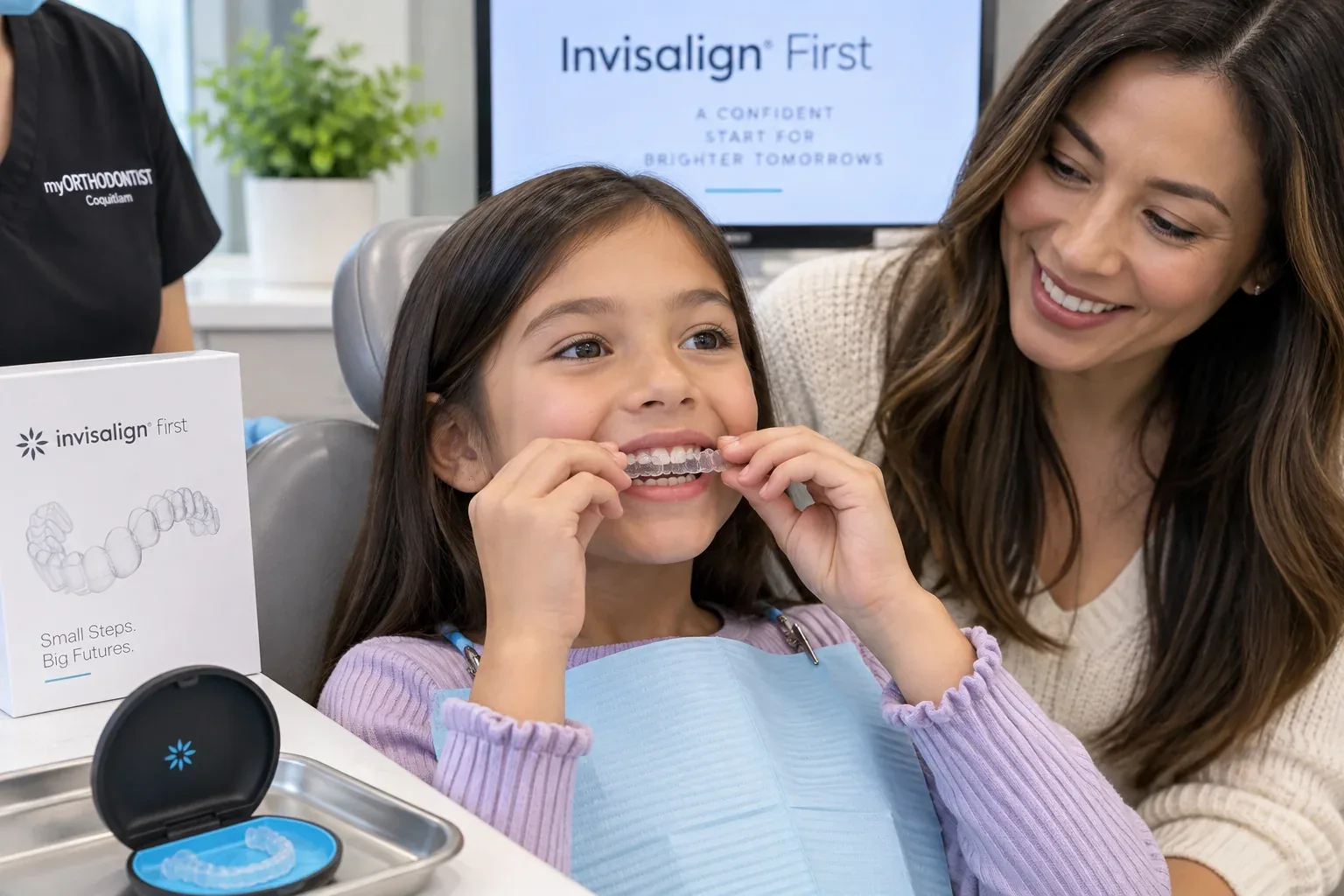
Invisalign moves teeth with a series of custom clear trays, each worn one to two weeks. It is nearly invisible, removable for eating and brushing, and for a wide range of cases produces results equivalent to braces. The three variables that actually determine your outcome are less advertised: case selection, compliance, and the experience of the doctor planning your movements.
Variable 1: is your case an aligner case?
Crowding, spacing, and mild-to-moderate bite issues respond very well. Severe rotations, large bite corrections and some vertical movements are harder for plastic to control — a specialist will tell you where your case falls and whether a hybrid approach makes sense.
Variable 2: the 22-hour reality
Aligners only work while worn — 20 to 22 hours a day, every day, for the full treatment. Removability is Invisalign’s best feature and its biggest failure mode. Be honest about your (or your teen’s) habits; a specialist should raise this before you commit, not after refinements pile up.
Variable 3: who plans the movements
Invisalign manufactures the trays; the treatment plan comes from your doctor’s modifications to the digital setup. This is where specialist training and case volume show. Provider tiers (Bronze through Diamond, plus the invitation-level Sapphire tier) reflect case volume — our tier guide explains how to read them. The featured clinic on this site is led by a Sapphire-tier provider, a status held by roughly the top half-percent of providers globally.
Cost and timeline
Coquitlam pricing typically runs $4,500–$8,500 depending on complexity, broadly overlapping braces. Treatment commonly takes 6–24 months, with checkups every 6–10 weeks. See the full Invisalign cost guide.
What treatment actually looks like
A scan at the consultation; a digital plan you see on screen before committing, tooth by tooth; small tooth-coloured attachments bonded at the first visit so the trays have something to grip; then a new tray every one to two weeks, worn 20–22 hours a day, with checks every six to ten weeks. Partway through, a fresh scan and a refinement series to finish precisely. Then retainers. Most comprehensive cases run twelve to eighteen months; limited cases can be under a year. The timeline page has the honest ranges.
The conversation we have with every aligner patient
It's about hours. Trays out for meals and brushing, in for everything else — including coffee that isn't black, including the long afternoon at the office, including the school day. Adults usually manage this easily. Teenagers vary, and we'd rather say so before treatment than discover it after three refinement rounds. When we have doubts, we say braces would serve better, and we mean it as a recommendation rather than a warning; Invisalign for teens is the fuller version of that conversation.
Why we fit so much of it anyway
Because for the right case — crowding, spacing, mild-to-moderate bite issues in a patient who'll wear the trays — the results are excellent, the comfort is better, food is unrestricted, and the aesthetics matter to a lot of people. Our Sapphire-tier status reflects the volume we do, and in aligner treatment volume is the variable that most predicts your outcome after your own wear-time, because the plan is the doctor's design rather than the manufacturer's. Costs and inclusions are on Invisalign cost; the myths are tested on their own page.
Frequently asked questions about Invisalign in Coquitlam
How much does Invisalign cost in Coquitlam?
At our practice, typically $4,500–$8,500 depending on the package the case requires, with refinements and retainers included. Details.
How long does Invisalign take?
Six to nine months for limited cases; twelve to eighteen for most comprehensive ones; longer for real bite correction. Honest ranges.
Can Invisalign fix an overbite or crowding?
Mild-to-moderate versions of both, well. Severe versions lean braces or hybrid. The limits, honestly.
Is Invisalign suitable for teenagers?
For the right teenager, yes — Invisalign Teen has wear indicators and eruption tabs. The wear-time is the whole question. The parent's guide.
Why does provider tier matter?
Because the treatment plan is the orthodontist's design, not the company's, and planning skill comes from volume. What the tiers mean.
Is mail-order aligner treatment the same thing?
No — no examination, no X-rays, no supervision. We've treated the results.
What we've learned from a high aligner caseload
That case selection matters more than anything the manufacturer does. That most patients need one refinement and a plan that pretends otherwise is optimistic. That attachments are non-negotiable for real movements and patients accept them once they see why. That teenagers who chose aligners wear them and teenagers who were assigned aligners don't. That adults who travel for work do best with a two-week tray schedule and a spare set in the suitcase. And that the first tray change, when the patient feels the pressure and realises the plastic is actually doing something, is the moment most aligner patients become believers.
Invisalign for children and growing teens
Two members of the Invisalign family are built for growing patients, and we recommend both for suitable cases. Invisalign First handles early treatment in six-to-ten-year-olds — arch development, dental crossbites, habit-related changes — and has become one of our preferred Phase 1 tools for children who'll wear the trays. Invisalign with mandibular advancement adds precision wings that guide a growing teenager's lower jaw forward while the aligners align the teeth — jaw correction and alignment in one appliance, and our regular recommendation for eleven-to-fourteen-year-olds with a mild-to-moderate skeletal overjet. For younger children with larger corrections or a significantly narrow palate, a twin block with expansion remains our first choice; the records decide.
A closer look: attachments, refinements and the plan
Three things about aligner treatment surprise most patients. First, attachments — small tooth-coloured bumps bonded to several teeth — are nearly universal, because smooth plastic on a smooth tooth can't rotate or extrude it without a handle. Second, refinements — a fresh scan partway through and an additional tray series — are normal, because teeth don't always track the plan exactly; a refinement is how the plan catches up, and it's included in our fee. Third, the plan itself is the orthodontist's work: the manufacturer prints what the doctor designs, and the design decisions — staging, attachment placement, over-correction, elastics — are where experience shows. The digital simulation you see at the consultation is the plan; ask about all three before you commit anywhere.
Why we're candid about limits
Because the cost of an over-promised aligner case is high for the patient: months of trays that stop tracking, refinement after refinement, and sometimes a switch to braces that could have been the plan from the start. We fit a great deal of Invisalign and we decline it for cases that need something else, and both halves of that are why our aligner outcomes are good. The limits page is the frank version; the decision page is the constructive one.
Before you go
If you're an adult with mild-to-moderate crowding or spacing and you'll wear the trays, you're likely an excellent candidate — book the free consultation and see your simulation. If you're a parent of a teenager, read Invisalign for teens first. Either way, the cost page tells you what the fee includes.
Misconceptions we correct most often
“Invisalign is always faster.”
For mild alignment, often. For bite correction and rotations, braces usually win.
“The company plans the treatment.”
The orthodontist does; the company prints the trays. Planning skill comes from volume.
“If I lose a tray I've lost weeks.”
Wear the previous tray and call us; replacements are quick and, on Invisalign Teen, included.
What Coquitlam families search for, answered
“Does Invisalign work?”
Very well for crowding, spacing and mild-to-moderate bite issues in patients who wear the trays; less predictably for severe rotations and large bite corrections. Case selection by a specialist is most of the answer.
“Invisalign vs braces — which is cheaper?”
Overlapping ranges. Limited aligner cases can be cheaper; complex aligner cases about the same as braces. At our practice both include retainers.
“Can you eat with Invisalign in?”
No — trays out for anything but water, then brushed teeth and trays back in. It's the feature people love and the discipline that decides outcomes.
Invisalign consult: verify before signing
- Doctor is a certified specialist, not tier-only marketing
- Refinements/extra trays included in the quote
- Retainers included at the end
- You see the digital plan before committing
- Honest answer: would braces do this better?