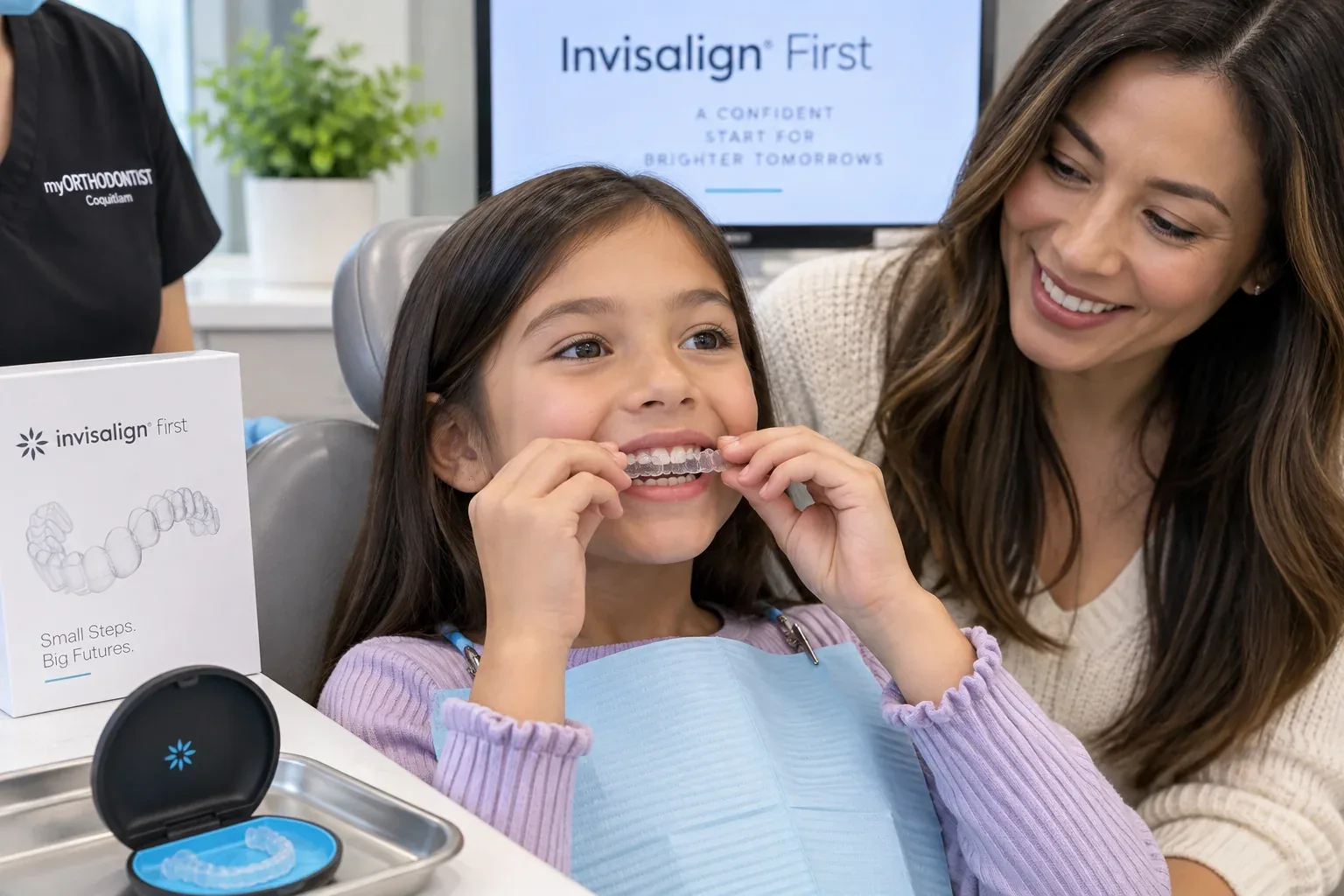
Invisalign First is a clear-aligner system designed for the mixed dentition — children of roughly six to ten with a combination of baby and adult teeth. It can widen a narrow arch, create room for erupting teeth, correct dental crossbites and address the effects of habits, doing much of the job that expanders and partial braces have traditionally done, in removable plastic. At our practice it has become one of our preferred Phase 1 tools, and we recommend it for a good share of the children who genuinely need early treatment.
What it's designed to do
The system's features are built around growing mouths: the aligners accommodate erupting teeth with built-in eruption compensation, they're trimmed for small arches, and they're planned for arch development — gently widening a narrow upper arch and rounding out a squeezed one so the adult teeth have somewhere to go. The movements are staged through a series of trays changed every one to two weeks, planned on the child's scan, and refined as the teeth respond. For a child, the practical appeal is obvious: nothing fixed, nothing to break, normal eating, easier brushing, and the trays come out for the school photo.
Who we recommend it for
- Narrow arches with crowding where modest, controlled expansion creates the room and the case doesn't need heavy skeletal widening.
- Dental crossbites — one or a few teeth biting inside the lowers — in a child who'll wear the trays.
- Habit-related bite changes alongside the habit work, once the habit is stopping.
- Early alignment of protruding or displaced front teeth where trauma risk or self-consciousness argues for acting before the teens.
- Children and parents who will manage the routine — twenty to twenty-two hours a day, trays in a case, a parent as compliance officer.
Where we'd still choose something else
Honesty is the point of this site, so: a child who needs a large amount of skeletal expansion — a markedly narrow palate with a crossbite on both sides and an airway concern — is usually better served by a fixed expander or by expansion built into a twin block, because plastic has limits on how much true jaw width it can generate. A child whose lower jaw sits well back needs jaw guidance, which is a twin block or, in an older child, Invisalign with mandibular advancement. And a child who won't reliably wear a removable appliance needs something fixed. We'll tell you which category your child is in, on the records, rather than defaulting to the product.
What treatment looks like
A scan at the free assessment; a digital plan the parent sees; small attachments bonded to a few teeth at the first fitting; trays changed at home; short checks every six to ten weeks. A first phase typically runs nine to fifteen months, followed by retention and free monitoring until the teens, when a shorter comprehensive phase — often Invisalign Teen or braces — completes the bite. Fees sit in our usual Phase 1 range, retention included, with an honest expectation of the second phase given at the same time.
Frequently asked questions
Is Invisalign First as effective as an expander?
For modest arch development and dental corrections in a compliant child, comparable. For heavy skeletal expansion, a fixed expander or expansion within a twin block is more predictable. We'll say which your child needs.
Will my child wear it?
Most do, once it's routine — the trays are comfortable and the progress is visible. Parents are the compliance officers; a case in the pocket is the whole habit.
Does Invisalign First replace Phase 2?
Usually not; a shorter second phase in the teens completes the bite. What it changes is how simple that phase is.
How is it priced?
As a Phase 1 fee, $2,000–$4,500 at our practice, retention included — quoted alongside the likely second phase.
Invisalign First: confirm before starting
- The specific indication — what the first phase prevents
- Amount of expansion needed is within what aligners deliver
- Child and parent are realistic about 20–22 hours
- Retention and free monitoring between phases included
- What Phase 2 will still involve, honestly