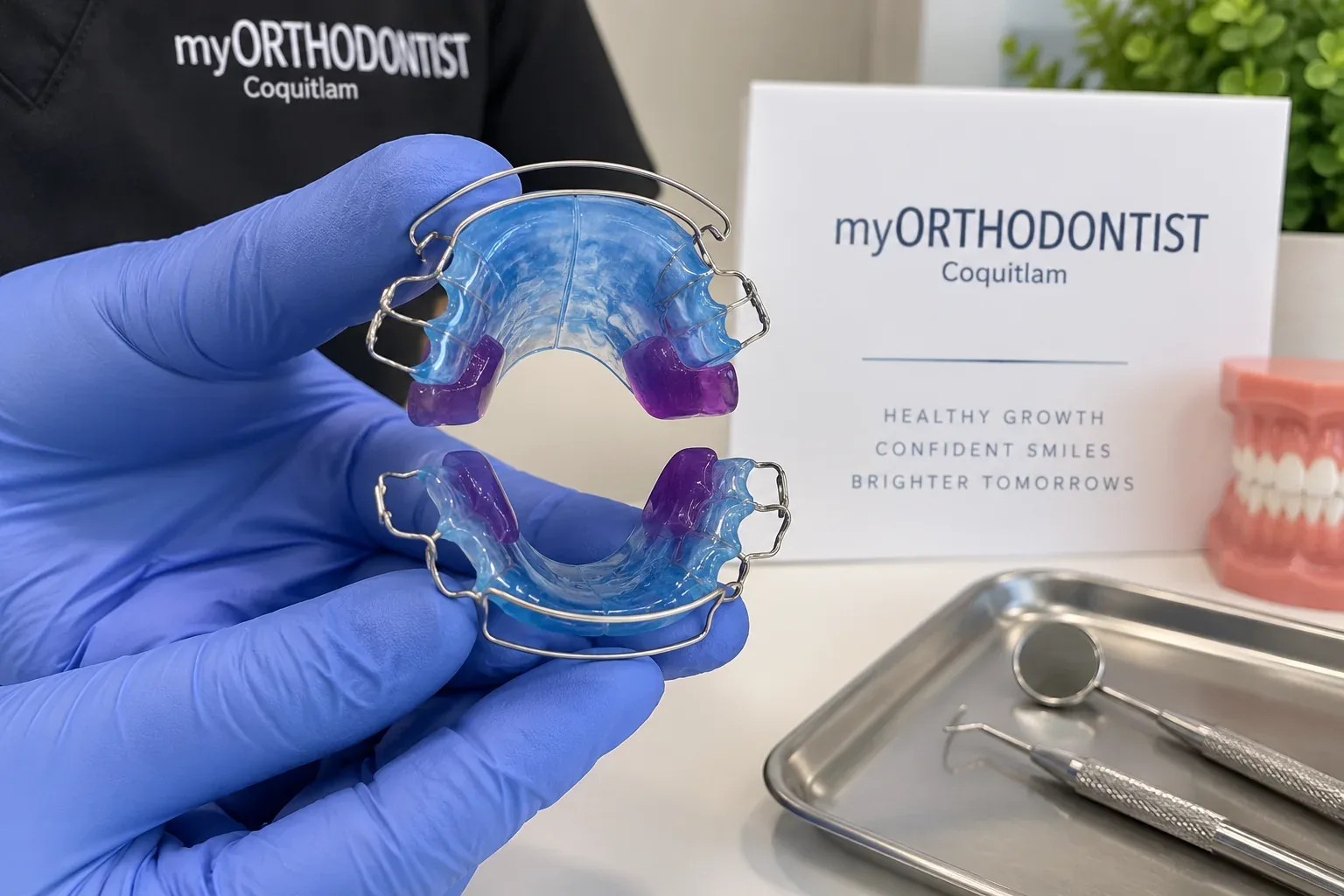
A twin block is a pair of removable plates, upper and lower, with angled bite blocks that guide the lower jaw into a forward position every time the child closes. Worn through the growth years, it encourages the lower jaw to develop into that position — correcting the "overjet" profile where the lower jaw sits back — without brackets, and while the child is still growing.
What it does well
For the retruded-lower-jaw pattern that produces prominent upper front teeth and a weak chin, the twin block is, in our hands, the most reliable and child-friendly growth-modification appliance we have. It works during growth, it comes out for sports and meals, and children tolerate it remarkably well once the first fortnight is past. Treatment typically runs nine to twelve months, followed by a rest period before any comprehensive phase.
Our refinement: expansion built in
Many of these children also have a narrow upper arch. The conventional sequence is a separate rapid palatal expander first, then the twin block — two appliances, two adaptation periods, extra months and extra cost. We prefer, wherever the case allows, to build the transverse correction into the twin block itself with an expansion screw in the upper plate, so the arch widens while the jaw relationship is being corrected. One appliance, one sequence. In our experience it also avoids the uneven, one-side-more-than-the-other expansion we've sometimes seen from rapid expanders, and the posterior bite inconsistencies that follow.
The aligner alternative
For older children and teenagers with a milder version of the same pattern, Invisalign with mandibular advancement does the jaw-guidance job with wings on the aligners while straightening the teeth at the same time. We recommend it regularly for eleven-to-fourteen-year-olds who'll wear it; for younger children and larger corrections, the twin block remains our first choice. Sometimes the honest sequence is one, then the other.
What to expect
- Fitting — impressions or a scan, then a fitting visit; speech is odd for a week and normal after two.
- Wear — as many hours a day as possible; the appliance only works while it's in.
- Adjustments — every six to eight weeks to advance the position and turn the expansion screw.
- Afterward — a rest period with retention, then usually a shorter, simpler Phase 2 in the teens.
Whether a twin block suits your child is a records decision — a profile X-ray tells us how much of the pattern is jaw position versus tooth position. The free early assessment answers it.
Who it isn't for
Children whose overjet is dental — front teeth flared forward on a normally positioned lower jaw — don't need a jaw appliance; they need braces or aligners at the right time. Children past their growth peak get diminishing returns. Children who won't wear a removable appliance need a fixed alternative. And an underbite is the opposite pattern entirely, treated with different tools. The profile X-ray sorts these out, which is why we won't recommend a twin block from a photograph.
What parents ask us most
Will they wear it? Most do, once it's routine — we make it easier by involving the child in the plan and by the visible progress they can see in the mirror within months. Does it hurt? Pressure for the first days; then it's just there. Sports? Out for contact sports, in a case, back in afterward. Will we still need braces? Usually a shorter, simpler second phase — we'll set the expectation at the start, and the cost page shows how the two fees relate.
Twin block questions
How many hours a day must a twin block be worn?
As many as possible — ideally all but meals and sport. It only works while it's in.
Can my child eat with it in?
We recommend removing it for meals and cleaning it after.
What if it breaks or gets lost?
Call us. Repairs are quick; replacements are made from the original records.
Does a twin block replace braces?
No — it does the jaw work braces can't. A shorter, simpler braces or aligner phase usually follows in the teens.
Related reading
- Palatal expansion — the width component we build in
- Growth modification — the philosophy behind the appliance
- Phase 1 costs — what a twin block phase costs
The bottom line
For a growing child whose lower jaw sits back, the twin block — with expansion built in where the arch is narrow — is the most reliable, child-friendly growth-modification appliance we have. Nine to twelve months, one appliance, a visibly changed profile, and a simpler second phase later. The profile X-ray decides whether your child is that child.
Twin block: confirm before starting
- Overjet is skeletal — shown on the profile X-ray
- Child is in the growth window
- Expansion built in if the arch is narrow
- Expected duration, rest phase and retention
- What Phase 2 will still involve