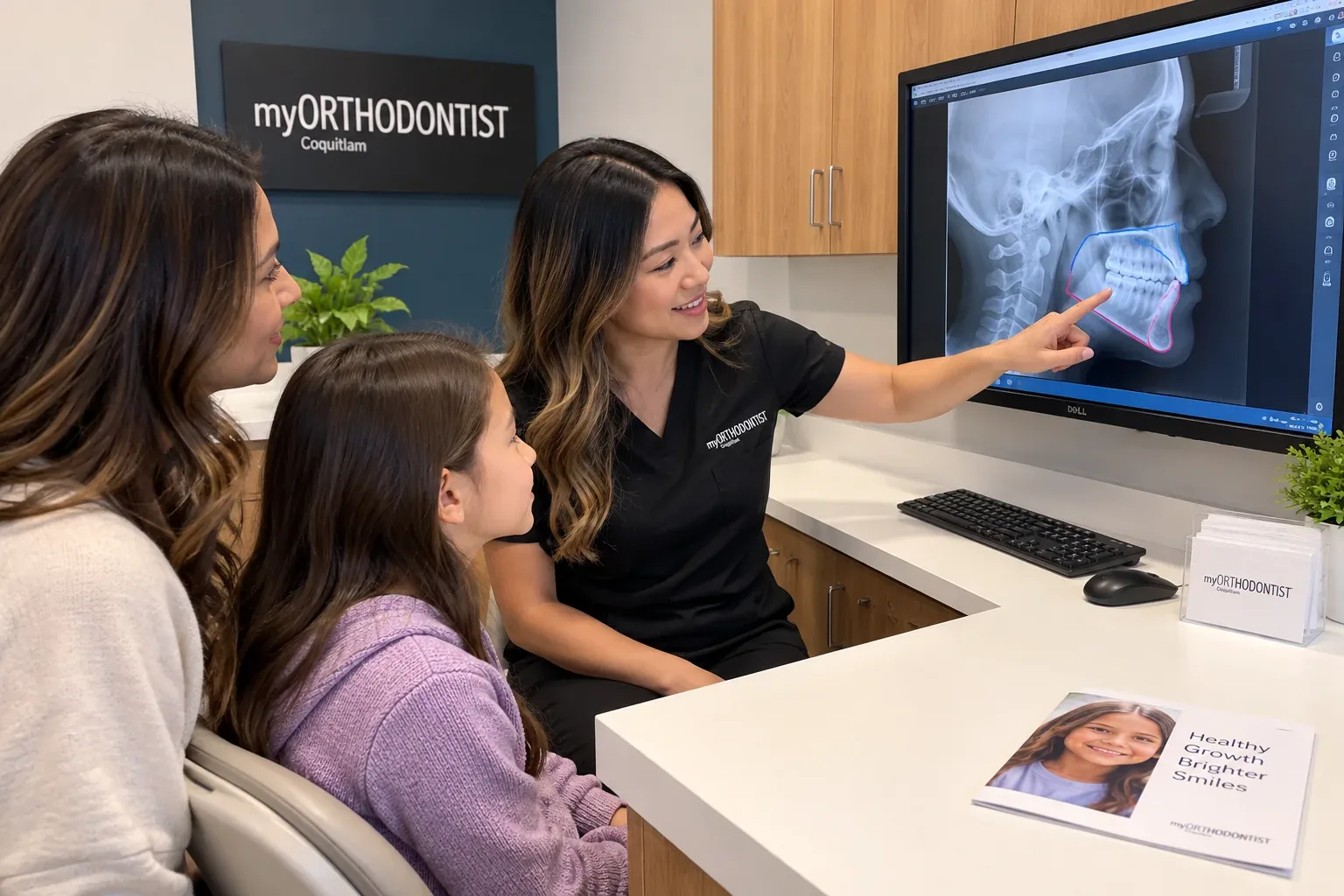
Children are built to breathe through the nose. When a child breathes through the mouth habitually — day and night — the tongue drops from the palate, the lips part, the head tilts, and the growing jaws follow the posture: a narrow upper arch, a long lower face, a lower jaw that swings back. The airway is patient-specific and orthodontics is one part of the answer, but the pattern is real and worth catching early.
Why it happens
Usually because the nose is hard to breathe through: enlarged adenoids or tonsils, allergic swelling, a narrow nasal floor — which is, in part, the roof of a narrow palate. Sometimes it began as an obstruction that has since resolved and persisted as a habit. Sorting out which is the first job, and it isn't ours alone: a physician or ENT is often part of the picture.
What we screen for
- Lips habitually apart at rest; dry, chapped lips; a "long face" appearance.
- A narrow, high palate and crowded upper teeth; a crossbite.
- Reports of snoring, restless sleep, dark circles, daytime tiredness or attention concerns.
- Tongue resting low and forward; open-bite tendency.
What orthodontics can and can't do
We can widen a narrow upper arch during growth, which also widens the nasal floor and gives the tongue somewhere to rest, and we can guide a retruded lower jaw forward, which brings the tongue base with it. In the right child that materially supports nasal breathing. What we can't do is remove enlarged adenoids or treat allergies — so when we see the pattern we say so, coordinate with your family doctor or an ENT, and plan the orthodontic part around theirs. Our airway-aware approach is a screening discipline, not a promise.
What we ask the family to watch for at home
Lips apart while watching television or reading — not just during a cold. Snoring, or breathing through the mouth during sleep. Waking with a dry mouth. Chapped lips, dark circles, a tired morning face. Chewing with the mouth open. Parents often haven't noticed until asked, and then recognise all of it. Bring the observations to the assessment; they're as useful as anything we measure.
How the plan usually goes
If the nose is obstructed, medical care first — an ENT assessment, allergy management, sometimes adenoid or tonsil removal — because no orthodontic appliance can make a blocked nose breathe. Alongside or after that, where the palate is narrow or the lower jaw sits back, expansion or growth guidance during the window when it's possible. And in every case, retraining: lips together, tongue up, nose breathing, practised until it's automatic. We coordinate the pieces and we'll tell you honestly which belong to us.
Mouth-breathing questions
Is mouth breathing always a problem?
During a cold, no. Habitually, day and night, it's worth assessing — it shapes growth.
Can an orthodontist fix mouth breathing?
We can widen a narrow palate and guide a retruded jaw during growth, which supports nasal breathing. We can't remove adenoids or treat allergies — that's medical.
What's the connection to crooked teeth?
A low tongue and parted lips let the cheeks narrow the upper arch, which crowds the teeth. The pattern is common and recognisable.
Who should we see first?
Your family doctor, for the nose. Then us, for the jaws. We coordinate.
Related reading
- Snoring in kids — the night-time version
- Airway-aware orthodontics — our screening approach
- Palatal expansion — the structural piece
The bottom line
Habitual mouth breathing shapes a growing face, and it's usually because the nose is hard to breathe through. See your doctor about the nose; see us about the jaws. Where the palate is narrow or the lower jaw sits back, guiding growth can support nasal breathing — and it's only possible while the child is growing. We coordinate the pieces and we're honest about which are ours.
If it were our own child
We'd watch the lips at rest for a week, then see the doctor about the nose and the orthodontist about the palate in the same month, and let the two talk to each other. We wouldn't wait for the adult teeth.