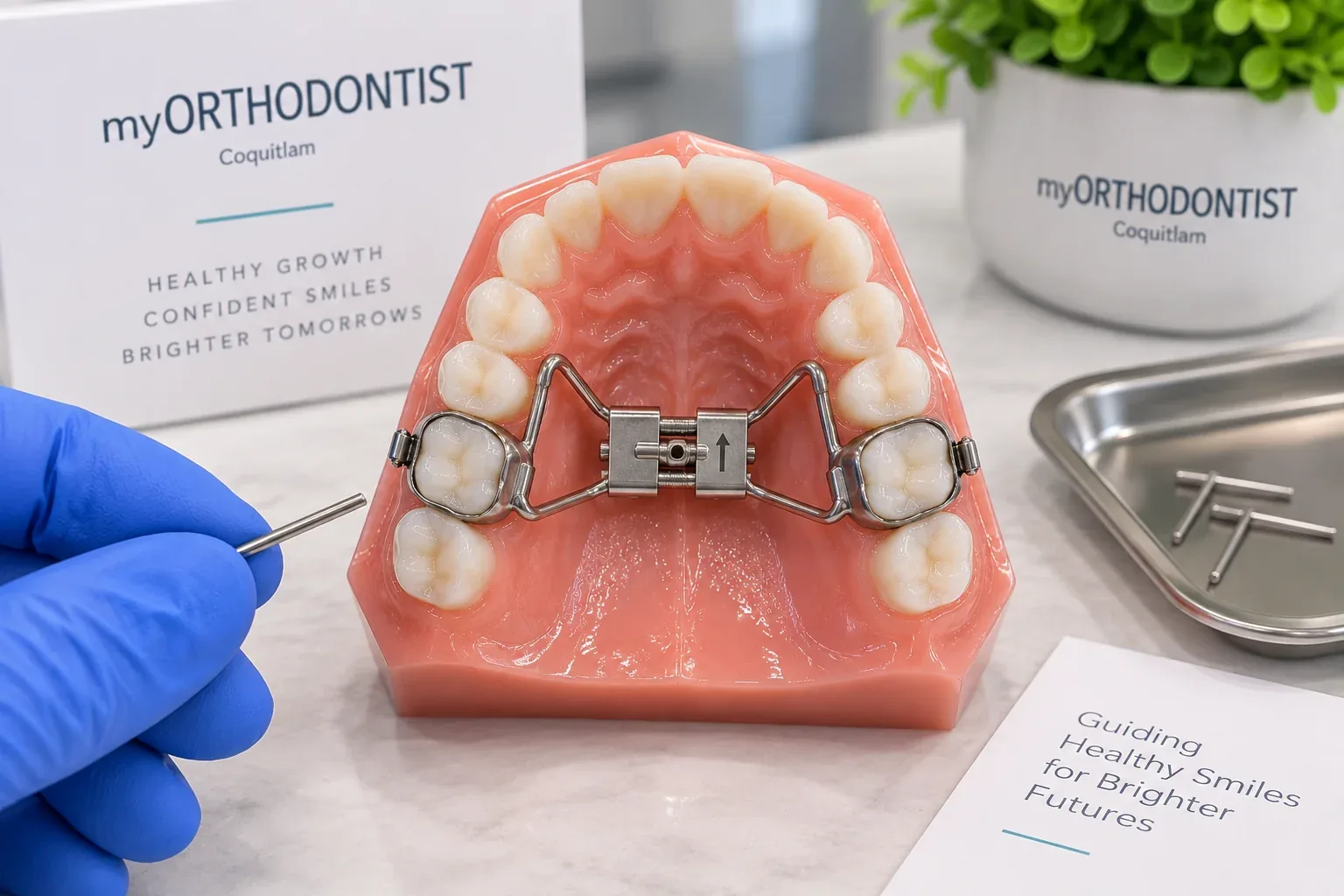
The upper jaw is two halves joined by a seam that stays open through childhood and fuses around the early teens. While it's open, the jaw can be widened relatively easily; once it fuses, widening it means surgery. That single fact drives much of the timing in children's orthodontics.
Why a narrow upper arch matters
A narrow palate crowds the upper teeth, produces crossbites where upper teeth bite inside the lowers, and can force a growing lower jaw to shift sideways on every closure. It also narrows the floor of the nose and reduces the space the tongue rests in — which is where the airway conversation begins for some children. Widening the arch during growth addresses all of these at once, and often the crowding largely resolves on its own as the adult teeth find room.
How we approach it
Conventional rapid palatal expanders are fixed appliances turned daily over a few weeks. We use them where a case calls for it, but our preference is to integrate expansion into a twin block when a child also needs jaw-position correction — one appliance rather than two, and a gentler, more even widening in our experience. For children with a narrow arch and no jaw-position issue, a simpler removable expansion plate is often enough.
What parents should know
- A gap often opens between the front teeth during expansion. It's expected, and it closes.
- Expansion in a growing child is comfortable; adults who need widening face a different conversation.
- The result is held with a retainer while new bone consolidates in the seam.
Living with an expander
A fixed expander is cemented to the upper back teeth with a small screw in the middle of the palate; a parent turns it with a key once a day for a few weeks, and the child feels pressure across the nose for a minute or two. Speech is thick for a week and normal after two. Eating is normal minus the sticky and the hard. A gap opens between the front teeth and closes again over the following months as the new bone fills in. When expansion is built into a twin block instead, it's a removable appliance the child wears most of the day and the turns are done at our visits.
After expansion
The expanded arch is held for several months while the seam consolidates — the expander stays in passively, or a retainer takes over — and then the child rests. In many cases the crowding that prompted the visit has largely resolved on its own as the adult teeth found room; in some, a simpler second phase follows in the teens. We'll tell you which we expect. Expansion is also where the airway and mouth-breathing conversations most often intersect, because a wider palate is a wider nasal floor.
Expansion questions
Does palatal expansion hurt?
Pressure across the nose for a minute after each turn; tenderness the first days; then routine.
Will the gap between the front teeth close?
Yes, over the following months as the teeth drift together and new bone fills the seam.
Can expansion help with breathing?
In a child with a narrow palate, it widens the nasal floor and gives the tongue room — meaningful for some children, not a cure for all.
How long is the expander in?
Active turning a few weeks; then several months passive while the seam consolidates.
Related reading
- Crossbite — the commonest reason to expand
- Airway — when expansion is about breathing
- The twin block — expansion built into jaw guidance
The bottom line
A narrow upper jaw is easy to widen while the growth seam is open and hard afterward. In a child with a crossbite, crowding or a breathing concern, expansion — often built into a twin block — is one of the highest-value interventions we make. In a child whose arch is fine, we don't. The scan and the X-ray decide, and we'll show you both.
Before agreeing to expansion
- What is the arch width now, and what should it be?
- Crossbite or airway concern driving it — or crowding alone?
- Which appliance, and why that one for this child?
- How long, and what retention follows?
- What does it change about Phase 2?