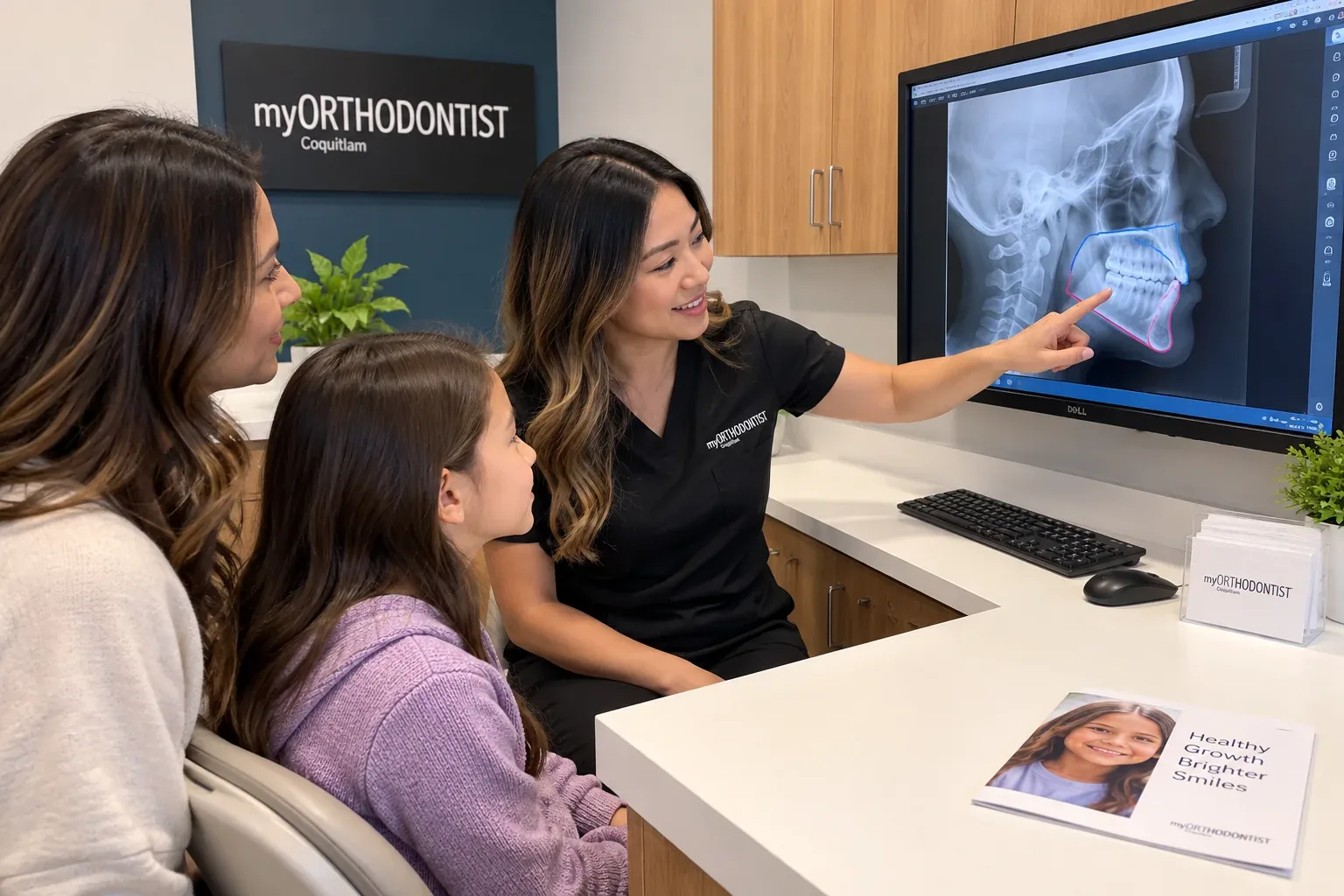
Children who snore most nights, breathe through the mouth in sleep, sweat or thrash, wake tired, or wet the bed past the usual age may be working harder to breathe than they should. That is a medical question first, and we say so. It is also, quite often, connected to how the jaws are developing — which is where an orthodontist enters.
Why it connects to orthodontics
A narrow upper jaw narrows the nose. A lower jaw that sits back carries the tongue back with it. Both reduce the space air moves through at night. Children with this pattern frequently show the same signs we look for in the chair — crowding, crossbite, a long lower face, lips apart at rest — and guiding jaw growth while it's still possible can be a meaningful part of the solution alongside medical care.
The team approach
- Your family doctor or pediatrician — first stop; may refer for an ENT assessment or a sleep study.
- ENT — adenoids and tonsils are the commonest culprits, and orthodontics doesn't treat them.
- Orthodontist — assesses arch width and jaw position, and where indicated treats them during growth.
- Your dentist — often the first to notice tooth wear from grinding or a narrow arch at a routine visit.
What we'll tell you honestly
Whether we see a structural pattern that expansion or growth guidance could help, or whether the jaws look fine and the answer lies elsewhere. Airway involvement is patient-specific; we won't oversell orthodontics as a cure for snoring, and we won't miss a narrow palate in a child who snores either. Read mouth breathing alongside this page — the two usually travel together.
What we can see in the chair that connects to the night
A high, narrow palate. Upper teeth crowded because there isn't room for them. A crossbite. A lower jaw that sits well back. Lips that don't meet at rest. Wear on the teeth from grinding. A long, narrow face. None of these diagnoses a sleep problem — that's a physician's job — but when a parent describes nightly snoring and we see several of them, the structural picture is worth naming, because part of it is treatable while the child is growing and not afterward.
What we'd say to a family
Take the snoring to your doctor and ask about an ENT referral or a sleep assessment — first, and regardless of anything we find. Then, if the palate is narrow or the jaw sits back, let's talk about whether expansion or growth guidance belongs in the plan alongside the medical care. We won't promise it ends the snoring; airway involvement is patient-specific. We will promise not to miss the narrow palate in a child who snores.
Snoring questions
Should I be worried if my child snores every night?
Regular snoring in a child is worth a conversation with your doctor. It's common, and it's not nothing.
Can braces stop snoring?
Braces, no. Expansion or jaw guidance during growth can change the structures involved, in the right child, alongside medical care.
What will an ENT do?
Assess adenoids and tonsils, which are the commonest causes, and consider a sleep study.
Do you screen for this at the first visit?
Yes, every time, as part of the airway-aware assessment.
Related reading
- Mouth breathing — the daytime version
- Airway — what we screen for and refer
- Palatal expansion — the orthodontic contribution
The bottom line
Nightly snoring in a child is worth a doctor's visit first. Then let us look at the palate and the jaw position, because a narrow arch or a retruded jaw can be part of the picture and is only guidable during growth. We'll say honestly what we see and won't sell an appliance as a cure. Book the free assessment and mention the snoring when you do.
If it were our own child
Doctor first, that week. Then our own look at the palate and jaw, and a plan that names which part is medical and which is structural. We'd want no one promising a cure and no one ignoring a narrow palate.