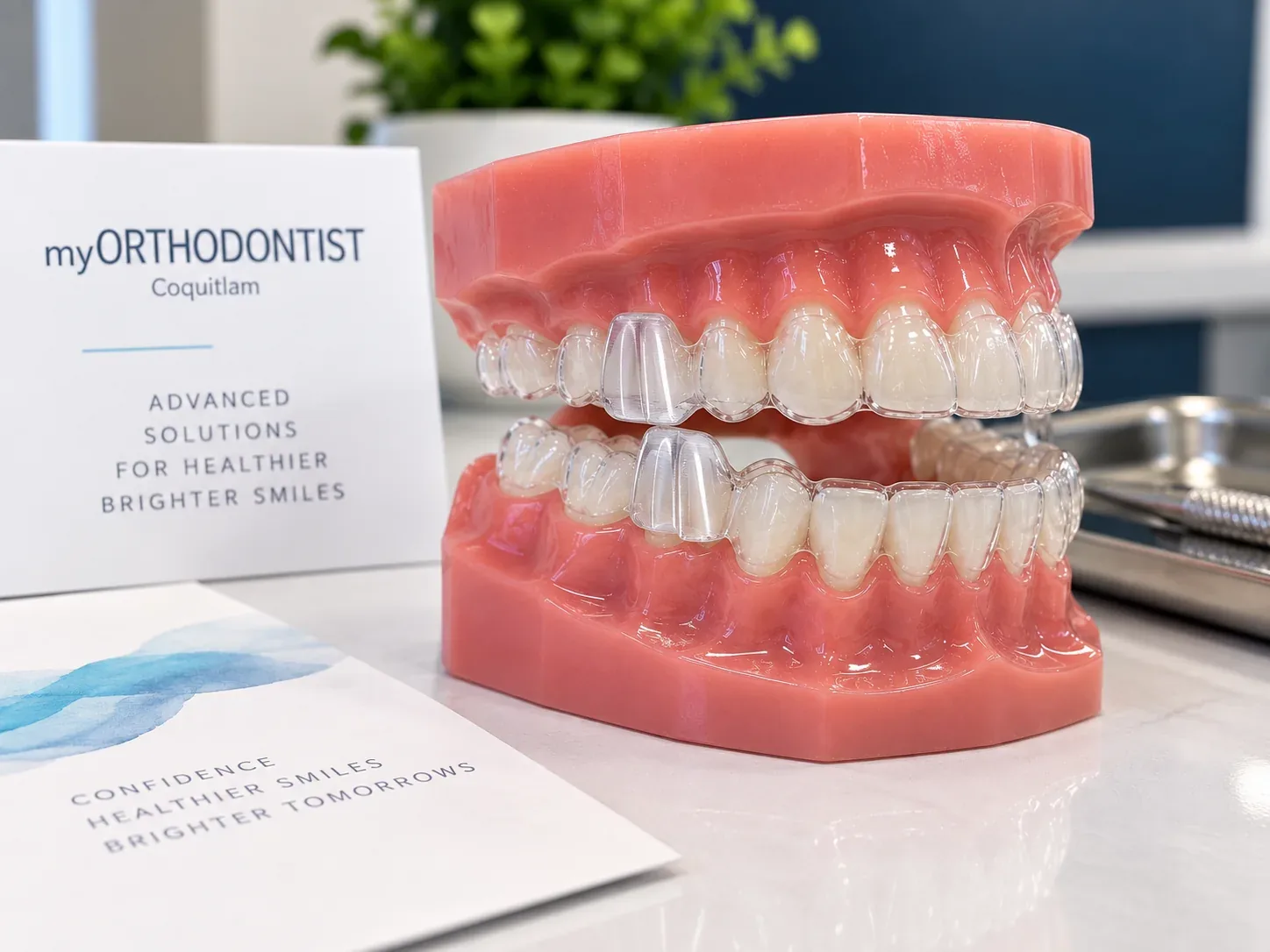
Invisalign with mandibular advancement adds precision wings to the sides of the aligners. When the teenager closes, the wings engage and hold the lower jaw in a forward position — the same principle as a twin block — while the aligners themselves straighten the teeth. In a growing patient, that forward posture over months encourages the lower jaw to develop into the corrected position. Two jobs, one appliance, no separate functional phase.
Why we recommend it for the right teenager
The retruded-lower-jaw pattern — prominent upper front teeth, a receding chin, a large overjet — has traditionally been treated in two stages: a functional appliance such as a twin block to bring the jaw forward, then braces or aligners to align the teeth. Mandibular advancement collapses those into one continuous treatment. For an eleven-to-fourteen-year-old who is still growing, whose case is mild-to-moderate, and who will wear the trays, that means fewer appliances, a familiar routine from the first day, an invisible treatment through the self-conscious years, and — in our experience — good compliance, because the teenager chose it. We fit it regularly and we'd choose it for our own children in that situation.
Who it suits, and who it doesn't
- Suits: growing teens (typically 11–14, before or around the growth spurt) with a mild-to-moderate skeletal overjet, moderate crowding, and realistic wear-time.
- Doesn't suit: patients past their growth peak, where jaw guidance no longer works; severe skeletal discrepancies, where the amount of advancement needed exceeds what the wings deliver; teenagers who won't manage twenty-two hours; and younger children, for whom a twin block with built-in expansion remains our preferred tool.
How it compares with a twin block
A twin block is a removable acrylic appliance worn most of the day, usually at nine to twelve, with expansion built in where the arch is narrow; it's robust, powerful, and our first choice for younger children and for larger corrections. Mandibular advancement is better suited to older children and teenagers, to milder corrections, and to families who want alignment happening at the same time. Both depend on wear and on growth. The profile X-ray — how much of the overjet is jaw position, and how much growth remains — decides between them, and sometimes the honest answer is a twin block first and aligners after.
What treatment looks like
Records and a digital plan showing both the jaw advancement and the tooth movements. Trays changed every one to two weeks, with the wings advancing the jaw in stages. Checks every six to ten weeks, with the wear indicators of Invisalign Teen keeping the conversation factual. A typical case runs twelve to twenty months including the alignment phase, then retention. It's priced as comprehensive Invisalign, with refinements and retainers included in our fee.
Frequently asked questions
Does mandibular advancement really change the jaw?
In a growing patient, the forward posture encourages the lower jaw to develop into the corrected position — the same mechanism as a twin block. After growth, it repositions teeth, not jaws.
Is it uncomfortable?
The wings take a few days to get used to; most teens describe it as odd rather than sore.
What if my teen is past the growth spurt?
Then jaw guidance is no longer available and we'd treat the overjet with camouflage mechanics — aligners with elastics, or braces. We'll tell you honestly where your teen is.
Twin block or mandibular advancement?
Age, severity and growth decide. Younger and larger: twin block. Older, milder and motivated: mandibular advancement. Sometimes both, in sequence.
Before choosing mandibular advancement
- Skeletal overjet confirmed on the profile X-ray
- Growth remaining — assessed, not assumed
- Severity within the appliance's range
- Teen committed to 20–22 hours, in the room
- Refinements and retainers in the fee