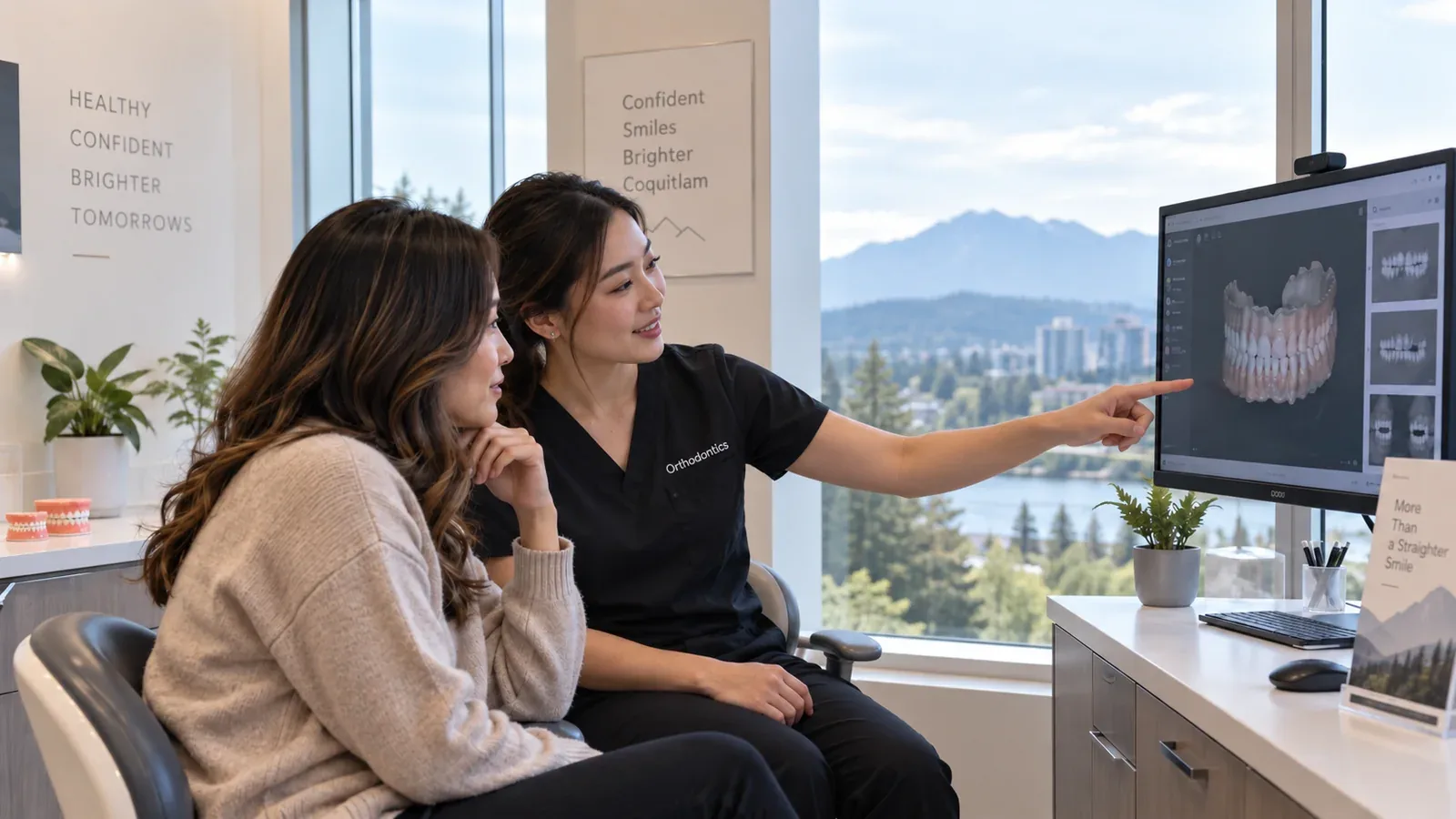
First consultations at specialist clinics — including our clinic — are typically free and take 45–60 minutes. You leave with an actual answer: what’s going on, what the options are, what each costs, and when treatment should start (which is sometimes “not yet”).
The sequence
- Records. Digital photographs, and usually a panoramic X-ray and 3D scan of your teeth — the raw material of a real diagnosis.
- Specialist examination. Teeth, bite, jaw function and — at airway-aware clinics — breathing and sleep screening. This is where a certified specialist earns the title.
- The conversation. What the records show, what happens if untreated, and every viable treatment option with honest trade-offs. For aligner cases you should be able to see a digital simulation of the plan.
- The numbers. A written quote per option — covering records, all visits, appliances, retainers and revision policy — plus payment-plan and insurance details.
How to prepare
Bring your insurance details, a list of medications, any recent dental X-rays your dentist can transfer, and our 12-question checklist. No referral is needed to see a specialist in BC. If anything is unclear, a good clinic expects follow-up questions — and never pressures a same-day signature.
What we'll actually do in the room
Ask why you came, and listen. Take photographs, a 3D scan, and usually a panoramic X-ray — and for children and bite cases, a profile X-ray, because we can't judge a jaw relationship without one. Examine the teeth, the bite, the jaw joints, and screen for airway signs. Then sit down with the images on the screen and explain what we see in plain language: what the pattern is, whether it's the teeth or the jaws, what happens if nothing is done, and what the options are — including waiting. For children, "developing well, see you in a year" is a frequent and genuine outcome.
What you'll leave with
A written fee for each viable option, with retainers included and every inclusion listed; payment-plan terms; a note of what your insurance is likely to cover; and, for aligner candidates, a digital simulation you've already seen. No pressure to sign. We'd rather you took it home, compared it with another clinic, and came back — or didn't — having understood your own case.
Questions we're asked most at first visits
Does it hurt? Nothing at this visit; a few sore days after bonding, later. How long? A range today, a firm estimate after the plan is designed. Can we start today? Rarely, and we'd gently discourage it — a day or two to think is part of a good decision. Do you need my dentist's X-rays? If recent, they may save a repeat; ask your dentist to send them. Bring the twelve questions — we'll have answers for all of them, and we'll enjoy being asked.
Frequently asked questions about the first visit
Is the first consultation really free?
Yes — examination, X-rays and scan, and a written plan. No obligation.
How long does it take?
About an hour for adults and teens; thirty to forty-five minutes for a young child's assessment.
Should I bring my child's dental X-rays?
If they're recent, yes — ask your dentist to send them and we may not need to repeat them.
Can I start treatment the same day?
Occasionally for simple cases, but we'd gently suggest taking a day or two. Good decisions aren't rushed.
Do I need to bring insurance information?
Bring your benefit booklet or plan details. Our coordinator maps coverage before you leave.
What if my child is nervous?
Most children find the visit interesting — no impressions, no drills, a screen with their own teeth on it. We take it at their pace.
The records we take, and why each one matters
Photographs, to document the starting point and the smile. A 3D scan, to measure the arches and, for aligner cases, to design the plan. A panoramic X-ray, to see every tooth including the ones not yet erupted — the only way to catch a drifting canine or a missing adult tooth. For children and bite cases, a profile X-ray, because the question that decides the plan — teeth or jaws? — can't be answered without it. Each is quick; together they take about fifteen minutes. A consultation that skips them and recommends anyway has skipped the diagnosis.
How the conversation goes
We show you the images and explain what we see — the pattern, whether it's dental or skeletal, what happens if nothing is done. Then the options, each with its downside: braces (visible, food rules), aligners (wear-time), waiting (a window that may close), a first phase (a second fee later). Then the numbers, in writing, per option. Then your questions, for as long as you have them. Then you leave with the plan — and, we hope, with a clearer understanding of your own case than you arrived with, whether or not you come back.
A closer look: what "not yet" looks like for a child
A seven-year-old's assessment often ends with us saying something like: "The jaws are developing well. The lower incisors are a little crowded, which is normal at this age and usually improves as the arch grows. The canines are tracking nicely on the X-ray. Let's see her in twelve months, no charge, and we'll talk about treatment when the adult teeth are in — probably around twelve." That's a good outcome, and it's the most common one. The family leaves with evidence rather than worry, and a date. When the answer is different — a crossbite shifting the jaw, a narrow palate — we show the parent on the screen and name what treating it now prevents.
How to compare two first visits
The evening after the second one, with both written plans on the table: Did each clinic take records before recommending? Did the specialist examine personally? Were the options and their downsides explained, including waiting? What does each fee include — retainers, refinements, emergency visits? Was there any pressure? Which explanation could you repeat to a friend? Families who do this exercise usually find the decision makes itself, and it's rarely about the headline price.
Before you go
Bring the twelve questions, your benefit details, and the thing you noticed. Read the red flags so you know what you're watching for. Then book — ours is free, and so is the second one you should also take.
Misconceptions we correct most often
“I'll be pressured to sign.”
Not here. Take the quote home; we'd rather you compared.
“X-rays at a consultation are unnecessary.”
They're the diagnosis. A recommendation without them is a guess.
“The first visit is just for the parent.”
The child or teenager is the patient. We talk to them.
What Coquitlam families search for, answered
“What happens at an orthodontic consultation?”
Records, a specialist examination, an explanation of what we see, every option with its downsides, and a written fee — about an hour, free.
“Should I bring my child's dental records?”
Recent X-rays, yes — your dentist can send them and we may not repeat them. Your benefit booklet too.
“Can I get braces the same day as the consultation?”
Occasionally for simple cases. We'd suggest a day or two to think; good decisions aren't rushed.
A complete consultation includes
- Records taken (photos, X-ray/scan)
- Exam by the specialist personally
- Every option explained with trade-offs
- Written, all-inclusive quote per option
- Zero pressure to sign that day