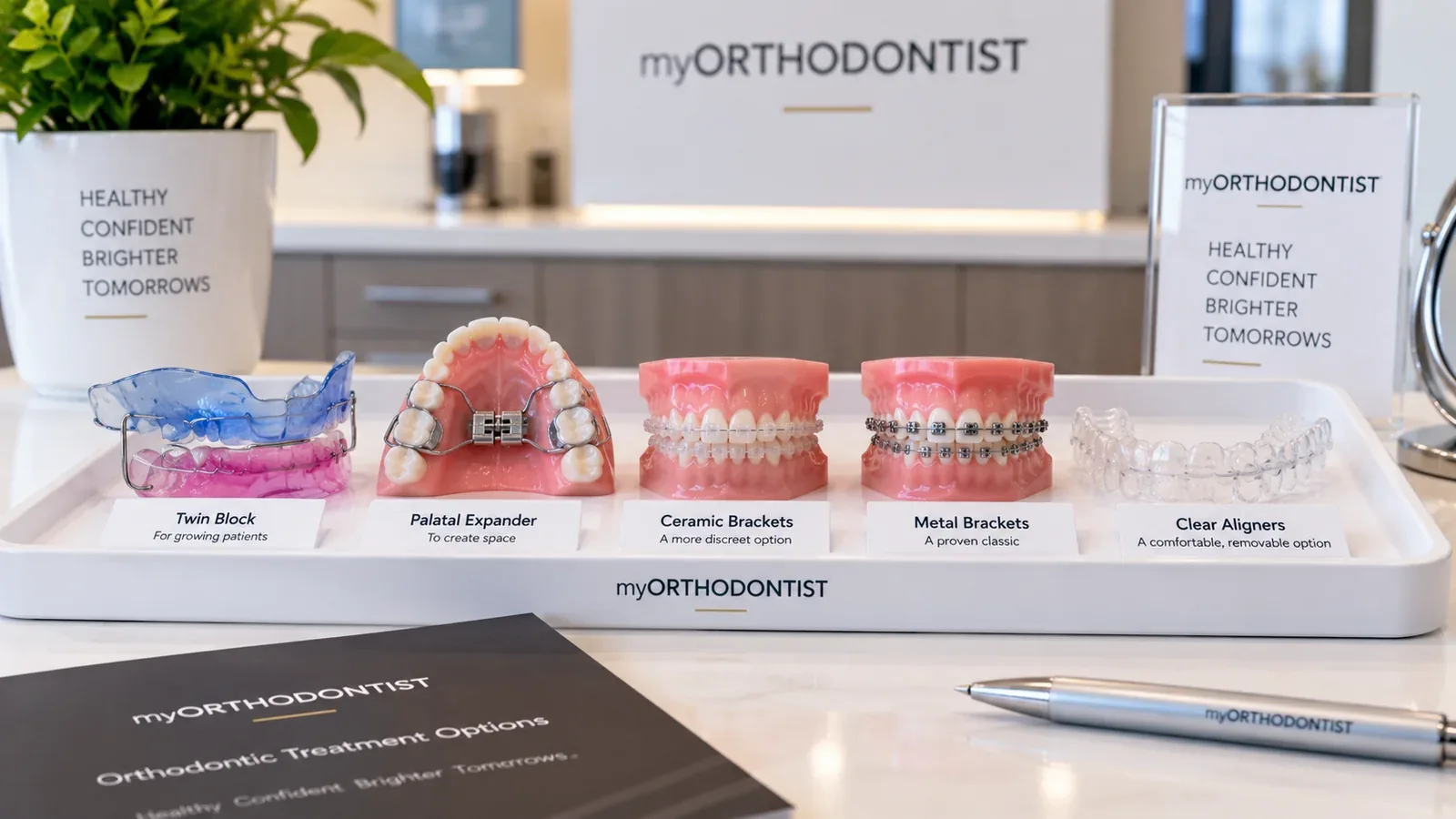
Every year, clear aligners take a larger share of orthodontic marketing — and every year, specialists keep bonding metal braces onto a huge share of their cases. That’s not nostalgia. For many malocclusions, fixed metal braces remain the fastest, most controlled and most economical route to a correct result.
Modern metal is not your childhood braces
Today’s brackets are dramatically smaller, wires are heat-activated alloys that deliver lighter continuous forces, and bonding has replaced the full metal bands of the past. Adjustment visits are quicker and spacing between them longer — typically 6–8 weeks.
Where metal braces outperform
- Complex bite correction — deep bites, significant overjet and vertical problems respond to the three-dimensional control of fixed appliances.
- Rotations and root positioning — brackets grip teeth in ways plastic cannot.
- Compliance-proof treatment — they work 24/7, which for many teens is the deciding factor.
- Value — usually the lowest-cost comprehensive option, and the most durable.
The honest trade-offs
They’re visible, they carry food restrictions (hard, sticky, chewy), and hygiene takes more effort. For image-conscious patients with suitable cases, ceramic braces or Invisalign close the aesthetic gap at a modest premium.
In Coquitlam, comprehensive metal-braces treatment typically falls in the $6,000–$8,500 range — see the full cost guide for what that number must include.
What we'd add from the chair
We fit more metal braces than any other appliance, and not because we're old-fashioned: for the bite corrections and rotations that make up much of a specialist's caseload, they remain the most controllable tool we have, and for teenagers they remove the compliance question entirely. Our patients choose colours at every visit, adjustments take fifteen minutes, and the appointment rhythm — every six to eight weeks — fits around school better than families expect. The fee includes every adjustment, emergency visits, debonding and your retainers; the cost page lists it item by item.
Who we'd steer elsewhere
An adult with mild crowding and a healthy bite who cares about invisibility — aligners, and we'll say so. A teenager with a complex case who cares about appearance — ceramic on the upper front teeth, metal elsewhere. The point of carrying every appliance is that the case decides. How we decide is the fuller version.
The question we're asked most about metal
"Will it show in photos?" Yes, and modern brackets show far less than the ones parents remember — smaller, lower-profile, and with clear or tooth-coloured ties on request. For teenagers the colours are usually the attraction rather than the concern. For adults who'd rather not have metal visible in a professional setting, we'll price ceramic on the upper front teeth alongside the metal quote, and let the numbers and the case decide. The ceramic page covers the trade.
Metal braces questions
Are metal braces still used?
More than any other appliance at our practice — for control, reliability and value.
Do metal braces hurt more than clear ones?
No; the mechanics are identical. Comfort differences are minor.
How much do metal braces cost?
Typically $6,000–$8,500 comprehensive at our practice, retainers included.
Can adults have metal braces?
Certainly, and many choose them for value and speed.
Related reading
- Braces — the full guide
- Ceramic braces — the discreet fixed option
- Braces cost — item by item
The bottom line
Metal braces remain the most capable, reliable and economical orthodontic appliance, and the one we fit most. Smaller than you remember, compliance-proof for teenagers, and the value choice for adults who'd rather be done. Discretion is available — ceramic on the front teeth — for a modest premium; the case and the budget decide.
If it were our own teenager
Metal, colours, and a mouthguard for soccer — the appliance that works whether or not a fifteen-year-old remembers it exists. We'd add ceramic on top only if the teenager asked.