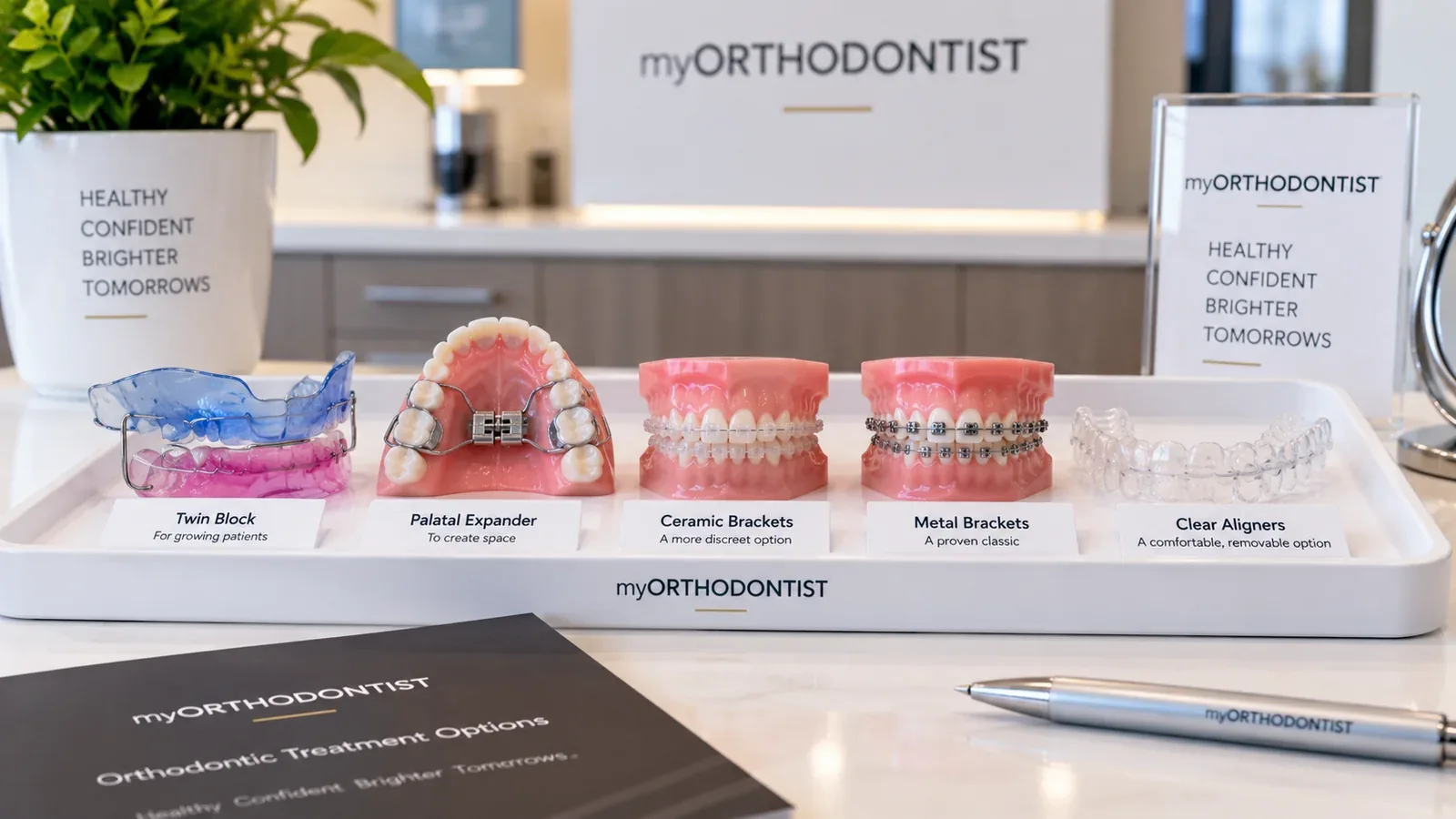
Ceramic braces answer a specific patient: someone whose case calls for the control of fixed appliances, but who won’t accept a mouthful of metal. Tooth-coloured or translucent brackets deliver the same mechanics as metal while reading as nearly invisible at conversation distance.
Same engine, different finish
Mechanically, ceramic and metal braces are the same treatment: brackets, archwires, 6–8 week adjustments, comparable timelines. The differences are practical: ceramic brackets are bulkier and more brittle, elastic ties can pick up stain from coffee and curry (the brackets themselves don’t), and treatment usually carries a modest price premium — commonly $300–$800 over metal for a full case in this market.
Ceramic vs. Invisalign
Both are discreet; the difference is control versus convenience. Ceramic braces handle the full range of fixed-appliance cases and never depend on wear-time. Invisalign is removable and more comfortable but leans on 22-hour daily compliance and suits a somewhat narrower case range. A specialist consultation should put your specific case on that map honestly — if you only hear one option, ask why.
Who chooses ceramic
Working adults with complex cases, teens who won’t reliably wear aligners but care about appearance, and patients whose bites need fixed control on the upper arch (some combine ceramic uppers with metal lowers to manage cost). See how it fits the full landscape in our treatments guide.
How we use ceramic at our practice
Most often on the upper front six or eight teeth only — the ones that show in conversation and photographs — with metal brackets elsewhere. It captures nearly all the discretion of a full ceramic set at a fraction of the premium, and the lower teeth, largely hidden by the lip, don't need it. We'll offer that configuration rather than assume you want the full set, and we'll tell you the two prices side by side. Ties are changed at every visit, so staining is a between-visits nuisance rather than a lasting one.
Ceramic or aligners, for the image-conscious
If the case suits plastic and the wear-time is realistic, aligners are usually the more comfortable discreet option. If the case needs the control of fixed braces — a bite correction, rotations, an impacted canine — ceramic is the discreet option that actually gets the job done. We carry both, so the recommendation follows the records; the decision page walks through it, and braces cost shows the ceramic premium.
Care that keeps ceramic looking clear
The brackets don't stain; the elastic ties can. Coffee, tea, red wine, curry and turmeric are the usual culprits, and a rinse after them helps. Pearl or smoke-coloured ties hide it better than clear. Ties are replaced at every six-to-eight-week visit, so even a well-stained set is a temporary problem. Brushing is the same as with metal — angled above and below each bracket — and we'll show you the routine at bonding.
Ceramic braces questions
How much more do ceramic braces cost?
Typically $300–$800 over metal for a full case; less if only the upper front teeth are ceramic.
Do ceramic braces stain?
The brackets don't; the elastic ties can, and they're replaced at every visit.
Are ceramic braces weaker?
Slightly more brittle. The food rules matter a little more.
Ceramic or Invisalign?
Ceramic when the case needs fixed control; aligners when it suits plastic and wear-time is realistic.
Related reading
- Invisalign or braces — the decision
- Braces — the full guide
- Adult orthodontics — the discreet options ranked
The bottom line
Ceramic braces give you fixed-appliance control with a discreet appearance, for a modest premium that shrinks if only the upper front teeth are ceramic. They're the right choice when your case needs braces and your circumstances need discretion. We'll price them beside metal and beside aligners so the decision is yours on real numbers.
If it were our own teeth
Ceramic on the upper front six, metal elsewhere, smoke-coloured ties — and a rinse after coffee. It's the configuration we recommend most to adults who need braces and would rather not advertise them.