Coquitlam has no shortage of providers offering braces and aligners — specialist clinics, general dentists, and everything in between, all with polished websites. The differences that matter aren’t on the surface. Here is the evaluation framework we’d hand our own families.
Step 1: confirm the credential
Know who's planning your treatment. A Certified Specialist in Orthodontics — registered with the BC College of Oral Health Professionals — completed an accredited 2–3 year residency after dental school focused entirely on moving teeth and growing jaws. Many general dentists also provide orthodontic care, and dentists and specialists work as a team; for comprehensive treatment, kids and bite work, the register tells you who carries the specialty depth. How to check the register in two minutes →
Step 2: weigh real experience
Years in practice, case volume, and — for aligner cases — Invisalign provider tier, which is a rough proxy for aligner case volume. A specialist who has planned thousands of cases has seen your case before.
Step 3: audit the consultation itself
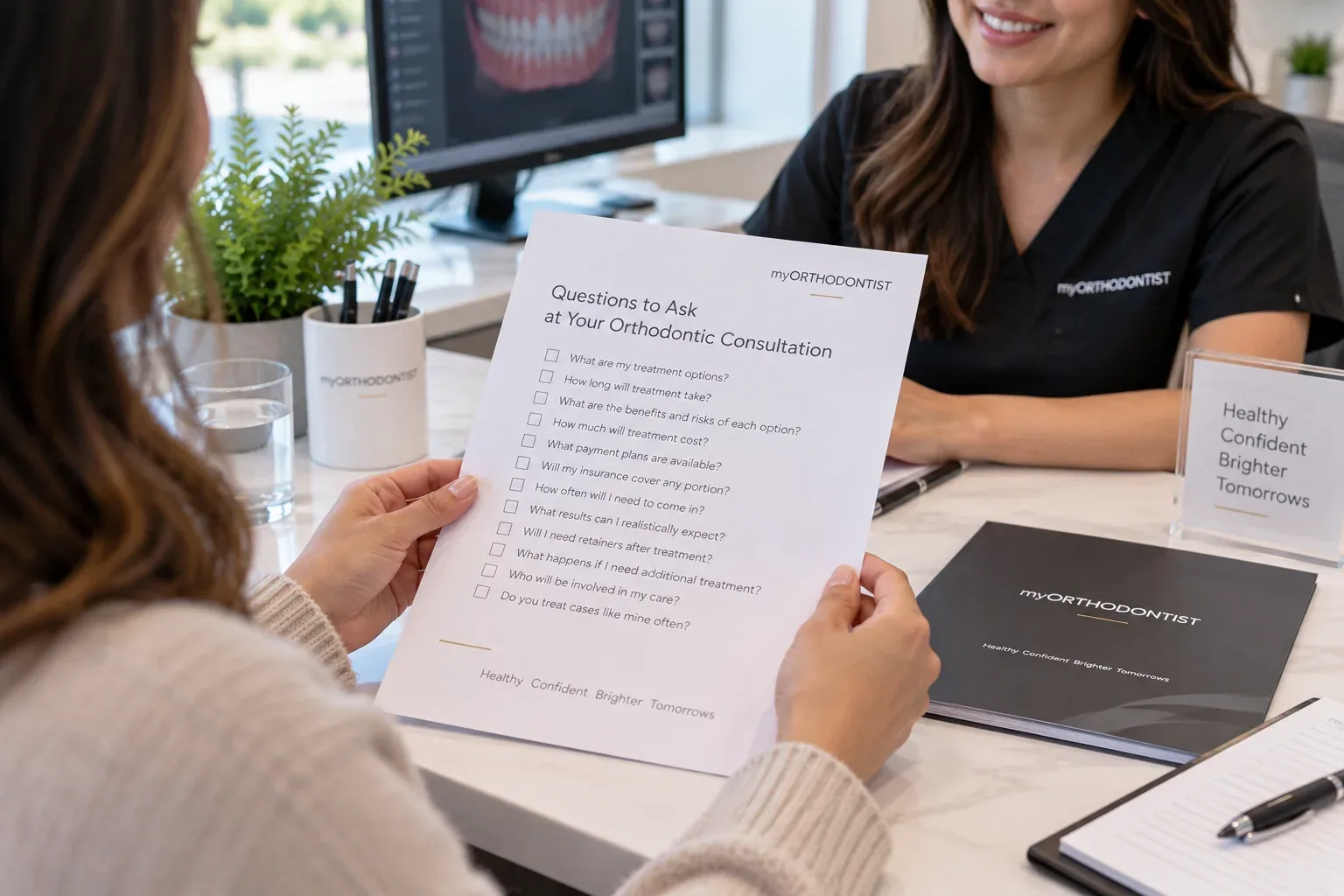
The consultation is a free preview of how the clinic practises. You’re looking for: records taken before opinions given; the specialist examining you personally; every viable option presented with trade-offs; and zero pressure to sign same-day. Our 12 questions make this audit easy.
Step 4: compare quotes properly
Never compare headline numbers. Compare what’s inside them: records and X-rays, all adjustment and emergency visits, refinements (aligners), retainers, and post-treatment checks. A quote $500 cheaper that excludes retainers and refinements is not cheaper — at our practice, retainers are included in the fee, and we'll show you every other inclusion in writing. See the full cost breakdown →
Step 5: weigh logistics honestly
You will visit this clinic 10–20 times. Location, parking, Saturday and after-school hours, and how the front desk treats you on the phone all compound over two years. A marginally “better” clinic you can’t practically get to is not better.
The 5-step shortlist test
- BCCOHP specialist registration confirmed
- Experience and case volume asked about directly
- Consultation was diagnostic, not a sales pitch
- Quotes compared on contents, not headline price
- Logistics work for 18–24 months of visits
Visit at least two clinics. Consultations are free, and the comparison itself will teach you more about quality than any website — including this one.
How the five steps play out in Coquitlam specifically
Step one is quick here: every specialist within the Tri-Cities is on the BCCOHP register, and the check takes two minutes per name. Step two — experience — is where clinics diverge more than they let on: some specialists have been in the same chair for twenty years, some rotate associates, some are new practices with a great website and a short case history. Ask directly how long the person who'll plan your treatment has been practising, and how many cases like yours they've managed. Step three, the consultation audit, is the one families skip because it feels rude; it isn't. Step four is where the money is actually saved. Step five matters more here than in most places because Coquitlam Centre parking, SkyTrain access and Saturday hours genuinely change how ten to twenty visits feel over two years.
A worked example
A family we'll call the Nguyens brought their eleven-year-old to two clinics. Clinic A quoted $6,200; Clinic B quoted $6,900. On the headline number, A won by $700. On contents, B's fee included retainers, unlimited emergency visits and a defined revision policy; A's excluded retainers ("about $600 at the end") and charged per emergency visit. Over the treatment, B was the cheaper quote — and the one whose consultation had begun with X-rays rather than a treatment recommendation. We tell this story not because we were Clinic B (we weren't part of it) but because it's the shape of almost every comparison: the visible number and the real number are different, and the consultation quality predicts which kind of clinic you're dealing with.
When to stop comparing
Two good consultations that broadly agree on diagnosis and range is enough. If they disagree on something fundamental — extractions, surgery, whether a child needs Phase 1 — a third opinion is worth the hour; see second opinions. Beyond that, more visits tend to add anxiety rather than information. Pick the clinic whose reasoning you could explain to a friend, and whose front desk you'd be happy to call fifteen times.
Frequently asked questions
Should I choose the orthodontist closest to home?
Only after the first four steps. Distance is a legitimate tie-breaker between clinics that both meet the criteria; it's a poor reason to accept an incomplete quote or a sales-led consultation.
Are consultations really free everywhere?
Almost universally in the Tri-Cities. If a clinic charges for the first visit, that's worth noting.
How do I verify a specialist's registration?
Search the name on the BCCOHP public register and confirm orthodontics specialty. Two minutes. Step by step.
What if my dentist provides orthodontics?
Some do it very well, particularly mild adult cases. A free specialist consult is a reasonable second data point, and good dentists welcome it. The team.
Two families, two good decisions
One family compared us with a clinic in Port Coquitlam, found both consultations diagnostic and both quotes complete, and chose the PoCo clinic because it was six minutes from their door. That's a good decision, and we said so. Another family compared us with a clinic that had recommended Phase 1 for their eight-year-old with mild crowding and a normal jaw relationship; we suggested monitoring instead, they took a third opinion that agreed, and they chose us. Also a good decision — not because we won, but because they saw the reasoning on both sides and could explain their choice. That's the standard: a decision you could defend to a friend.
A closer look: what "experience" should mean to you
Years in practice matter, but the more useful measure is pattern recognition in your kind of case. An orthodontist who has treated hundreds of impacted canines will look at your child's X-ray and see a familiar shape; one who has treated dozens will see a problem. Ask the specific question — "how many cases like this?" — and listen for a specific answer. Ask, too, who will see you at adjustments over two years: the same specialist, a rotating associate, or a coordinator with the doctor stopping by. Continuity is part of experience, and it's easy to lose in a large practice.
What we'd want a friend to know
That consultations are free, so comparing is cheap. That the register check takes two minutes. That the quote's contents matter more than its total. That "not yet" is an answer worth hearing. That a clinic which disagrees with you occasionally is diagnosing, and one that never does is selling. And that if the two consultations broadly agree, the decision can rest on which clinic you'd rather visit fifteen times — that's not a shallow reason, it's the one you'll live with.
Before you go
Print the twelve questions. Read the red flags. Book two free consultations. Compare on contents. Choose the reasoning you could explain — and if you'd like ours to be one of the two, we're here.
Misconceptions we correct most often
“Two consultations is excessive.”
It's the minimum for a five-figure decision, and both are free.
“I'd offend my dentist by comparing.”
Dentists expect it and often suggest it.
“The quote with the lowest number wins.”
The quote with the fewest exclusions wins. Read the inclusions.
What Coquitlam families search for, answered
“Orthodontist vs dentist for Invisalign — which is better?”
For mild adult cases, an experienced dentist can be reasonable. For bites, children and complex cases, a specialist. A free specialist consultation is a fair second data point either way.
“How many consultations should I get?”
Two, if they broadly agree; three if they don't on something fundamental.
“What questions should I ask an orthodontist?”
Twelve, published here with our answers. Start with what the fee includes.